No. 51462
Castell d'Orpí
Spain
CastleRestored11th century
No. 70281
Castle · Spain
No. 70281 · 41.534 N, 1.658 E
Quick summary
Castell de la Torre de Claramunt is a castle in Spain with origins associated with the 11th century.
See all castles in SpainCastell de la Torre de Claramunt stands in La Torre de Claramunt in the Anoia comarca of Catalonia, Spain. Erected by the medieval house of Claramunt in the 11th century, it began as an outlying watch tower placed to the west of the settlement to oversee the Riera del Carme valley and the road toward the Penedès. The early tower functioned as an advanced post attached to the larger castle of Claramunt; members of the Claramunt knightly family occupied the main castle from the 10th through the 12th centuries.
In 1306 the castle of Claramunt was sold to Viscount Ramon Folc VI de Cardona. After that sale Berenguer de Claramunt retired to the tower while keeping his lordship, and in 1318 the tower passed into the feudal lordship of Ramon Folc VI in exchange for ten thousand ducats. Over the following centuries the tower grew in both importance and size.
By the 15th century the building served multiple domestic and custodial functions; records list a prison, stabling, kitchen and cellar, a small parlor, several chambers, a bedroom and attic spaces within its plan. In 1561 Joan de Claramunt carried out a major rebuilding that transformed the defensive tower into a larger fortified residence; the renovation date was carved on the courtyard entrance. In 1566 Joan de Claramunt received a perpetual grant of jurisdiction from the Duke of Cardona, and in 1599 he was declared noble by King Philip III.
Documents record inventories and inspections in 1549, 1561, 1644, 1704 and 1763. The property passed through families tied to the lordship, including the Espuny, Ribera, Agulló, Pinós, Cardona, Pallars and Sentmenat lines. Throughout the early modern and modern eras the castle has remained within the extended family line connected to the Claramunt title, noted as one of the Catalan castles that has stayed within the same broad lineage from its medieval origins to the present.
In the 20th century Josep-Antoni de Febrer Monforte ran a restaurant on the ground floor between 1963 and 1969; the venue hosted the Ondas Awards in 1965, and de Febrer Monforte died in the castle in 1977. The site is legally protected as a Bien de Interés Cultural (BIC).
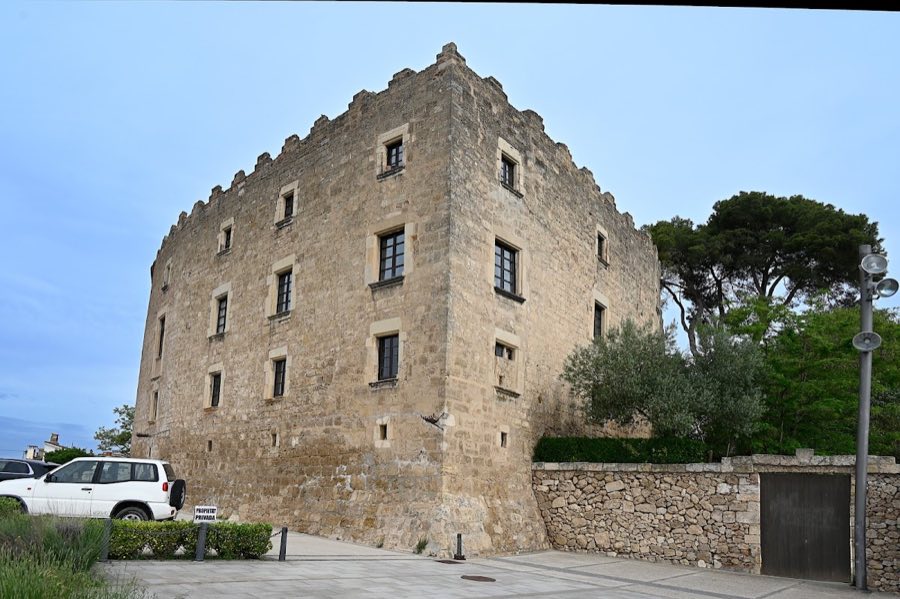
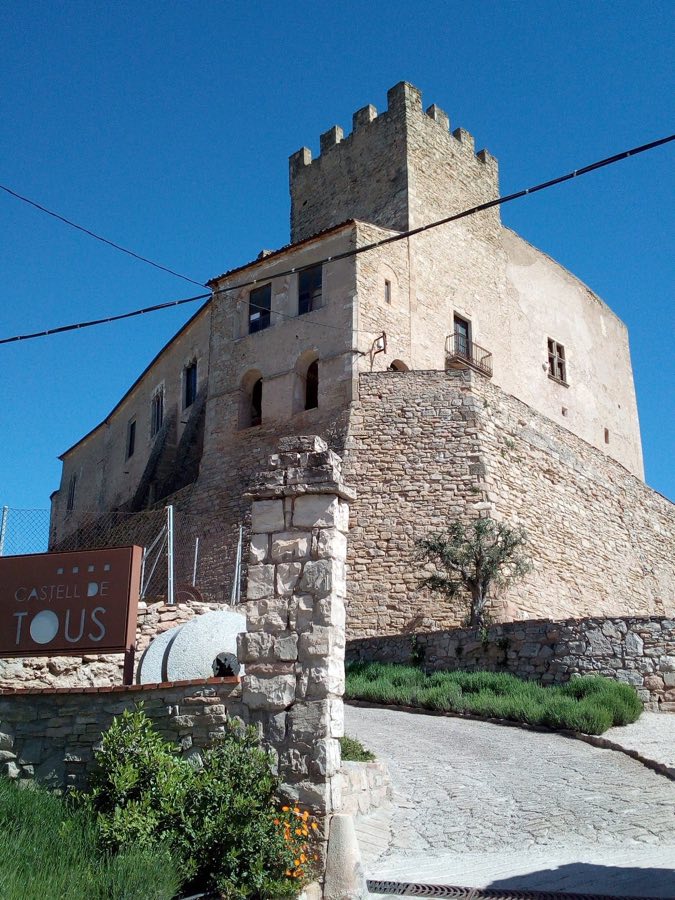
The standing complex is a fortified stone manor whose current form dates mainly to the 16th and 17th centuries, made up of a ground level and three upper stories with rectangular windows set in stone lintels. The fabric is masonry; visible features include stone lintels and an arched courtyard entrance that survives from the 1561 rebuilding.
The principal courtyard entrance is an arch of wedge-shaped voussoirs capped by a keystone carved with the date 1561 and the Claramunt emblem, a mount topped by a fleur-de-lis. The main domestic doorway has a horizontal stone lintel and opens onto the internal court. The 1561 conversion produced the durable plan that endures in the present ensemble.
The roofline is finished with tooth-shaped battlements resembling merlons, which underline the building’s fortified character. Carved heraldry remains on the exterior and within the courtyard: the Claramunt shield sits above the principal portal and at an exterior southeast angle, while additional shields in the courtyard and the principal hall display the arms or marks of later lords such as Espuny, Ribera, Agulló, Pinós, Cardona, Pallars and Sentmenat.
Internal arrangements documented in the 15th century included a prison, stables, a kitchen and cellar, a small parlor, several chambers, a bedroom and attic spaces; these functional spaces form part of the building’s late medieval plan. The original tower’s siting to control the Riera del Carme valley and the road toward the Penedès is integral to the site’s relationship with the landscape and historic communications. The overall stone manor produced by the sixteenth-century rebuilding has endured to the present.
No. 51462
No. 43589
No. 55382
No. 43671
Comments
Comments for Castell de la Torre de Claramunt will require a verified account before posting.
We'll send a verification link before your first comment is published.