
No. 46985
Castelo de Torre de Coelheiros
Portugal
Manor houseIntact14th century
No. 29765
Castle · Portugal
No. 29765 · 38.309 N, 7.703 W
Quick summary
Castle of Portel is a castle in Portugal with origins associated with the 19th century.
See all castles in PortugalThe Castle of Portel stands in the municipality of Portel in Portugal, built during the medieval period by Christian Portuguese rulers following the Reconquista. Its location on a prominent spur above the town provided a strategic vantage point over the surrounding lands.
The earliest traces of human presence are uncertain, but historical records from the reign of King Afonso III (1248–1279) refer to the area as “Portel Mafomede,” indicating it was once inhabited by Muslims. After the Christian reconquest, this territory was incorporated into the Évora region and granted to the noble João de Aboim, a royal steward rewarded for his loyalty during a dynastic dispute. By 1261, after resolving jurisdictional conflicts, the king authorized building a castle to secure João de Aboim’s interests, and in 1262, João established a formal charter to govern the settlement around the new fortress.
Following João de Aboim’s death, ownership of the castle became contested, and by 1289 the fortress returned to royal control through an exchange with his widow, D. Marinha. Under King Dinis (1279–1325), construction works resumed, including erecting defensive walls around the emerging town, reinforcing its fortifications beyond the castle itself.
During the crisis of 1383–1385, when Portugal’s throne was disputed, the castle’s governor sided with Castile, disarming the local population by storing their weapons inside the castle. In November 1384, Portuguese forces commanded by the military leader Nuno Álvares Pereira, assisted by a local cleric named João Mateus, seized the castle and the town, restoring Portuguese control. After the decisive Battle of Aljubarrota that secured Portuguese independence, the lands of Portel were granted to Nuno Álvares Pereira and subsequently became possessions of the House of Braganza.
Around 1509, under King Manuel I, the castle and town were illustrated by Duarte de Armas, documenting the site’s layout at the time. Soon after, substantial renovations transformed the fortress into a more comfortable residence. A ducal palace was added within the castle walls along with a barbican—a fortified outer defensive wall—on the orders of Duke Jaime of Braganza, with plans executed under the royal architect Francisco de Arruda.
Over the following centuries, the castle gradually lost its military importance and was neglected, falling into ruin by the 19th century. Recognized for its historic value, it was declared a National Monument in 1910. Restoration began in 1938, but further damage occurred in 1998 when part of a cylindrical tower and a section of wall near the keep collapsed. Efforts to restore the structure resumed in 1999, using traditional methods, though comprehensive research and plans for its preservation and public presentation have not yet been completed.
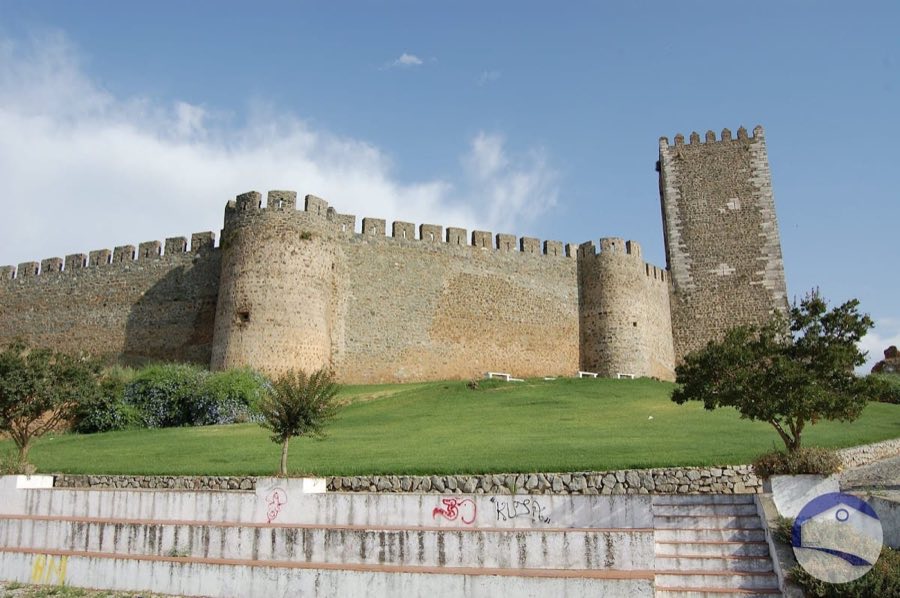
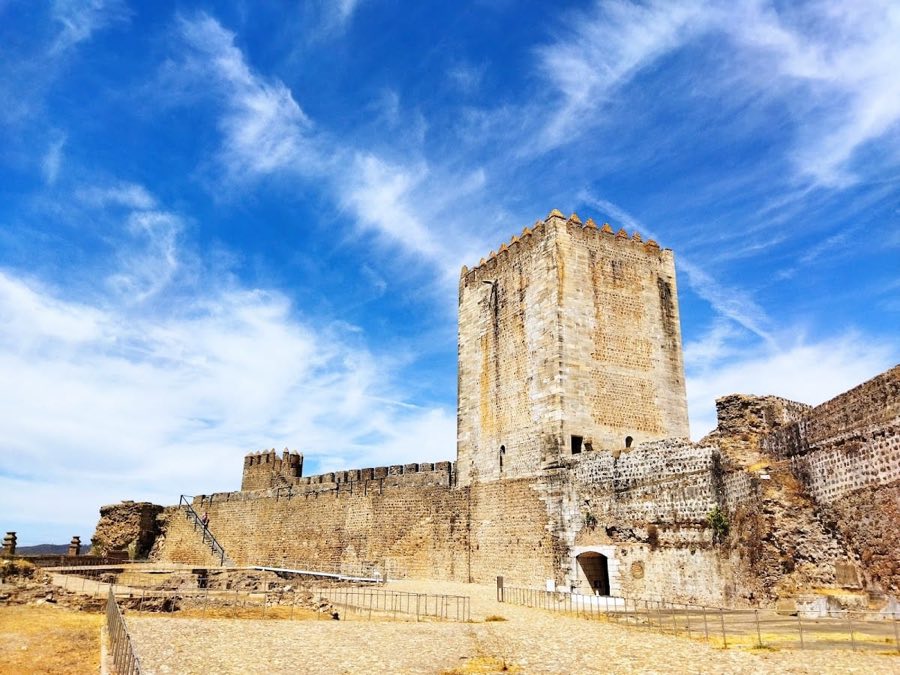
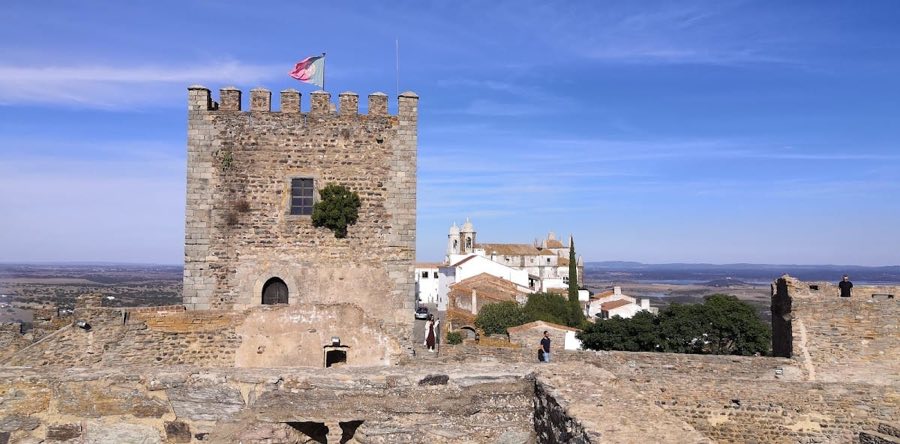
The Castle of Portel is shaped with a seven-sided, or heptagonal, layout that is reinforced by circular towers positioned at each corner. This Gothic design appears influenced by France’s Château d’Angers, showcasing a distinctive medieval European architectural style. The fortress is dominated by a large, square-shaped keep tower rising about 25 meters high. Inside, it contains two floors above the wall’s walkway, each supported by ribbed vaulted ceilings with pointed arches characteristic of Gothic construction. The lower chamber of the keep served as a prison.
The keep guards the castle’s main gate on the northern side, which features a pointed arch entrance consistent with Gothic design. Opposite this, the southern gate known as the Porta de Beja aligns directly, creating a clear axis within the interior. The castle also contains three other gates, including the Porta do Relógio and the Porta do Outeiro, providing additional access points.
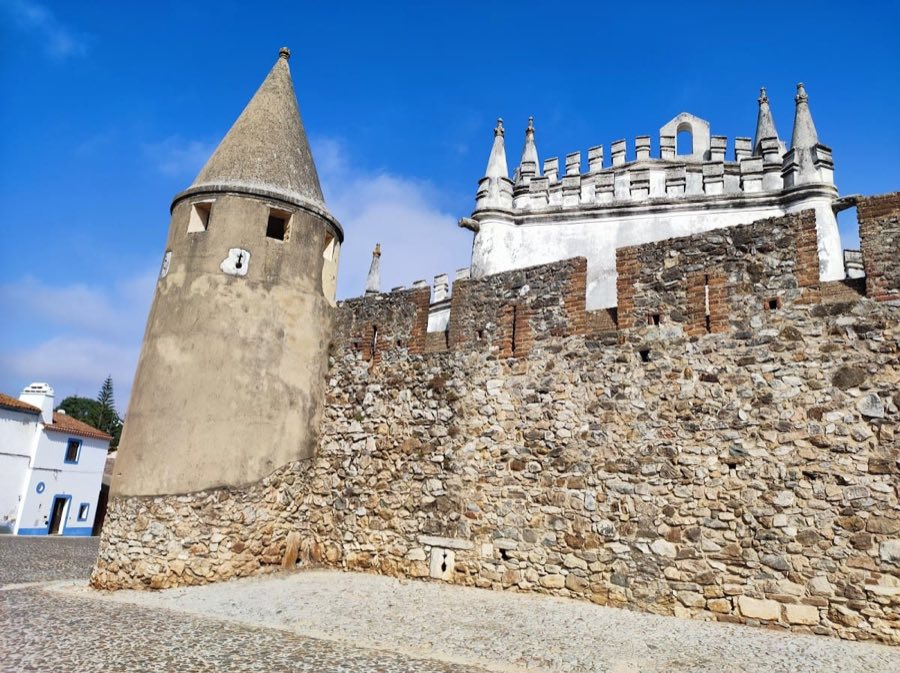
Within the castle’s courtyard, or praça de armas, visitors can find the remains of a cistern used for water storage, the ruins of the former Chapel of Saint Vincent, and the foundations of the ducal palace installed during the early 16th-century renovations. Although the town’s medieval defensive walls surrounding the castle have not survived, the fortress’s protection was enhanced by a barbican—a fortified outer enclosure—rebuilt in the 16th century under King Manuel I. Substantial sections of the barbican remain on the south, north, and west sides.
The barbican was constructed as a curtain wall strengthened by square bastions at intervals. Its Gothic-style gate is decorated with stacked royal coats of arms, signaling its date of reconstruction. Cornerstones and several Gothic windows of the castle are made from marble, further emphasizing the careful craftsmanship. The entrance door to the keep also features the pointed (ogival) arch typical of its period. Despite centuries of decay, much of the fortress’s key structural elements have been preserved or restored, offering insight into its medieval heritage and architectural importance.
No. 46985
No. 91960
No. 12538
No. 22249
Comments
Comments for Castle of Portel will require a verified account before posting.
We'll send a verification link before your first comment is published.