
No. 56367
Kožlí Castle
Czechia
CastleRuinFor events14th century
No. 95740
Castle · Czechia
No. 95740 · 49.779 N, 14.657 E
Quick summary
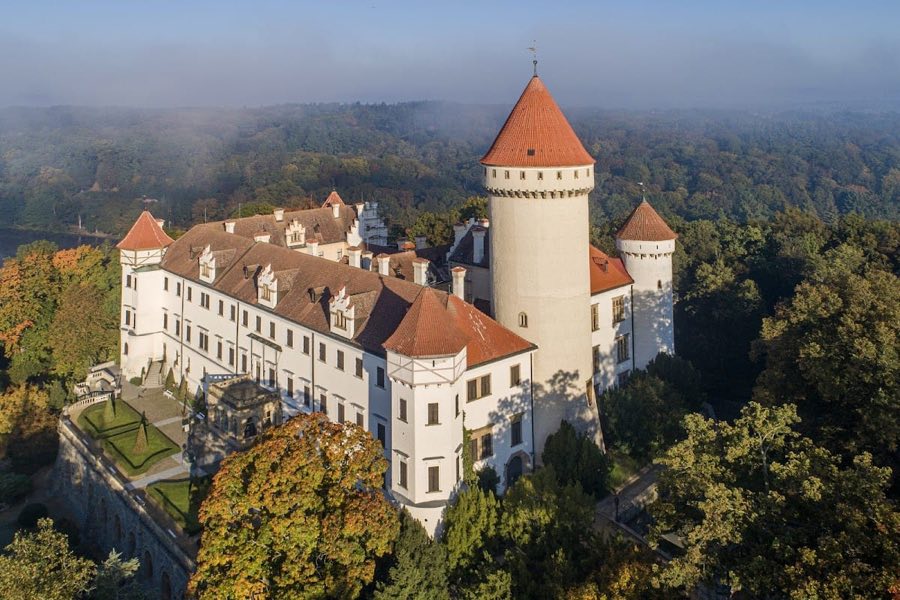
Konopiště Castle is a castle in Czechia with origins associated with the 13th century.
See all castles in CzechiaKonopiště Castle is situated in the municipality of Konopiště in the modern Czech Republic. It was established by medieval builders associated with the Gothic tradition, with origins dating to the late 13th century.
The castle likely began as a Gothic fortress around 1294, possibly founded by Bishop Tobiáš of Benešov of Prague, although the exact details of its origin are uncertain. Written sources first mention it in 1318, identifying it as the property of the Benešovic family. This family held the castle until their line ended in 1327.
Following the Benešovics, the Šternberk family acquired Konopiště and maintained ownership for over two and a half centuries, until 1590. During this period, the castle became a focal point in regional conflicts. Most notably, it withstood an extensive siege lasting approximately eighteen months between 1467 and 1468. This siege was part of the turbulent Hussite Wars and involved direct confrontation with forces loyal to King George of Poděbrady.
In the early 1600s, the castle came under the control of the Protestant Hodějovský family, who were active in uprisings against the Habsburg rule. After their defeat, the castle was confiscated and thereafter passed through a series of noble owners. Among them were Albrecht of Wallenstein, a prominent military leader, followed by the Michna, Vrtba, and Lobkowicz families, each contributing to the castle’s legacy.
A significant chapter began in 1887 when Archduke Franz Ferdinand d’Este, heir to the Austro-Hungarian throne, purchased Konopiště. He transformed it into his primary residence and lived there until his assassination in 1914, an event that is historically linked to the outbreak of World War I. After the establishment of Czechoslovakia, state authorities confiscated the castle in 1921 and made it accessible to the public.
During the Second World War, Konopiště was repurposed to serve as the headquarters of the SS in Bohemia. After the war, extensive restoration efforts aimed to preserve the castle’s historical character, focusing especially on retaining much of Franz Ferdinand’s original furnishings and collections. Today, the castle remains under state ownership and is recognized as a national cultural monument.
Archaeological discoveries around Konopiště have revealed medieval siege works adjacent to the fortress, remnants from the dramatic 1467–1468 siege. These findings offer insight into the military strategies employed during prolonged attempts to capture the stronghold.
Konopiště Castle’s original structure reflects a Gothic fortress design organized around a rectangular plan. This layout was divided by a transverse wall into two distinct courtyards. The eastern courtyard was elevated and featured two long palace wings running parallel along the northern and southern sides, while the western courtyard contained the main access gate.
The defensive system included at least seven towers. Four of these were prominent round towers located at the corners. At each short end of the rectangular plan stood massive round bergfrieds—large fortified towers used primarily as strongholds; only the eastern bergfried survives intact today. Along the northern wall, there was a central tower equipped with a unique double stair turret, distinguished by two slender turrets side by side, adding to the fortress’s defensive complexity. Additional smaller round towers flanked key points along the walls.
Surrounding the castle was a parkán, an outer defensive curtain wall enhancing protection. Beyond this, a large double-sided stone moat encircled the fortress, providing an effective barrier against attackers. Elements of the earliest Gothic stonework have been identified in parts of the castle, including characteristic pointed twin windows that were later incorporated into subsequent architectural modifications.
In the late Gothic and Renaissance periods, the castle underwent interior transformations. Vaulted ceilings were introduced in the northern palace wing, with two chambers featuring windows blending Gothic and Renaissance styles. A chapel dating from the early 16th century showcased a four-part ribbed vault—a vaulted ceiling divided into four segments—although this intricate vaulting was later concealed beneath painted decorations.
The 18th century brought Baroque changes that altered the castle’s silhouette. The main entrance was relocated from its original western position to the eastern façade. The castle’s wings and towers were unified in height, reducing the original varied profile. A new stone bridge replaced the traditional drawbridge at the entrance. The Baroque gate built in 1725 was designed by architect František Maxmilián Kaňka and adorned with sculptures crafted by Matyáš Bernard Braun. Inside, carved fireplaces and altars were added by Lazar Widman, accompanied by a grand Rococo ceiling fresco by František Julius Lux that depicted scenes of the Olympian gods and spirited bacchanalian revelries.
Neo-Gothic renovations took place in two key stages. Before 1872, the Lobkowicz family added polygonal battlements with distinctive keyhole-shaped windows to various towers. Later, in the 1890s, the architect Josef Mocker led a more extensive restoration commissioned by Franz Ferdinand, which modified or removed some earlier Gothic and neo-Gothic elements. Interior decoration during this period was overseen by František Schmoranz, and a new library wing was constructed in the early 20th century.
The castle is renowned for its vast collection of arms and armor, prominently displayed in a large hall on the third floor of the northern palace wing. Among these are 16th-century Italian plate armor pieces and a variety of firearms originating from both Europe and the Orient. Franz Ferdinand’s extensive hunting trophy collection, numbering over 300,000 specimens, is also housed here.
Surrounding Konopiště is an English-style landscape park, covering approximately 340 hectares. This park was created after 1887 under Franz Ferdinand’s direction, with contributions from the Viennese landscape architect Mösmer and Prague’s chief gardener Karel Rozínek. The grounds include a rose garden, terraced areas, and the St. George Museum, which contains artworks dedicated to the legend of St. George.
A special feature within the park is the Cross Path (Křížová cesta), a devotional trail established in 1775 consisting of fourteen stone pillars. At its center lies a chapel and a Lourdes grotto. Franz Ferdinand later added to this arrangement following his visit to Lourdes in 1905.
Historically, the castle moat served as a habitat for bears, a traditional feature of castle menageries. Records document individual bears kept there from the late 20th century up until 2011, reflecting the continuation of this long-standing custom.
No. 56367
No. 54102
No. 59551
No. 75617
Comments
Comments for Konopiště Castle will require a verified account before posting.
We'll send a verification link before your first comment is published.