No. 47260
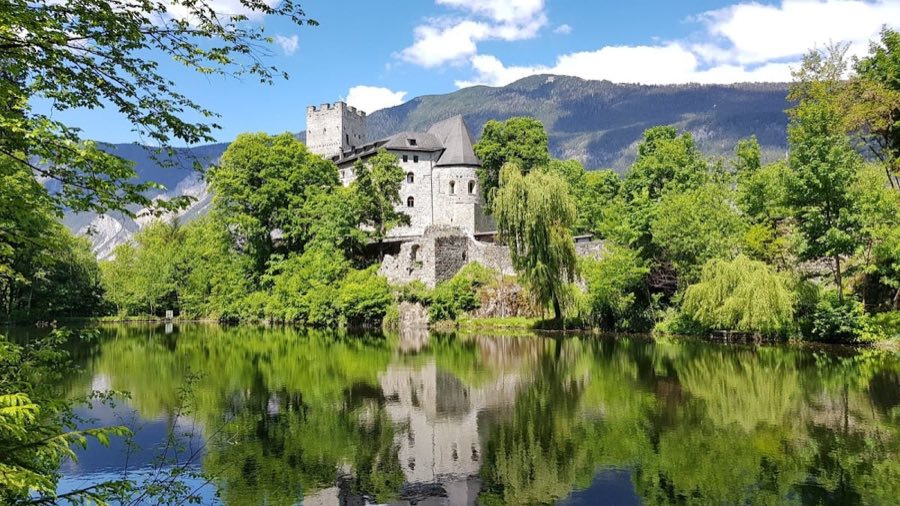
Schloss Petersberg
Austria
CastleRestored13th century
No. 91515
Castle · Austria
No. 91515 · 47.262 N, 10.754 E
Quick summary
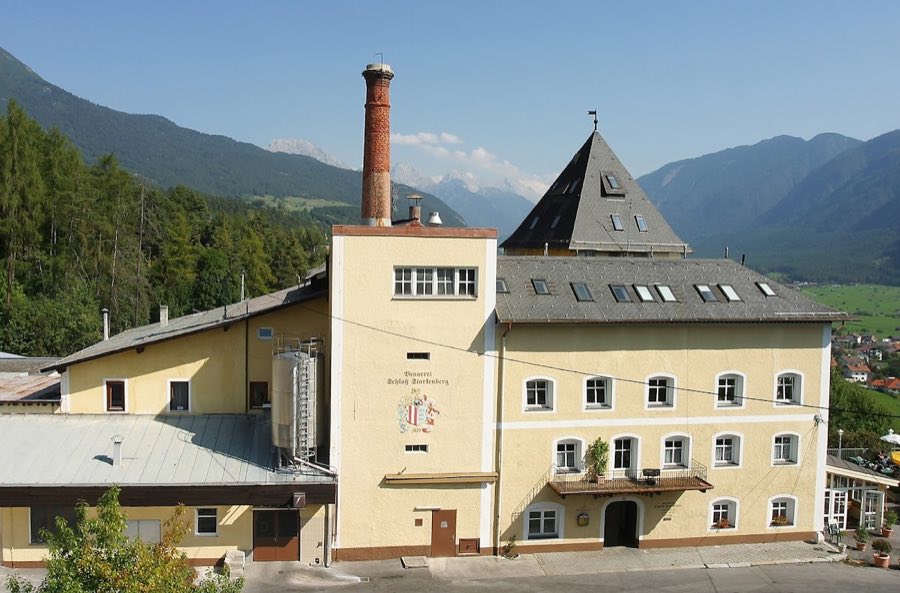
Neustarkenberg, Tarrenz is a castle in Tarrenz, Austria with origins associated with the 14th century.
See all castles in AustriaNeustarkenberg in Tarrenz, Austria, is a palace that grew out of the medieval castle Neu-Starkenberg, erected by the local Starkenberg family in the 14th century and later reshaped into a palace in the mid-1500s with further Baroque-era modifications. The site began as a medieval stronghold and then served as a territorial administrative seat under appointed stewards, a continuity that helped it remain in use despite the decline of its founding family.
The early legal and physical beginnings appear in 1317 when King Henry of Bohemia confirmed rights to Heinrich von Starchenberch for a burgstall, a non-masonry castle site, beside the road near Tarrenz. Because that grant applied to an unbuilt or timber structure it avoided the territorial lord’s usual building controls and was described as equivalent to forbidding the erection of a full masonry fortress. Despite that restriction, the castle Neu-Starkenberg was in existence by 1331. In that year Heinrich von Starkenberg passed the lordship called “new Starkenberg” to his daughter Margarethe, who was married to Peter von Hoheneck.
In 1351 the lordship was pledged to the Rottenburger family. After the Rottenburger fall the property reverted to the territorial lord and thereafter functioned as a territorial castle administered by stewards. That administrative arrangement shielded the site from the collapse of the Starkenberg lineage. In 1415 Gerwig von Rotenstein acquired the lordship Neustarkenberg for 800 gulden. Named stewards include Reinprecht Hendlein in 1448 and Watzlaus Colaus in 1475, the latter noted as a Bohemian immigrant. In 1497 the future Emperor Maximilian I promised that Watzla Klaws’s stewardship would pass to his son Jörgen Klaws after Watzla’s death.
By 1531 a man named Jörg Colaus held the stewardship, and the chamberlain to King Ferdinand, Erasmus Heidenreich, ordered Jörg to carry out repairs on the castle. Under Jörg Colaus the medieval stronghold began a transformation into a residence, with conversion work in the mid-16th century that added a northern connecting wing and filled in space on the east side between the south wing and the tower. An inscription on a gravestone in the cemetery chapel begins “Ano dm. 1556 am 20. October,” linking that generation to the site’s recorded fabric.
Ownership shifted through several families over the early modern and modern centuries. From 1609 to 1619 the Schurff family held the estate. In 1698 it was sold to the Coreth family, later made counts, who incorporated the old Starkenberg coat of arms into their own heraldry. In 1809 the manufacturer family Strele from Imst took possession and they established a brewery there in 1816. Financial trouble led to Carl Kapferer becoming the principal creditor and acquiring the property in 1902. Two years later ownership passed to the merchant family Kapferer‑Schatz from Innsbruck, an ownership change that brought widespread destruction of older building fabric.
Management of the estate passed to Carl Kapferer’s daughter Herta and her husband Rudolf Schatz in 1919. Carl Kapferer’s death in 1934 led to an inheritance division. In 1947 Herta Schatz was required to pay 40 percent of the estate’s estimated assets as a punitive payment because she had been a member of the National Socialist German Workers’ Party (NSDAP) from 1938. Rudolf Schatz died in 1969 and Herta Schatz in 1972. In 1973 a company called Starkenberg GmbH & Co KG was established with Helga Schatz as managing director. The Amann family took over operations in 1985 after involvement since 1984. In 2008 the brewery operation was formalized as Brauerei Schloss Starkenberg BetriebsGmbH.
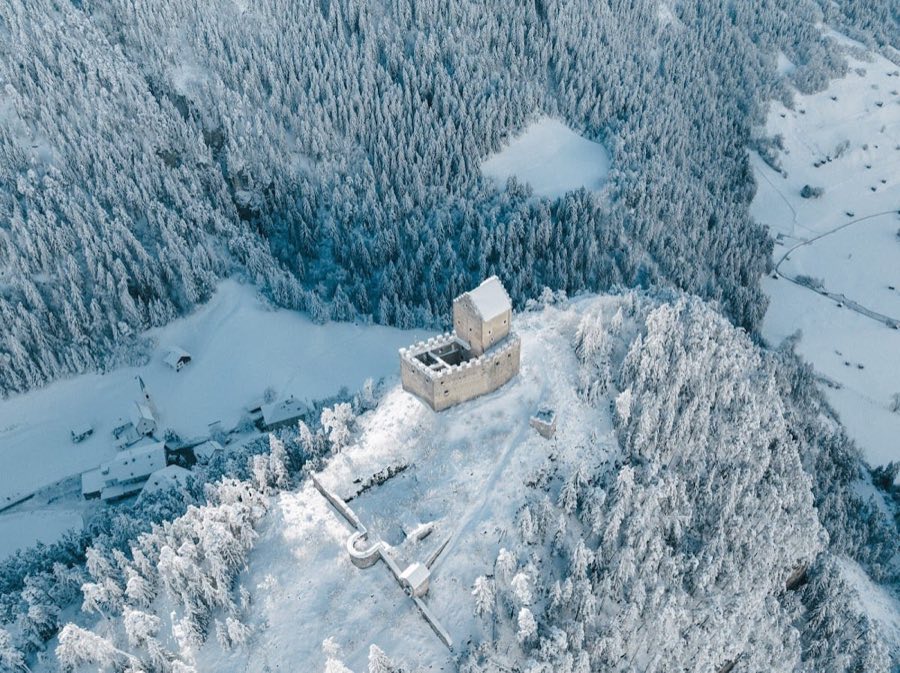
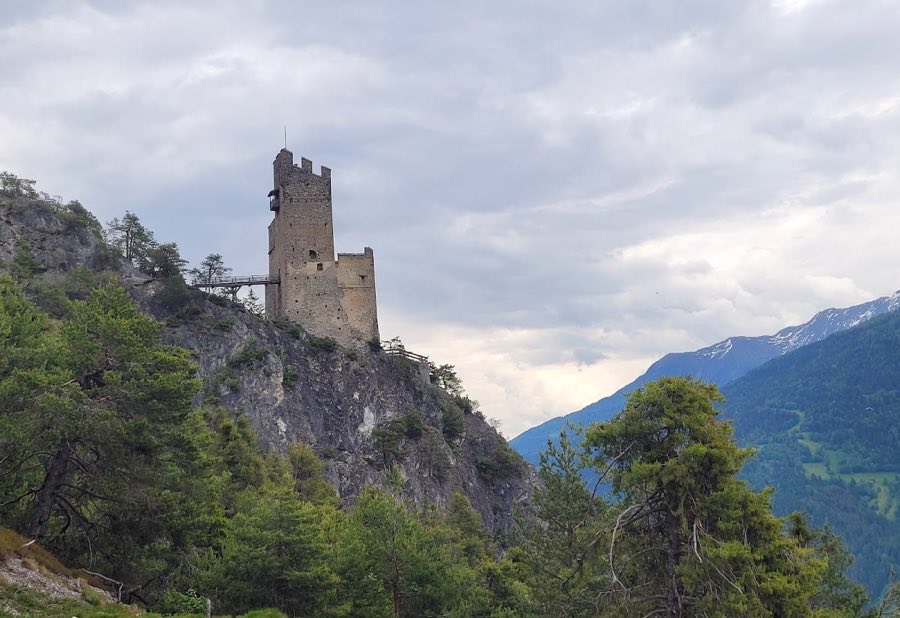
The site is laid out around a rectangular curtain wall, a defensive ring wall, with a bergfried, or keep, standing at the northeast corner and an ancillary building aligned on the east side. The earliest construction belongs to the medieval phase and the later palace and Baroque additions were built around and into that original enclosure, producing a complex of connected wings and infilled spaces.
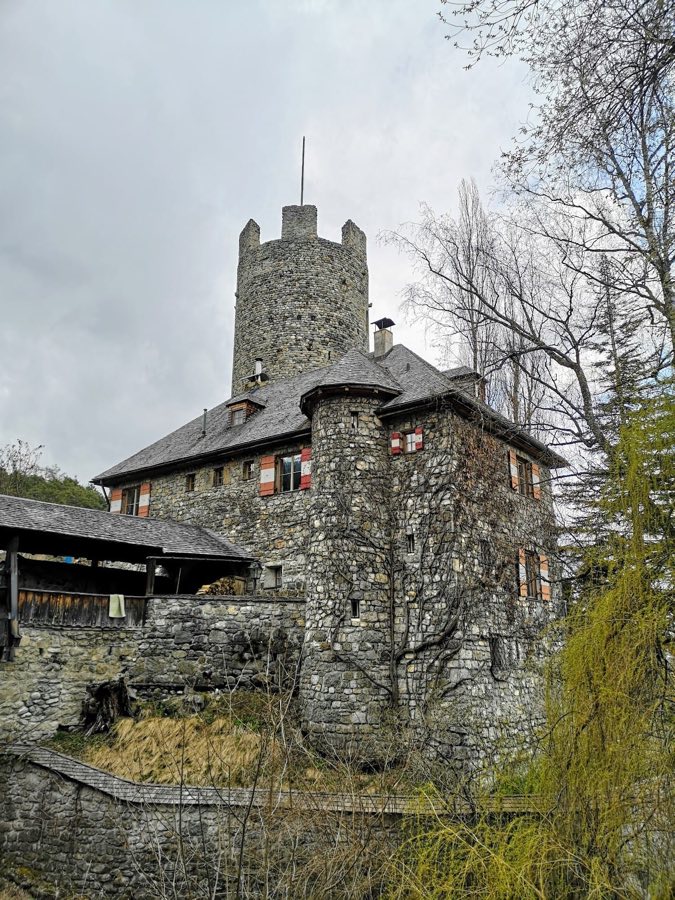
The bergfried (keep) is a principal surviving element. It measures about 9.4 meters on each side and its masonry reaches wall thicknesses of roughly 1.4 meters. Medieval construction survives on the second-to-top floor where a heavy timber-beam ceiling remains in place above visible rubble masonry, showing the original structural workmanship. That upper medieval fabric stands in contrast to later alterations that joined the tower more closely to adjacent residential wings.
The curtain wall and the ancillary east building form the skeleton of the medieval plan. Mid-16th-century works under steward Jörg Colaus added a northern linking wing and carried out infill between the south wing and the tower, integrating former defensive spaces into a palatial residence. Subsequent Baroque-period changes further altered the plan and elevations, leaving a palimpsest of medieval, early modern, and Baroque construction in the standing walls and the layout.
Religious architecture at the site changed in the 19th and 20th centuries. An external chapel was erected in 1837. Remains of a late-Baroque chapel were removed in the 1930s to make room for a brewing installation, the Sudanlage. The cemetery chapel preserves a gravestone inscription beginning “Ano dm. 1556 am 20. October,” linking the mid-16th-century conversion phase to surviving memorial fabric.
Industrial and modern interventions have left visible traces in the standing fabric. A brewing enterprise established in 1816 and later installations associated with 20th-century ownership altered and in some places destroyed older structural fabric, while subsequent commercial management has continued to shape which sections of the complex survive in situ and which have been rebuilt or replaced.
No. 47260
No. 98391
No. 54346
No. 25033
Comments
Comments for Neustarkenberg, Tarrenz will require a verified account before posting.
We'll send a verification link before your first comment is published.