No. 20226
Methoni Castle
Greece
CastleRuinFor events7th century
No. 28068
Castle · Greece
No. 28068 · 36.958 N, 21.657 E
Quick summary
Old Navarino Castle is a castle in Greece with origins associated with the 13th century.
See all castles in GreeceOld Navarino Castle is situated in the municipality of Pylos, Greece. It was established by the Frankish crusaders in the late 13th century, specifically in 1278, under the direction of Nicholas II of Saint-Omer, a Flemish prince ruling the Principality of Achaea.
Before the castle’s construction, the site held great significance in ancient times as the acropolis of Pylos, associated with the legendary kingdom of Nestor from classical Greek tradition. During the Peloponnesian War in the 5th century BCE, the fortified acropolis saw Athenian defense efforts between 425 and 421 BCE but subsequently came under Spartan control. Following this period, the site saw little continuous habitation until the arrival of the Frankish rulers.
The castle’s strategic importance stemmed from its position overlooking the northern entrance of Navarino Bay, making it a key coastal fortification against naval threats. Ownership of the castle changed multiple times through the centuries. Initially controlled by the Saint-Omer family, it passed to the Navarrese Company, a mercenary group from Navarre and Gascony, during the late 14th century. In the early 15th century, the Venetians gained possession of the fortress, around 1417 to 1423, strengthening regional control over maritime routes.
After 1500, the Ottoman Empire captured the area, overtaking the castle. In 1572, recognizing new defensive needs, the Ottomans constructed a nearby fortress now known as New Navarino, which led to the decline in military relevance of the older fortification. The castle nonetheless remained strategically significant through the Greek War of Independence beginning in 1821, during which Greek revolutionaries first seized it. However, Ibrahim Pasha, leading Ottoman-Egyptian forces, retook the site in 1825. The castle was ultimately returned to Greek control after the decisive Battle of Navarino in 1827. Following this, Old Navarino Castle was abandoned as a military stronghold.
In the 20th century, archaeological exploration of the area intensified, uncovering remnants of Mycenaean civilization nearby, including the famous Palace of Nestor. Noteworthy archaeologists such as Heinrich Schliemann conducted early excavations in 1874, followed by scholars like Carl Blegen, Konstantinos Kourouniotis, and Spyros Marinatos in later years. Since 1932, the site has been legally protected as a historical monument. Current preservation efforts are overseen by the Ephorate of Antiquities of Messenia.
Old Navarino Castle occupies roughly 50,000 square meters atop the Koryfasio peninsula. Its layout forms an irregular trapezoid and incorporates parts of earlier classical fortifications from the ancient acropolis beneath. The fortress is divided by a transverse wall into two main parts: a larger southern section and a smaller northern citadel, known as the acropolis. The primary entrance once stood on the south side and was reached by a steep path leading from the nearby channel of Sykea. Though much of the gate has since collapsed, its original location remains identifiable.
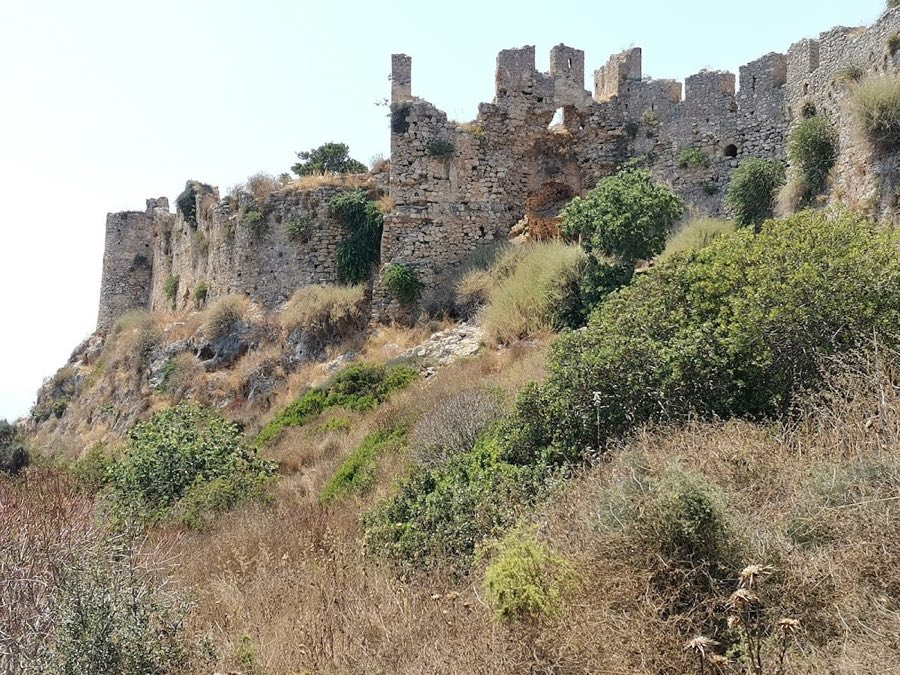
The surviving outer walls include extensive perimeter stretches along the southern side, where three distinct layers of brickwork are visible, as well as lower sections of the northeastern walls. Foundations mark the base of two circular towers on the northeastern flank, which would have played a role in surveillance and defense. Within the enclosure are ruins that suggest both public and private buildings once stood here, alongside a Catholic church reflecting the castle’s Frankish and Venetian periods. The site also contains underground cisterns designed to store water, essential for withstanding sieges.
On the western outer wall is a small rectangular tower built using Byzantine brickwork techniques. This structure predates the Frankish construction and hints at earlier defensive efforts on the site. The castle’s superstructure exhibits evidence of two main phases of construction: one associated with Venetian control from 1423 to 1500 and a later phase reflecting Ottoman alterations in the following century. The southern wall enclosure may have been added either by the Venetians or the Ottomans to improve fortifications.
The eastern side of the castle was left largely unfortified due to natural defenses offered by the steep terrain. Here, tall but relatively thin walls survive, some topped with swallowtail battlements—a characteristic crenellation shape used in medieval fortifications. Overall, the fortress stands in varying states of ruin. Portions of the outer walls remain, but many sections have deteriorated. The terrain is rugged and overgrown, limiting access for safety reasons.
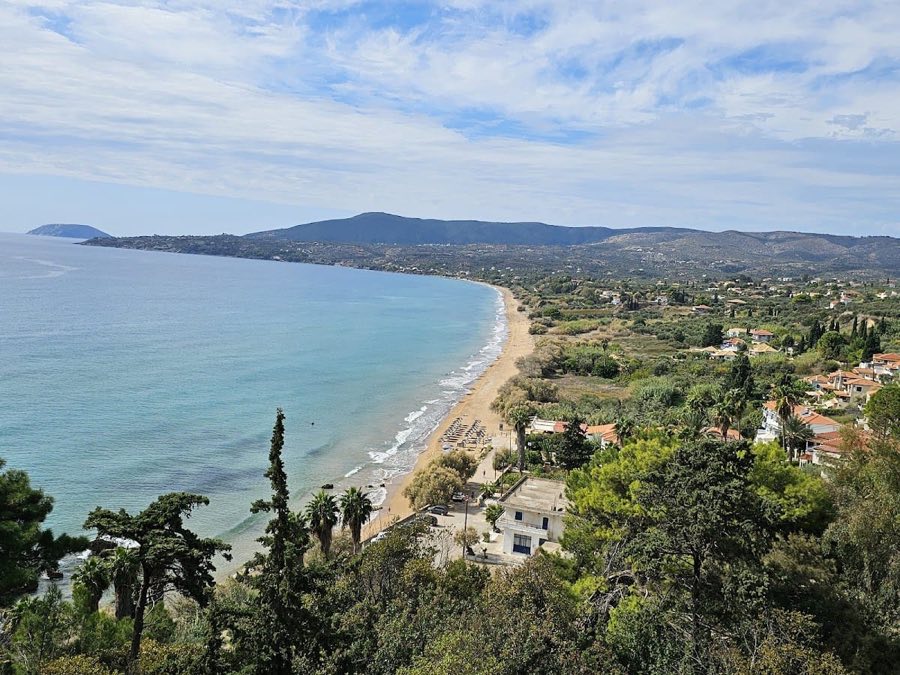
From its elevated position, the castle overlooks the Ionian Sea, the bay of Voidokilia, and the lagoon known as Osmanaga or Divari, commanding views that stretch from the island of Proti to the Messinian Oinousses islands. This vantage enabled control over maritime approaches to Navarino Bay, underlining its historical strategic importance throughout the medieval and early modern periods.
No. 20226
No. 67512
No. 86170
No. 11357
Comments
Comments for Old Navarino Castle will require a verified account before posting.
We'll send a verification link before your first comment is published.