
No. 89684
Klenová Castle
Czechia
CastleRuin13th century
No. 96241
No. 96241 · 49.277 N, 13.137 E
Quick summary
Pajrek Castle is a castle in Czechia with origins associated with the 14th century.
See all castles in CzechiaPajrek Castle is located near the municipality of Nýrsko in the present-day Czech Republic. It was constructed in the early 14th century by the noble family of Janovice, who maintained ownership for nearly two centuries. The earliest written record mentioning the castle dates to 1360 and references a certain Něpr of Pajrek, establishing the site as a recognized stronghold during that period.
In the turbulent era of the Hussite Wars during the 15th century, the castle’s lord Jan of Janovice navigated shifting religious and political allegiances. He alternated his support between the reformist Hussites and the Catholic forces, reflecting the complex and often divided loyalties in the region at the time. In 1472, Pajrek Castle suffered a significant attack when Bavarian troops captured and set it ablaze, marking a moment of military defeat and destruction.
By the early 1500s, the castle had fallen into disrepair. In 1512, Jindřich Kostomlatský of Vřesovice acquired the deteriorating fortress and undertook partial restoration. However, Kostomlatský notably used Pajrek as a base for raiding activities in the surrounding area, actions for which he was eventually captured and executed in Prague. Following his death, ownership of the castle became contested among noble families, including the Kostomlatský and Vidhostic lineages. Records by 1504 describe the castle as deserted, and by the mid-16th century—a period that saw its final abandonment—it was largely in ruins.
After abandonment, the remains of Pajrek Castle served as a convenient source of building materials for nearby constructions. It was not until 1964 that the site received formal protection as a cultural monument, preserving the ruins as an important historical link to the region’s medieval past.
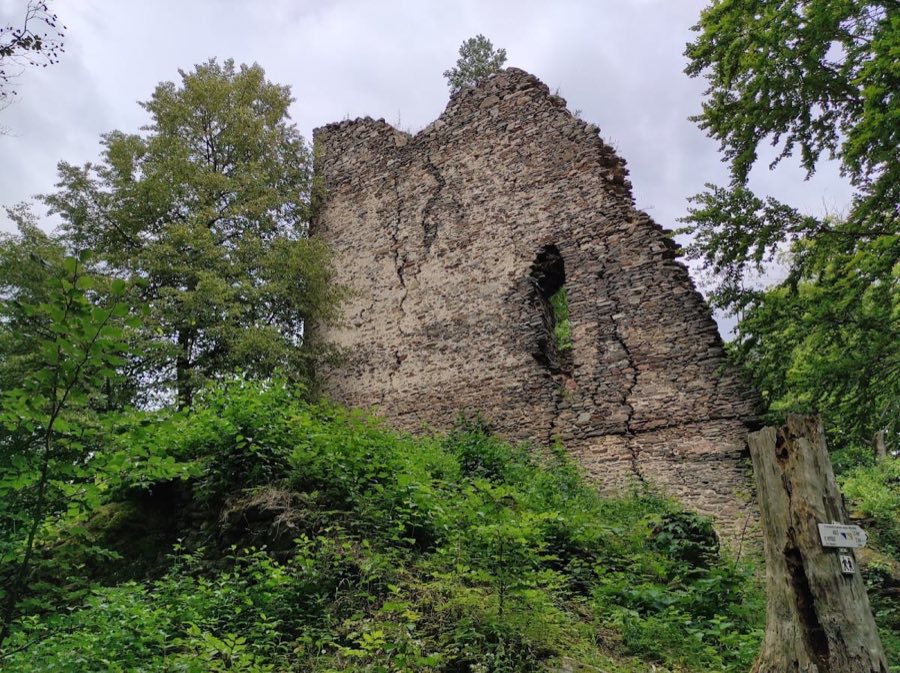
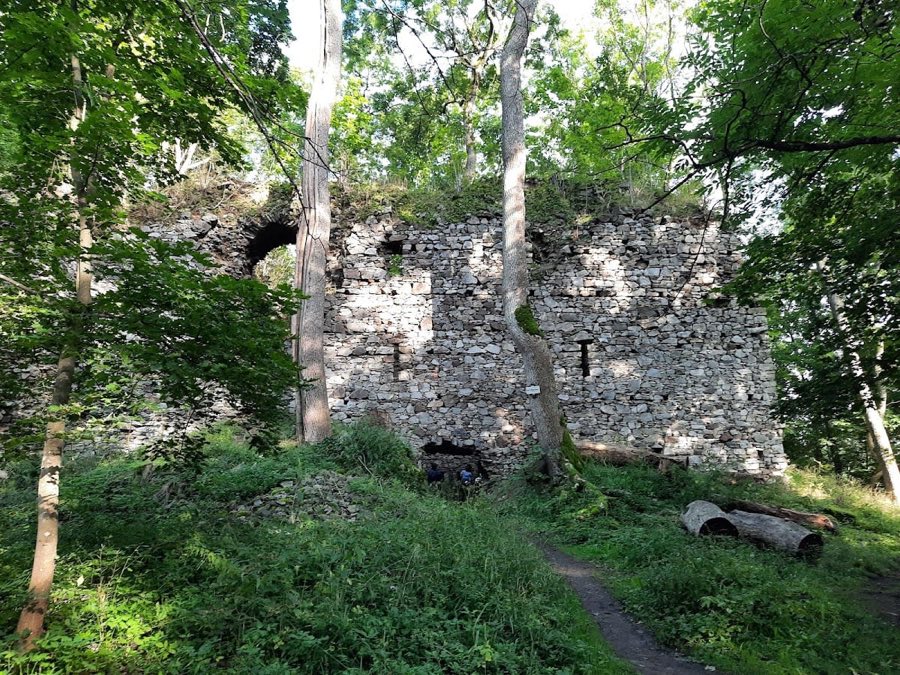
Pajrek Castle was built as a donjon-type fortress, occupying a rocky ridge on the northern slopes of Hraničář mountain at an elevation of approximately 617 to 620 meters. The heart of the castle was a large prismatic tower known as a donjon—a fortified keep designed for defense and residence. This tower measured about 16 meters on each side, making it one of the largest medieval towers of its kind in the Czech lands. Its walls were exceptionally thick at the base, reaching up to 2.4 meters, which narrowed toward the upper parts to reduce weight. Today, remnants of the tower survive up to the height of the fourth floor on its northern and western sides. These sections retain traces of original plaster, while the southern wall has suffered more extensive damage, likely because window openings weakened its structure.
The donjon’s entrance was originally situated on the western wall’s second floor, a design intended for defense by limiting ground-level access. This doorway was partially sealed with brickwork in the late 19th century. The door itself was a substantial single-wing wooden structure secured by a locking system that used a massive beam set into a specially carved wooden slot measuring 25 by 25 centimeters. Inside, the tower featured multiple floors supported by large wooden beams, each approximately 35 by 35 centimeters in cross-section and extending 12 meters in length. These beams rested on stone offsets built into the masonry walls and were also supported by central wooden posts. At least three stories are confirmed, with indications that the tower possibly rose even higher.
Surrounding the donjon was a roughly square courtyard enclosed by stone curtain walls. At the northeastern corner of this courtyard stood a smaller tower, which, along with the main donjon, was likely connected by a drawbridge, allowing controlled movement between the two structures. Defensive features of the castle included natural steep slopes to the north and south, which were enhanced by ditches cut directly into the rock. The southern side featured additional moats and walls, designed to protect the original access route. These outer defenses probably date back to the late 15th century, coinciding with the period after the Bavarian assault.
Today, the visible ruins primarily consist of the substantial remains of the main tower and the fragments of the smaller adjoining tower and the enclosing curtain walls. The fortification’s defensive layout and integration with the natural terrain offer a clear sense of its original strategic design. Since its abandonment, no decorative elements or inscriptions have been recorded among the surviving structures.
No. 89684
No. 10295
No. 36119

No. 91270
Comments
Comments for Pajrek Castle will require a verified account before posting.
We'll send a verification link before your first comment is published.