No. 63073
Panemunė Castle
Lithuania
CastleRuin14th century
No. 57460
No. 57460 · 55.097 N, 23.131 E
Quick summary
Raudonė Castle is a castle in Lithuania with origins associated with the 19th century.
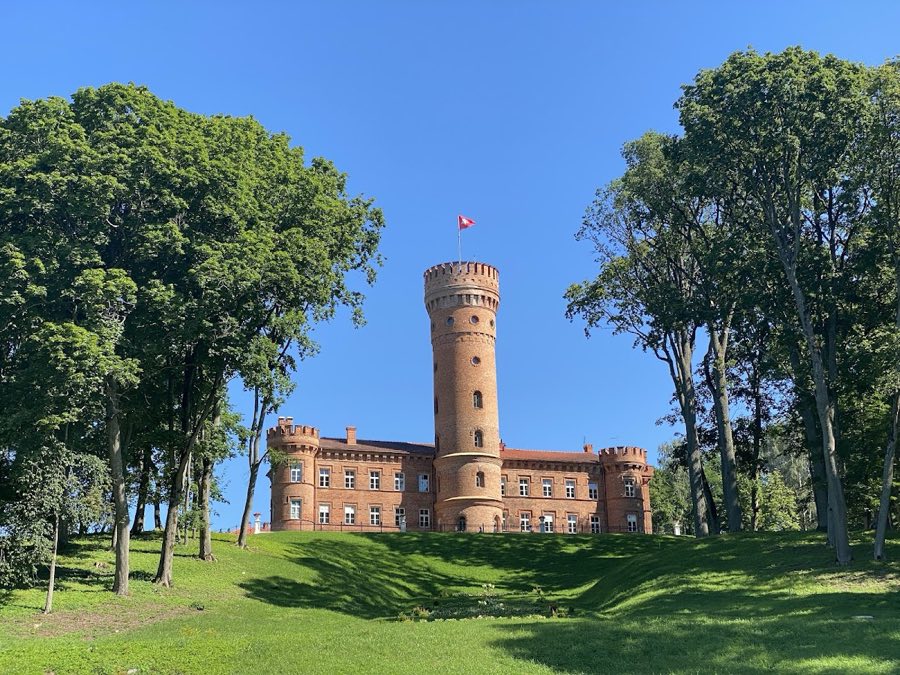
See all castles in LithuaniaRaudonė Castle in Raudonė, Lithuania began as a timber fortress raised by the Teutonic Order around 1337. Over the centuries the site developed from that wooden stronghold into a brick-built castle and later into a noble manor, with major building phases in the Renaissance and a pronounced Neo-Gothic remodelling in the 19th century. The place has local cultural significance, being linked to the East Prussian tale of the White Maiden of the Bayersburg, and it served repeatedly as a manorial centre under royal and private ownership.
In the late 1500s the royal manor was granted by Grand Duke Sigismund II Augustus of Poland to the Prussian merchant Krispin (Hieronim) Kirszenstein, who replaced the earlier fortifications with a Renaissance-style residence built on the old castle footprint. That house, completed by the early years of the 1600s, included a prominent cylindrical tower rising roughly 33–34 metres and formed the principal domestic core on the site. Medieval records refer to the earlier masonry castle under the name Bayersburg II.
During the 1700s the estate passed into the hands of Polish–Lithuanian nobility who ordered renovations that introduced Baroque elements to the existing fabric. In the early decades of the 1800s the property became the possession of Russian Prince Platon Zubov; the Zubov family carried out further transformations during the nineteenth century and expanded the complex with Gothic revival forms. A new Neo-Gothic structure was added within the castle grounds in 1877; that annex served as storage and as living quarters for household staff, and it was adapted for use as a mill in 1923.
From 1898 until 1937 the castle remained in private ownership under Sophia Waxell and her family, the heirs of the earlier proprietors. In 1937 the estate transferred to the National Bank of Lithuania. The castle suffered heavy damage during World War I and again in World War II when, on 6 August 1944, German forces blew up the main tower and destroyed part of the southern wing. Following the Second World War the complex was rebuilt and repurposed as a school, with restoration work completed in 1965 and the tower reconstructed in 1968.
The site occupies a layered complex whose plan reflects medieval defence, a Renaissance residence, and nineteenth-century Gothic revival additions. The earliest phase survives in the form of the castle’s location and the later brick fabric laid down at the end of the sixteenth century. The main residential block erected after the medieval fortifications was built of red brick and centered on a cylindrical tower that originally rose to about 33–34 metres, a vertical feature that dominated the manor and that was later rebuilt after wartime destruction.
The Renaissance manor functions as the principal living and representative quarter from the early 1600s and retains its masonry construction and the footprint of the earlier castle. Brick is the consistent building material for the surviving walls. The cylindrical tower served as a visual and functional focal point; it was demolished by explosion on 6 August 1944 and rebuilt in the late 1960s, and it now stands restored as part of the complex.
A separate Neo-Gothic building added in 1877 sits within the castle ensemble. Originally used as a warehouse and for servants’ living quarters, that nineteenth-century block was converted into a mill in 1923, reflecting a change from purely residential service use to an industrial function. The nineteenth-century Gothic additions altered the castle silhouette and expanded usable space, and the nineteenth-century brickwork remains part of the composite structure.
The grounds form an extensive historical park of roughly twenty-seven hectares, planted with notable trees that were recorded by name. Among these are a silver fir, a Swiss pine, a grey walnut, a multi-stemmed linden with nine trunks that was nominated for European Tree of the Year, and the Gediminas Oak, which had ceased to produce leaves in later reports. The park provides the setting for the restored buildings, and the reconstructed tower serves as an observation point overlooking the Nemunas valley.
No. 63073
No. 39220
No. 97623
No. 93286
Comments
Comments for Raudonė Castle will require a verified account before posting.
We'll send a verification link before your first comment is published.