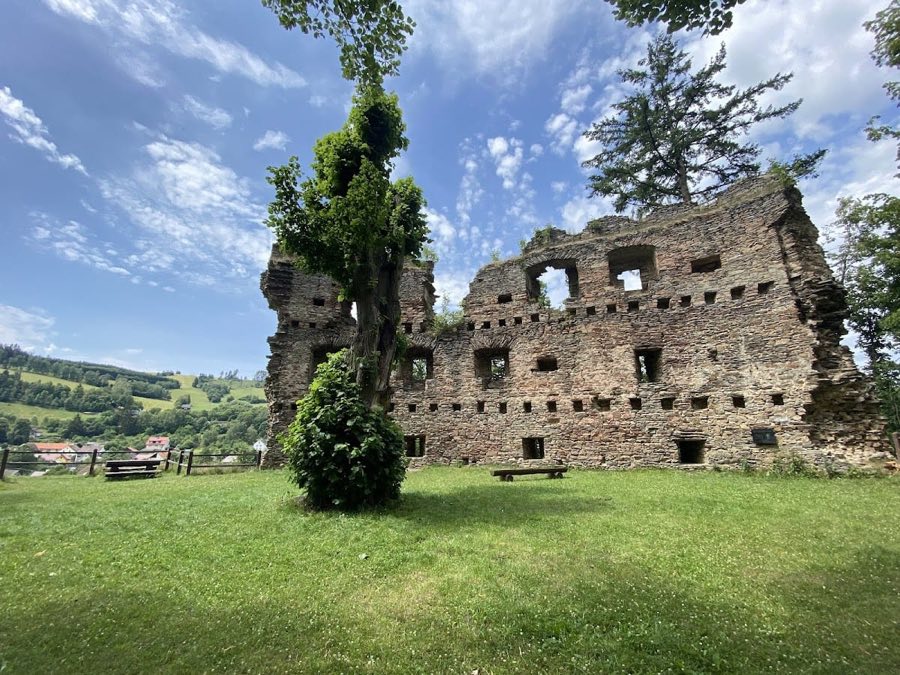
No. 36834
Dalečín Castle
Czechia
CastleRuinFor events14th century
No. 11054
Castle · Czechia
No. 11054 · 49.639 N, 16.171 E
For events
Skály Castle is marked as a château or castle venue lead. Capacity, indoor/outdoor spaces, catering rules, and accommodation options are published only after public verification.
Event types: Private events, Cultural gatherings, Filming and photography
Quick summary
Skály Castle is a castle in Czechia with origins associated with the 14th century.
See all castles in CzechiaSkály Castle, also known historically as Štarkov, Starkov, or Stařechovice, is situated near the municipality of Nový Jimramov in the present-day Czech Republic. This medieval fortress was established by the Bohemian nobility in the late 14th century, likely around 1380, with ties to Archleb Stařechovický of Kunstadt or possibly his son Erhart, who had acquired the surrounding lands from the 1360s onward.
The earliest written mention of the castle dates to 1384 when Archleb divided the lordship of Jimramov between his sons Erhart and Jan. In the early 15th century, Skály gained notoriety as a center of unrest when it was occupied by the robber knight Erhart Puška of Kunstadt starting in 1415. From this stronghold, he and his followers launched raids that devastated several towns in Moravia. Royal pardons issued in 1417 and 1418 attempted to curb the violence, but the castle remained a refuge for outlaws and later for Hussite forces, a religious and military faction involved in the broader Hussite Wars.
Ownership of the castle became a matter of dispute in the subsequent decades. Erhart’s daughter Sophie Tovačovská of Cimburk contested claims from members of the Kunštát family, leading to legal battles in the 1420s. In 1438, Skály was besieged by Margrave Albrecht but held firm, defended by a garrison of over 500 Hussites. By 1440, regional authorities commanded the castle’s evacuation and transferred control to Hynek Ptáček of Pirkstein. That same year, the fortress was likely deliberately destroyed, a process known as slighting, to prevent its use as a military base.
Following these events, Sophie Tovačovská regained control of the Jimramov estate in 1447 and sold it in 1448 to Vaněk of Bystřice, a burgrave serving the influential Pernstein family. By 1464, Skály was described in records as ruined. The castle remained a part of the Jimramov domain, passing through various noble hands over the following centuries.
Archaeological interest in the site revived under the Belcredi family, who initiated the first excavations focusing on the castle’s defensive walls and gate structures. Renewed digs in the 1970s uncovered artifacts dating from the 15th century, connecting the material culture to the castle’s last period of active use. Starting in 1996, systematic archaeological research has uncovered significant remains, including foundations of the original palace buildings. Since 1958, the ruins have been recognized and protected as a cultural monument, preserving an important piece of medieval Bohemian heritage.
Skály Castle is perched atop Štarkov hill, rising 679 meters above sea level, where natural gneiss rock formations formed a key element of its defensive scheme. The castle’s core was nestled below the highest rock outcrop on the hill, with the courtyard encircled by steep rocky faces topped by tall masonry walls. This integration of stone outcrops into the fortifications provided a rugged and imposing barrier against attackers.
Within this enclosed area, a rectangular palace adjoined the southeast face of a large rock, forming the main residential structure. Nearby stood a square tower used for habitation, enhancing the defensive and domestic functions of the courtyard. The main tower, known as the bergfried, survives today as a partial ruin displaying an oval-shaped ground plan, hinting at its original prominence as a lookout and stronghold.
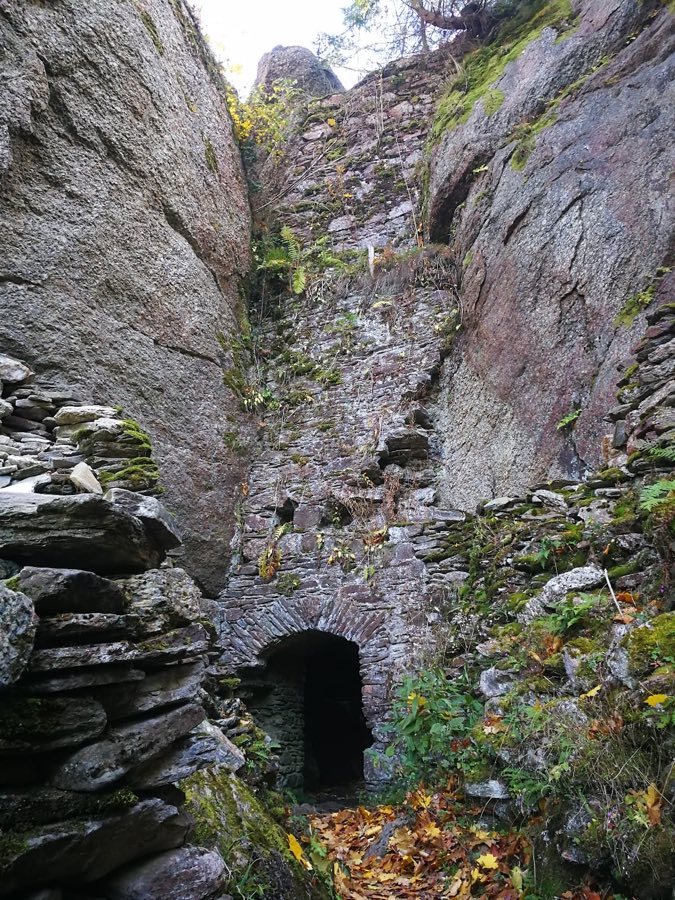
Access to the castle passed through a narrow gatehouse positioned in a 3-meter-wide and 15-meter-long cleft between two closely spaced rock walls rising about 20 meters high. Portions of the stone gate and enclosing walls remain visible between these natural barriers, emphasizing how the builders utilized the terrain to control entry.
South of the main courtyard lay a second bailey, an enclosed courtyard section reached by passing through a gate tower framed by extended defensive walls. A small tower once stood above this area, likely connected to the fortress’s interior by an elevated gallery running along the core walls. This arrangement highlights a layered defense system that protected important auxiliary spaces.
To the northeast, a horseshoe-shaped bastion was constructed directly on the rock formations. It was accessible via a stone ramp and a wooden bridge, controlling the approach to the castle from this direction. The inner castle was further safeguarded to the north and west by a combination of a rock-cut ditch, a raised earth rampart strengthened with three large bastions, and an outer ditch. The main pathway to the castle passed centrally among these bastions, illustrating a designed funnel for potential attackers.
Beyond the rocks and main fortifications, a fortified outer bailey occupied the southern area, likely serving as the site for Hussite troops to camp or store supplies during the fortress’s later periods of use.
At the western edge, the castle featured a gate beneath a prominent rock outcrop crowned by a slim round tower. Defensive stone walls filled gaps between the rocky outcrops here, reinforcing the castle’s position. From the palace, a smaller gate with a segmental stone arch allowed access heading southeast.
Two additional towers guarded the core enclosure. One was a rectangular tower with sides measuring approximately 5.5 meters located to the north, while the other was an oval tower about 9 by 5.2 meters, built on a solitary rock to the south of the core. The interior of the oval tower had a rectangular layout, suggesting a functional, utilitarian design.
Excavations, especially those carried out in the late 20th and early 21st centuries, have uncovered artifacts from the 15th century that provide tangible links to the castle’s final active phase during the Hussite conflicts. Today, while several structures stand only in fragments, the ruins of Skály Castle remain accessible in situ and are protected as part of a cultural heritage site within a designated natural monument area.
No. 36834

No. 92639
No. 45075
No. 69782
Comments
Comments for Skály Castle will require a verified account before posting.
We'll send a verification link before your first comment is published.