
No. 88012
Šember Castle
Czechia
CastleRuin7th century
No. 78166
Castle · Czechia
No. 78166 · 50.046 N, 14.846 E
For events
Tuchoraz Castle is marked as a château or castle venue lead. Capacity, indoor/outdoor spaces, catering rules, and accommodation options are published only after public verification.
Event types: Private events, Cultural gatherings, Filming and photography
Quick summary
Tuchoraz Castle is a castle in Czechia with origins associated with the 15th century.
See all castles in CzechiaTuchoraz Castle is located in the municipality of Tuchoraz in the modern Czech Republic. It originated during the medieval period and was built by the Bohemian nobility in the early 15th century.
The earliest known construction was a small stone fortress established before 1409 by Petr of Klučov. This initial stronghold was strategically placed on a low rock overlooking the Šembera stream, taking advantage of the natural terrain during the reign of King Wenceslaus IV. The fortress’s modest design reflected its defensive purpose in a period of regional instability.
In 1441, the estate passed into the hands of Daniel Žitavský, a burgher from Prague. Daniel developed the surrounding landscape by creating a pond and a mill along the Šembera stream, integrating agricultural activity with the fortress’s functions. Following Daniel’s death in 1462, ownership transferred through his widow, Hedvika, to her second husband Mikuláš of Landštejn, who held the office of royal burgrave at Hluboká Castle.
After 1468, Mikuláš oversaw a significant rebuilding of the site, transforming the small fortress into a stately noble residence. This renovation added a large entrance tower and a spacious palace, marking a shift from purely military use to a combined defensive and residential function. Documentation above the entrance gate credits Master Květoň as the leader of this reconstruction, indicating the presence of skilled craftsmen and a deliberate investment in the castle’s stature.
The estate remained within Mikuláš’s family line until 1579. From 1542 onwards, it was referred to as a “chateau,” highlighting its evolution into a more refined noble dwelling rather than a purely fortified site. That year, Jaroslav I Smiřický acquired the property, incorporating it into the larger Černokostelec estate. After this change, the castle no longer served as a noble residence; instead, local estate officials occupied it, marking a decline in its prominence.
During the protracted conflicts of the Thirty Years’ War, Swedish forces laid siege to the castle in 1639 but failed to capture it. Despite this resilience, the castle slowly deteriorated over subsequent decades. By 1770, the majority of the complex had been dismantled. Stones and building materials were removed from the site and repurposed to reinforce nearby dams and weirs, reflecting a shift in priorities toward local infrastructure over historical preservation.
In the 20th century, the remaining parts of the castle, especially around the courtyard, were managed by various private owners, including an agricultural cooperative. The regional monument preservation institute assumed responsibility for the ruins in the 1970s, restoring the castle’s entrance tower in the 1980s. Following the restitution process in 1992, ownership passed to Markéta Grossová, who eventually closed the site to visitors, and after difficulties in upkeep, the property was sold at auction in 2013 to František Vyšata, a native of the area.
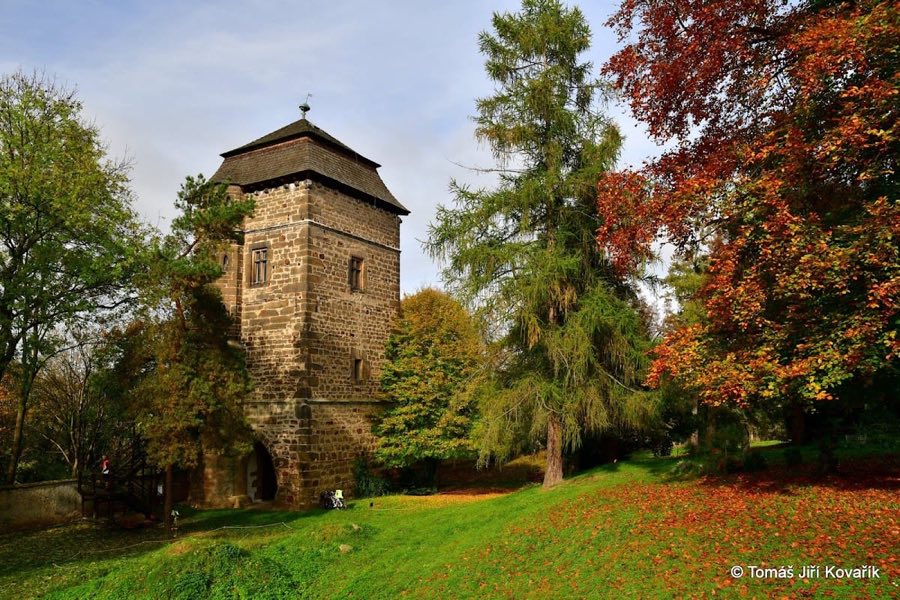
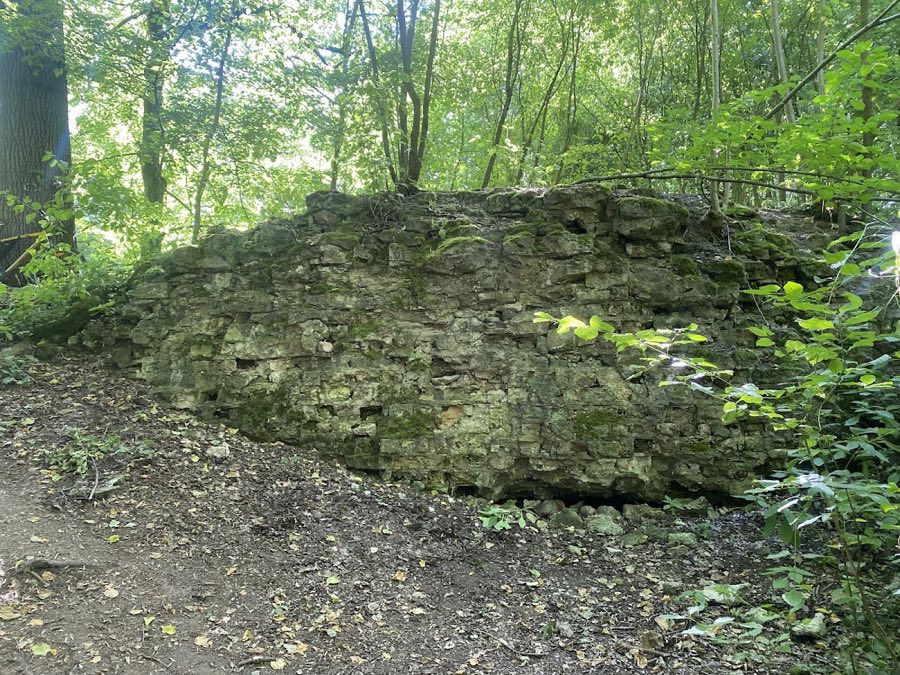
Today, the remains of Tuchoraz Castle present a fragmentary glimpse into its historical layout and medieval construction. The site retains portions of a palace, the perimeter walls of a square bastion reinforced at its corners by carefully cut ashlar stones, and extensive cellars beneath the courtyard. The most prominent surviving element is the residential entrance tower, standing approximately 20 meters tall.
The entrance tower served both defensive and residential purposes and is notable for its rare Gothic vaulting. Inside, the second floor features a star-shaped groin vault, an architectural form characterized by the intersection of vaulted ceilings to create a star pattern. This style is uncommon and dates to the reign of George of Poděbrady in the mid-15th century, suggesting the tower’s construction or renovation during that period.
The castle is situated on the edge of a terrain plateau, overlooking the Mlýnský pond at an elevation of 275 meters. This location provided both natural defense and control over the water resources, including the pond created by Daniel Žitavský in the 15th century.
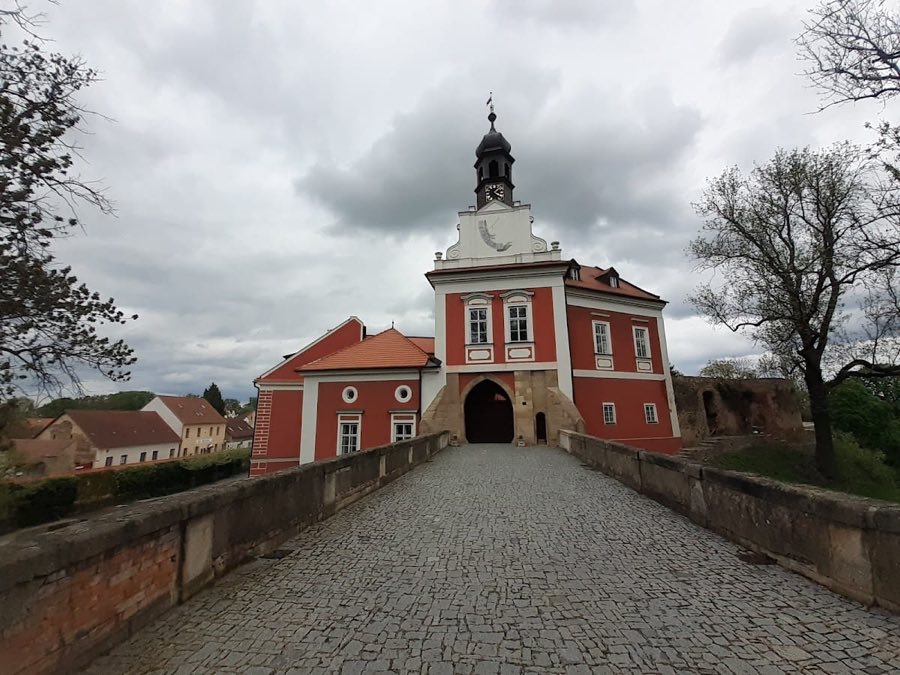
A distinctive feature of the castle’s entrance gate is a rare Czech inscription, which documents the construction work conducted under the supervision of Master Květoň. This inscription marks the castle as a site of significant craftsmanship and provides valuable insight into the individuals involved in its building phase.
Over time, the tower and gate underwent restoration efforts in the late 20th century. The entrance tower, in particular, now stands as a preserved monument, allowing access during special cultural events or by prior arrangement. The walls and cellars remain largely in ruin but serve as important archaeological testimony to the castle’s former scale and structure.
No. 88012
No. 39850
No. 67889
No. 71086
Comments
Comments for Tuchoraz Castle will require a verified account before posting.
We'll send a verification link before your first comment is published.