No. 37047
Muszyna Castle
Poland
CastleRuin14th century
No. 43943
No. 43943 · 49.353 N, 21.298 E
Quick summary
Zborov Castle is a castle in Slovakia with origins associated with the 14th century.
See all castles in SlovakiaZborov Castle is located above the village of Zborov in eastern Slovakia. It was built by Hungarian medieval authorities, likely in the early 14th century, to serve as a border fortress guarding the kingdom’s northern frontier and an important route leading to Poland.
The first reliable written record of the castle dates to 1347, during the reign of King Louis I of Hungary. Some earlier traditions suggest a founding around 1270 by Otto Biberstein, but the stronger evidence points to construction in the 14th century. Initially constructed as a royal Gothic stronghold, Zborov Castle soon became the center of a large feudal estate known as Makovica. Throughout the following centuries, ownership passed between several noble families, including the Cudar family from 1364 to 1470, followed by the Rozgonyi family after 1470. In the early 1500s, the Tarczay family held the estate, and from 1548 to 1601, it was under the Serédy family. The Rákóczi family acquired it in 1601 and retained it throughout the 17th century.
During its active use, the castle witnessed various regional conflicts. It played a role in struggles over the Hungarian throne and in anti-Habsburg uprisings. Notably, in 1684 it was attacked and taken by imperial forces amid the Thököly uprising, a significant anti-Habsburg revolt. This assault led to the castle’s destruction, and by the early 18th century, it had already fallen into ruin. Later, during World War I, the castle suffered additional damage amid fighting between Russian and Austrian armies in the area.
In the 20th century, the castle hill gained protection status to preserve its natural environment, particularly the centuries-old oak trees lining the access path. Archaeological research has not settled the precise date or motives behind the original construction, but its strategic location supports the view that it was intended primarily for defense and border control. By the 17th century, the castle estate remained economically important, supporting a thriving agricultural base, crafts, and benefiting from markets authorized in nearby towns.
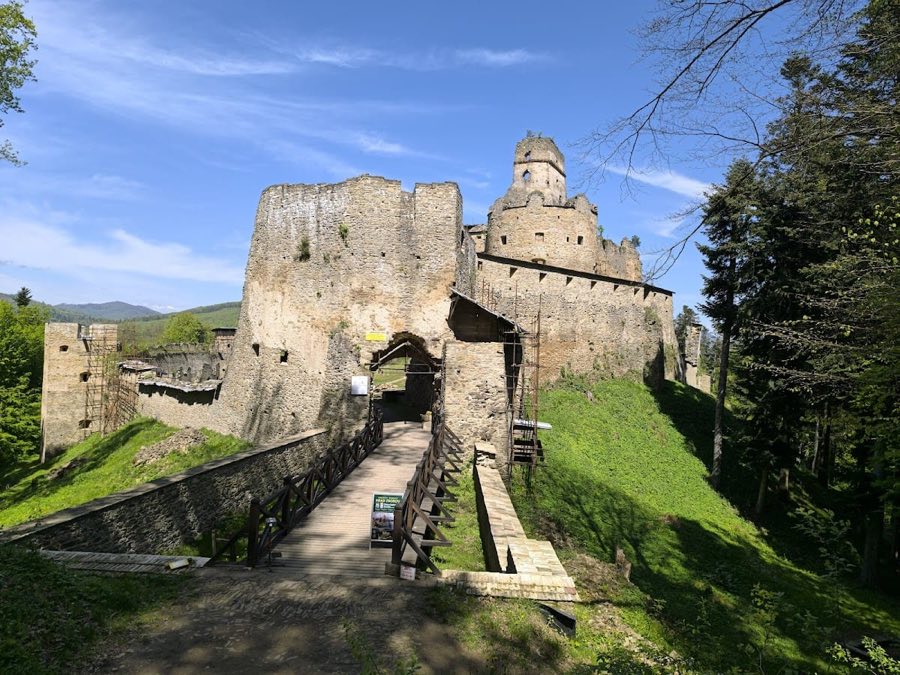
Zborov Castle is built on a rocky hill and originally featured a roughly triangular courtyard surrounded by strong defensive walls. Its earliest construction phase revealed a royal Gothic fortress comprising a rectangular donjon or tower, a noble residence known as a palace, and a chapel within the inner enclosure. This compact layout served both military and residential purposes.
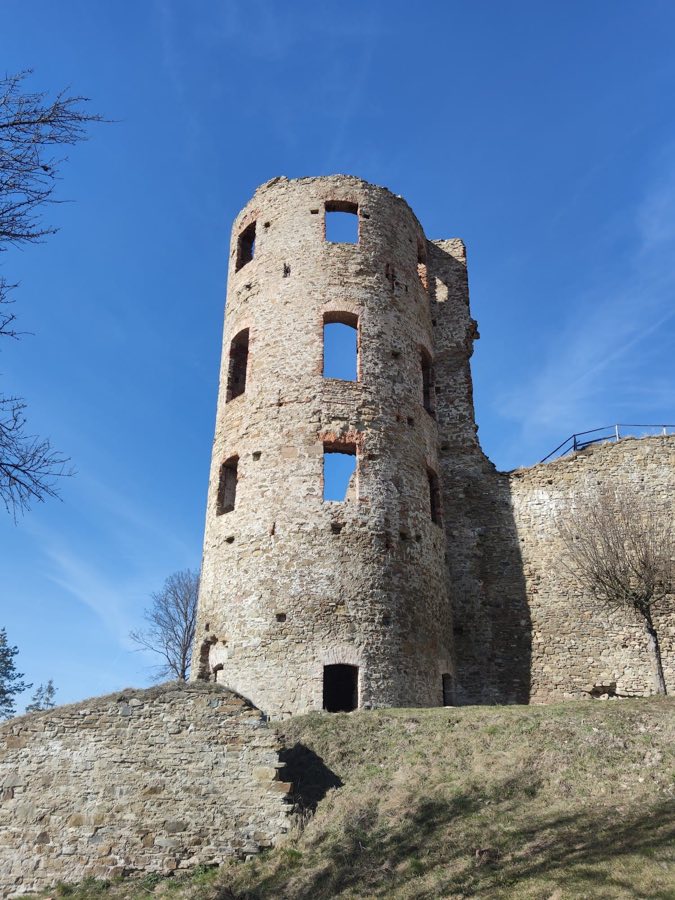
Between the 14th and 16th centuries, the fortress expanded with a second courtyard, which included at least two semicircular bastions—rounded defensive towers projecting from the walls—likely added during the Cudar family’s rule. These additions strengthened the castle’s defenses and provided better coverage of approaches.
In the latter half of the 16th century, under the owners from the Serédy family, the castle underwent significant Renaissance-style modifications to meet evolving military challenges, especially threats from the Ottoman Turks. This included enlarging the second courtyard and constructing a third, lower courtyard with polygonal (multi-sided) and semicircular bastions. The third courtyard’s walls featured a walkway with openings called arrow slits, designed for defenders to fire upon attackers while being sheltered. Access was controlled by a carefully designed gate protected by a drawbridge, which could be raised to prevent entry.
The third courtyard was subdivided internally by walls to regulate movement and control access to the middle courtyard. The western part of this area housed farm buildings built along the curtain wall, which is the continuous defensive wall surrounding the castle. The castle’s fortifications reflected advanced Italian military architectural principles of the Renaissance period, emphasizing strong, angled bastions and layered defenses.
Today, the castle remains as a ruin, with fragments of walls and bastions still visible. The original Gothic and Renaissance elements can be traced in the surviving layout. Along the path leading to the castle, centuries-old oak trees have been preserved and protected as part of the natural reserve established in the 20th century. These trees mark the historical access route to the fortress and contribute to the site’s landscape character.
No. 37047
No. 41400

No. 94061
No. 97384
Comments
Comments for Zborov Castle will require a verified account before posting.
We'll send a verification link before your first comment is published.