No. 53257
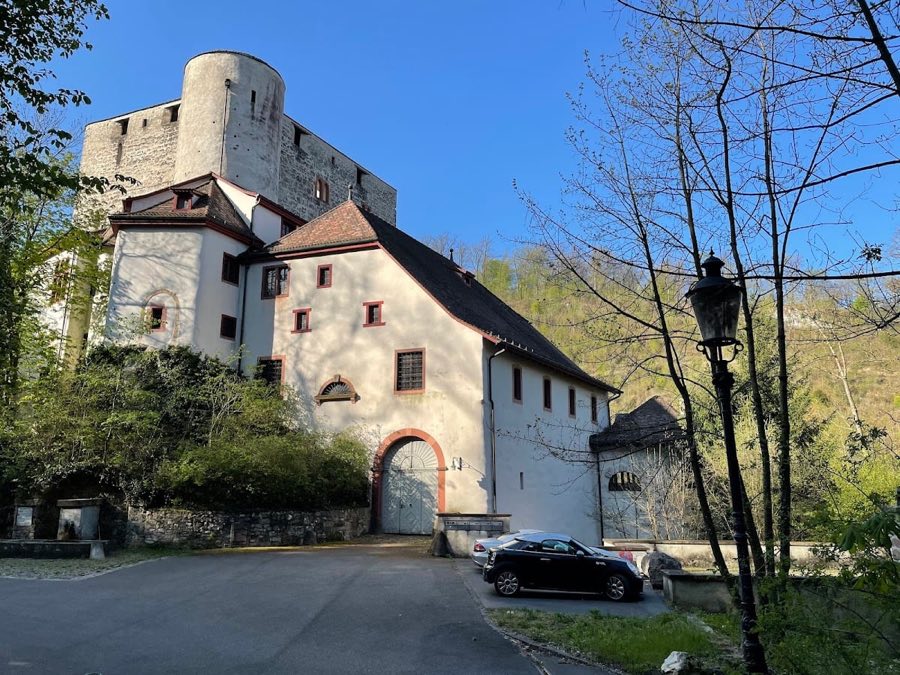
Angenstein Castle
Switzerland
CastleRuin13th century
No. 39869
Castle · Switzerland
No. 39869 · 47.463 N, 7.614 E
Quick summary
Bärenfels Castle Ruins is a castle in Switzerland with origins associated with the 14th century.
See all castles in SwitzerlandBärenfels, also known historically as Aeschburg, is a medieval castle ruin located in the municipality of Duggingen, Switzerland. Constructed by the medieval civilization that once thrived in the region, the castle stood on a strategic hill slope, close to the boundary between two historical areas.
The initial phase of the castle’s development began sometime after the year 1200. It was established as a “Rodungsburg,” which means it was built on newly cleared land. This type of castle allowed its owners to hold estates independently rather than as fiefs under feudal overlords. The first known proprietors were the knights from the Aesch family, who served as ministeriales, or unfree knights, under the Counts of Thierstein.
During the 14th century, control of the castle passed to the Bishop of Basel, who transformed the land tenure by granting the Aesch family the castle and lands as fiefs, altering its administrative status. After the Aesch lineage died out, ownership of the castle became divided: the oldest section went to the Basel-based knightly family Macerel, while the remaining parts were acquired by the Lords of Frick. As the century progressed, the Lords of Bärenfels consolidated the entire property and all associated rights, giving the castle its enduring name.
In 1356, the castle sustained damage due to a significant earthquake centered near Basel. While records do not clearly state if repairs followed, by the 15th century the structure was noted as being in ruins. Since that time, no systematic archaeological excavations have been carried out, leaving much of the castle’s detailed history and internal layout unexplored.
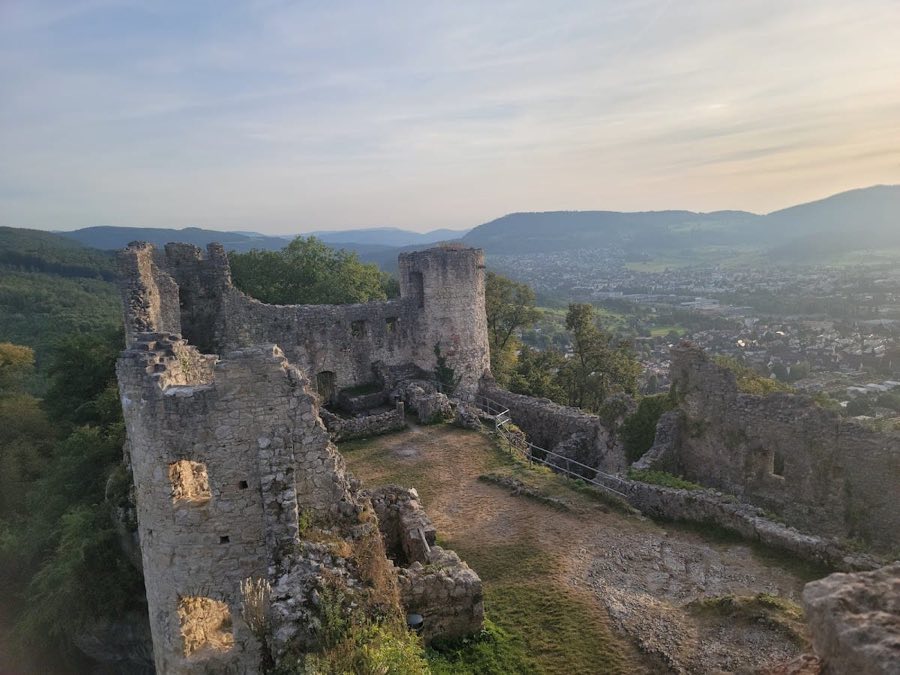
The ruins of Bärenfels form a complex, multi-part fortress perched on a rugged hilltop rock spur. The summit of this natural elevation is split by a deep fissure, a feature that medieval builders ingeniously incorporated into the castle’s design by constructing several floors within this split rock formation.
The oldest section, often called the “Old Castle,” occupies the highest point on the rock spur. It features a rock-carved chamber that once had a wooden ceiling, supported as evidenced by numerous beam holes visible in the stone. From this chamber, stone steps carved directly into the rock ascend to a tower above. Surrounding the chamber are traces of small buildings indicated by wall fragments, although their precise purpose remains unclear without further study.
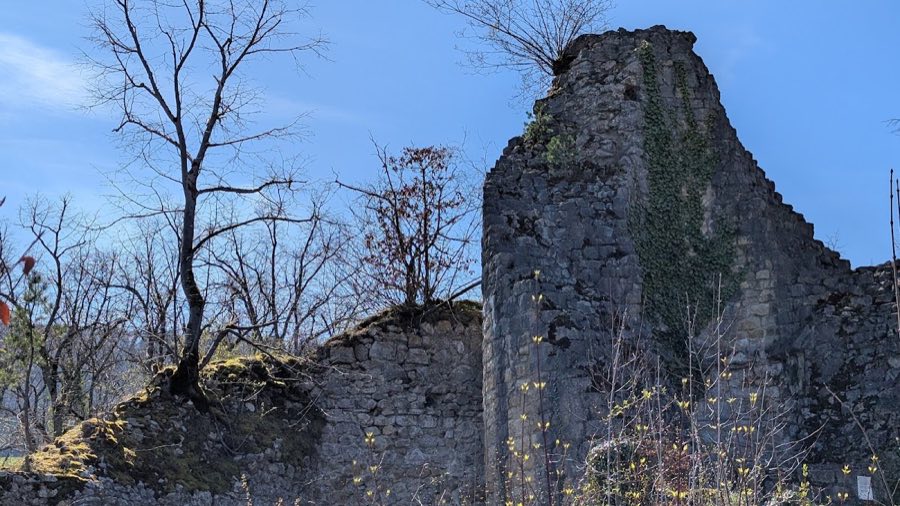
Approximately 10 meters to the northwest lies the “Middle Castle,” which appears to have consisted primarily of a single rectangular residential tower. Measuring roughly 13 by 13 meters externally, with walls about 2.5 meters thick, the interior likely offered an 8-by-8-meter living space. What remains today are only small sections of the walls, probably reduced through early stone removal activities.
Fifteen meters further northwest on a leveled, terraced rock platform stands the “New Castle.” This part of the complex was constructed with thinner walls using roughly shaped stones, suggesting a shift from strong defensive use toward more economic or domestic functions. Its northern entrance was guarded by a zwinger—a fortified outer enclosure—and a ring wall, to which wooden structures were likely attached on the inside. A filter cistern within the New Castle provided a source of clean water, essential for household needs. On the northwest side of the complex, a well-preserved neck ditch, known locally as a Halsgraben, forms a deep defensive trench that also served as a quarry for building stone.
The visible joints and differences in the masonry reveal that the castle was built in several phases, not as a single project, reflecting its long history of modification and use before falling into ruin. Together, these remaining structures offer a tangible glimpse into the medieval estate that once commanded this rocky hilltop.
No. 53257
No. 54324
No. 22990
No. 19619
Comments
Comments for Bärenfels Castle Ruins will require a verified account before posting.
We'll send a verification link before your first comment is published.