
No. 74441
Úsov Castle
Czechia
CastleRestoredFor events13th century
No. 47205
No. 47205 · 49.704 N, 16.890 E
Quick summary
Bouzov Castle is a castle in Czechia with origins associated with the 17th century.
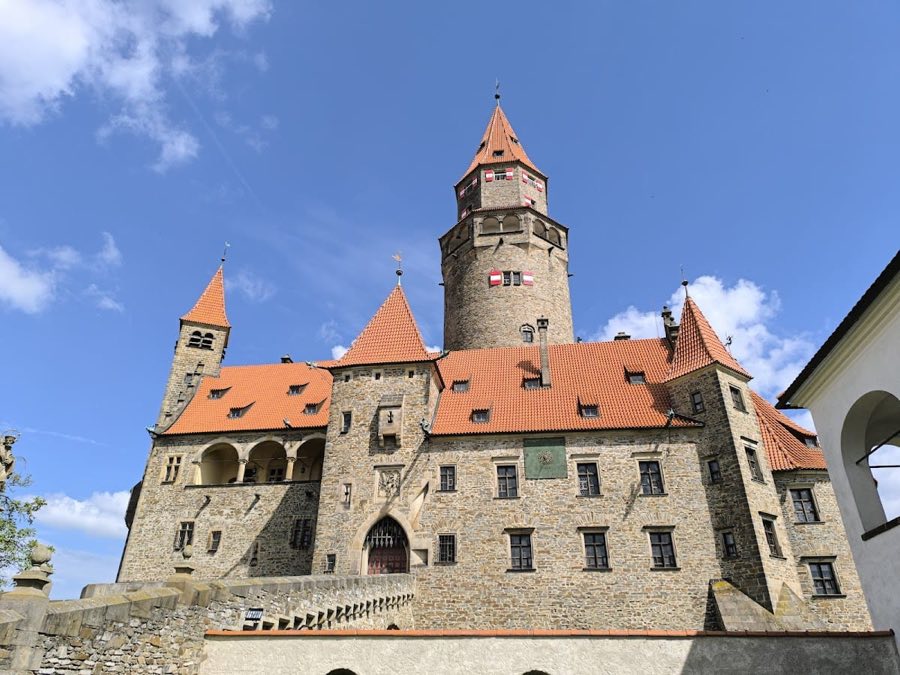
See all castles in CzechiaBouzov Castle stands on a hill above the village of Bouzov, located in what is now the Czech Republic. This medieval fortress was established by the Bohemian nobility around the transition between the 13th and 14th centuries, during a period of castle-building that reflected the growing importance of fortified residences in the region.
The earliest recorded owner of the castle was a minor noble named Búz of Bouzov, who held the estate from 1317 until 1339. The castle takes its name from this family, marking its origins with the local aristocracy of that era. Over the following centuries, Bouzov changed hands among several prominent noble families, including the Lords of Vildenberk and the Lords of Kunštát. Notably, Margrave Jobst of Moravia was also among its proprietors, linking the castle to the wider political landscape of medieval Moravia and Bohemia.
In 1420, George of Poděbrady was born at Bouzov. He would rise to become the King of Bohemia in 1458, cementing the castle’s role not just as a military stronghold but also as a birthplace of significant historical figures. Throughout the Thirty Years’ War in the 17th century, Bouzov served military purposes, including acting as a prison for captured Swedish soldiers.
By the late 17th century, the castle came under the ownership of the Teutonic Order in 1696. The Knights of this Catholic military order did not make Bouzov their residence, which led to a period during which parts of the structure fell into partial decay. After the fall of Austria-Hungary in 1918, the newly founded Czechoslovak state confiscated the property. Despite this, the Teutonic Order managed to reacquire the castle’s inventory to safeguard its historical collections.
During World War II, Nazi SS forces occupied Bouzov, utilizing it as a military base. Following the war, the castle returned to state hands under Czechoslovakia, a status it retains today. Between 1895 and 1910, prior to the war, the castle underwent an extensive Neo-Gothic renovation directed by Archduke Eugen of Austria, then the Grand Master of the Teutonic Order. Architect Georg von Hauberrisser led this transformation, infusing the castle with romantic medieval revival elements that reshaped much of its appearance while preserving its earlier medieval fabric.
Since 1964, Bouzov has been officially recognized as a cultural monument, and in 1999 it received national cultural monument status in the Czech Republic, marking its importance in the heritage of the area.
Bouzov Castle displays a horseshoe-shaped layout atop a hill, centered around an imposing eight-storey watchtower rising 58 meters high. This central tower serves as the focal point of the complex, originally constructed as a bergfried—a tall defensive tower typical in medieval castles used both for observation and refuge during attacks. Alongside the original one-story palace, the castle expanded considerably during the 14th century, incorporating a fortified settlement with additional buildings, defensive ditches, ramparts, and a moat wall featuring a high watchtower reaching 61 meters.
The castle’s fortifications evolved under various owners. The Lords of Kunštát enhanced the defenses by constructing a new rampart linked to two bastions and reconstructing the moat wall to include five rounded bastions and a circular gun bastion, reflecting advancements in military architecture. Repairs also extended to the tallest watchtower during this period to maintain its strategic function.
By the late 15th century, the Haugwitz family contributed a new palace wing on the eastern side. This addition connected previously separate northern and southern residential buildings, creating a larger, unified living space while integrating defensive and residential functions.
The overall fortification comprises numerous towers and bastions, battlement parapets, and oriel windows—small projecting windows common in Gothic architecture used for both defense and decoration. Loopholes, narrow vertical slits in the walls, allowed defenders protected lines of fire over the approaches. Two extended bridges cross a deep, dry moat encircling the complex, with a short drawbridge serving as an additional access point, combining defensive needs with access control.
Inside, the knights’ hall stands out as a significant room designed for gatherings and ceremonies. The armoury preserves original Gothic vaulting, presenting a vaulted ceiling typical of medieval stone architecture. Residential chambers for knights remain part of the interior spaces, evoking the castle’s role as a noble residence. The neo-Gothic chapel houses a Gothic altar and several tombs, blending historical and later stylistic elements.
The castle’s furnishings largely come from Archduke Eugen’s private collection and the Teutonic Order’s archives. Many medieval objects, along with carefully crafted replicas of period furniture, were introduced during the late 19th- and early 20th-century reconstruction to restore the castle’s historic ambiance. Modern improvements such as running water and central heating were installed during this renovation as well, reflecting efforts to adapt the medieval structure to contemporary standards of comfort.
Today, Bouzov Castle remains well preserved, showcasing a harmonious combination of original medieval structures and extensive Neo-Gothic romantic additions, embodying centuries of architectural evolution aligned with the castle’s dynamic history.
No. 74441
No. 54984
No. 52339
No. 51747
Comments
Comments for Bouzov Castle will require a verified account before posting.
We'll send a verification link before your first comment is published.