
No. 64659
Šaunštejn Castle
Czechia
CastleIntact14th century
No. 30559
Castle · Germany
No. 30559 · 50.929 N, 14.289 E
Quick summary
Burg Arnstein is a castle in Germany with origins associated with the 14th century.
See all castles in GermanyBurg Arnstein stands as a hilltop castle in Ottendorf, Germany, and was established by the noble family Berken von der Dubá.
Construction on the site took place in the 14th century and continued into the early 15th century, creating a compact hill castle complex that served as the family stronghold. The place is popularly known as the Ottendorfer Raubschloss, a name that reflects its reputation in later records. The castle enters surviving documents on 4 August 1436, when the Berken von der Dubá pledged the hill castle to Siegmund von Wartenberg of Tetschen.
In 1436 the Electorate of Saxony, acting together with the Upper Lusatian Six-City League, laid siege to the castle in response to raids carried out under Siegmund von Wartenberg. A ceasefire was reached and a formal peace was concluded on 19 October 1436 before Emperor Sigismund in Prague. Roughly six months after that treaty, a follower of Siegmund, the Tetschen citizen known as Rauchfuß or Bauerfeind, attacked six villages including Krippen, Schöna and Reinhardtsdorf, seizing livestock — recorded as 360 cattle, 120 horses and 200 sheep — and taking inhabitants as prisoners to Arnstein.
On 17 August 1437 Saxon princes, joined by Heinrich von der Dubá of Wildenstein, again besieged the castle. The stronghold burned during that siege and Siegmund surrendered. Under the Altenburg peace treaty of 17 April 1438 Siegmund was compelled to sell Arnstein to the Elector of Saxony for 500 Groschen. The Electorate then placed the site in the hands of the Berken von der Dubá on Wildenstein, who carried out only provisional repairs. After the destructions of 1437 and 1438 a much smaller second phase of rebuilding took place, but the site declined following transfer to Saxon control and was finally destroyed in 1451.
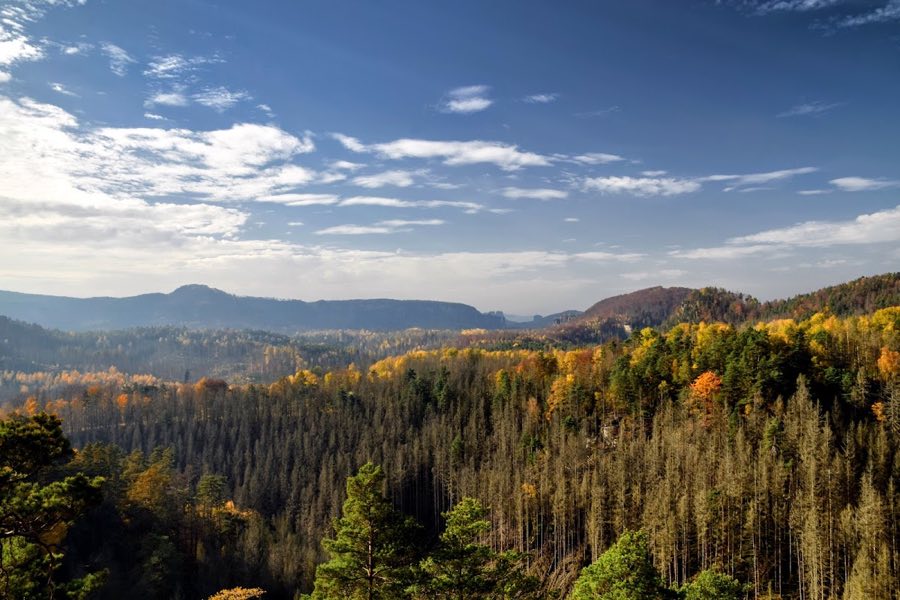
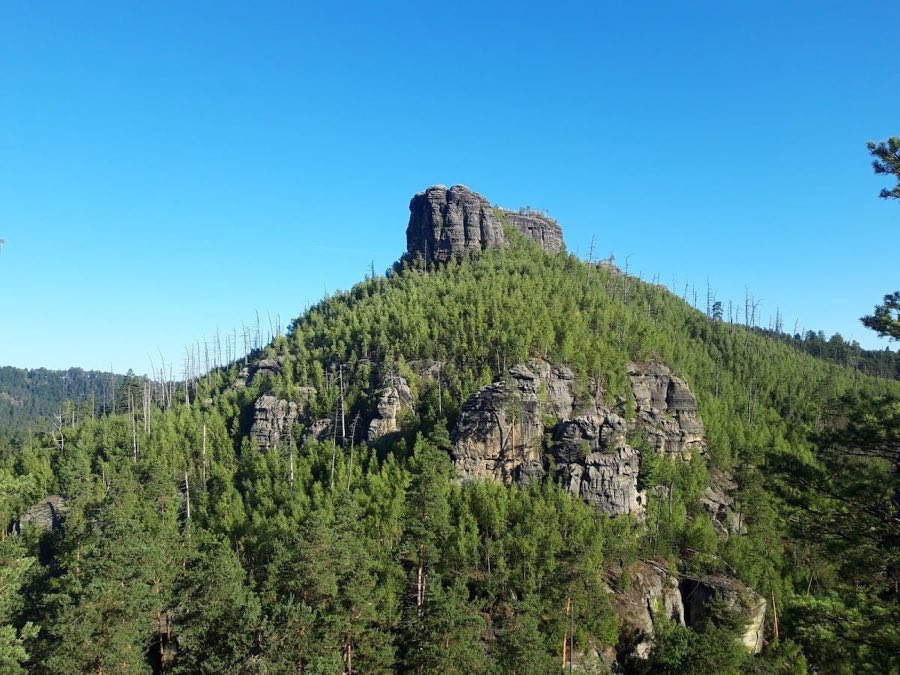
Perched on a rocky hill at 327 metres above sea level where a side valley meets the Kirnitzsch, the castle was a classic rock-built stronghold adapted to the natural outcrop. The initial building phase in the 14th and early 15th centuries produced the core elements of the site: a residential tower, living quarters with a kitchen area, gate structures for the inner castle, and service buildings and defensive works for the outer bailey. These components were integrated with the bedrock, using the rock itself as part of the foundations and support for timber-framed superstructures.
What survives today are primarily structural traces cut into the stone and worked masonry. Beam sockets mark where wooden floors and roofs were once carried; sockets attributed to the former main tower show how a substantial keep would have been fixed to the rock. Stone stairways remain in place, providing evidence of planned internal circulation. A castle dungeon survives within the rock, a carved chamber that served as a holding cell. Rock clamps and other anchorings testify to the way builders fixed masonry and timber to the rock face.
A cistern carved into the bedrock is preserved in situ, attesting to water management for the castle, and a nearby cave bears visible traces of quarrying and rock carvings. That cave appears in the regional cave register as No. 5051/SH-03. After the sieges of 1437 and 1438 the lowest rock terrace of the inner castle was abandoned and access was altered, rerouting entry from the outer bailey directly into the middle inner ward by way of a narrow rock fissure; this modification made the approach to the heart of the site constrained and difficult.
Archaeological intervention in modern times included excavations inside the cistern in 1987 and 1988; these investigations did not produce any hoards or buried treasure. The visible remains are fragmentary but in situ, with the carved features and stone stair segments offering a clear sense of the castle’s original layout and the ways builders exploited the rock. Contemporary routes to the summit follow marked footpaths from nearby valley sites, with the final climb aided by a sequence of steps and ladders that ascend the former castle plateau.
No. 64659
No. 52906
No. 26391
No. 83410
Comments
Comments for Burg Arnstein will require a verified account before posting.
We'll send a verification link before your first comment is published.