No. 26391
Falkenštejn Castle
Czechia
CastleRuin13th century

No. 64659
Castle · Czechia
No. 64659 · 50.869 N, 14.352 E
Quick summary
Šaunštejn Castle is a castle in Czechia with origins associated with the 14th century.
See all castles in CzechiaŠaunštejn Castle is located near the municipality of Jetřichovice in the present-day Czech Republic. It was established by medieval Bohemian nobility as a defensive stronghold.
The castle was founded at the end of the 14th century, likely by the Berken family from Dubá. Its primary purpose was to guard the Old Bohemian Road, a crucial trade route connecting Bohemia to Lusatia, which made it strategically important for controlling commerce and movement through the region. The first written references to Šaunštejn appear between 1413 and 1446, with notable mentions during the years 1431 and 1444 that describe military activity surrounding the castle.
In the early 15th century, ownership passed to the Vartenberk family, who used the castle as a base for raiding neighboring territories. This aggressive posture threatened the interests of the Lusatian Six-City League and Saxon lands nearby. In response, the city of Dresden undertook reconnaissance missions against Šaunštejn in 1431 to monitor its military presence.
Throughout the 15th century, Šaunštejn endured several sieges. The most significant among these was in 1444 when a large Lusatian force of approximately 9,000 soldiers equipped with firearms attacked the castle. Despite withstanding intense bombardments, Šaunštejn ultimately fell in September 1444. Following the end of regional conflicts and the restoration of stability, the castle’s strategic importance waned. By the late 15th century, it had fallen into disuse, with the last recorded mention occurring in 1490. The site was completely destroyed by the early 16th century.
Efforts to preserve the remnants of Šaunštejn began in the 20th century, leading to its designation as a protected cultural monument in 1966. Archaeological work has since clarified its origins and historical roles in the border region.
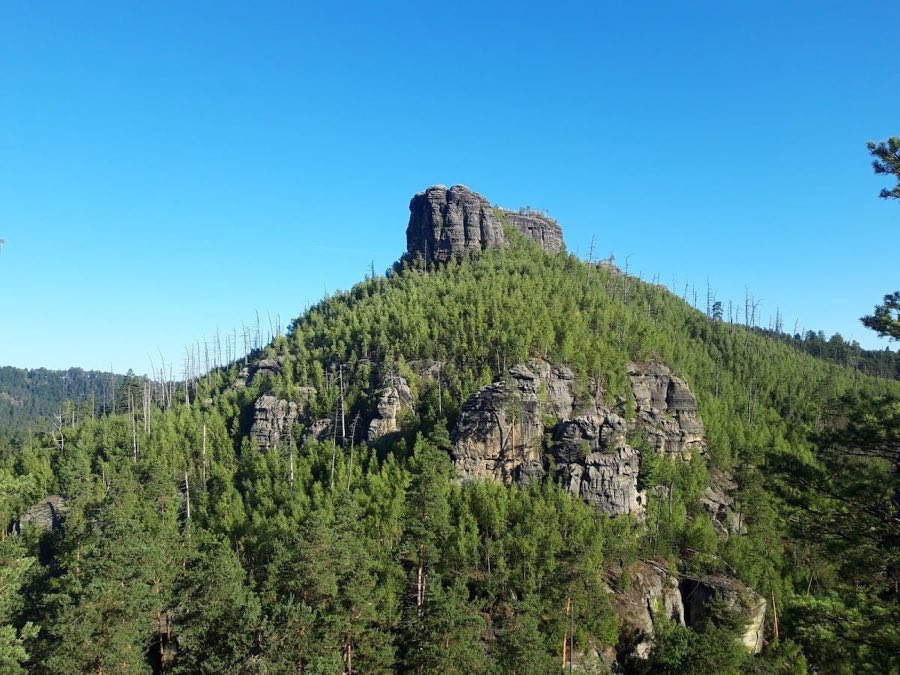
Šaunštejn was a rock castle built atop a sandstone outcrop reaching about 340 meters above sea level, situated roughly one kilometer north of the village of Vysoká Lípa within the Bohemian Switzerland National Park. The castle’s structures were wedged into the natural rock formations, combining carved stone rooms and wooden buildings set upon ledges and beams anchored into holes chiseled directly into the sandstone.
Access to the castle’s main rock core was through an entrance about four meters above ground level, originally reached by a wooden square tower. From this elevated entry point, stone-cut stairs led upward but were reachable only by ladders that defenders could pull up during attacks to block enemy advance. This design underscores the castle’s defensive strategy of controlling access vertically.
At the summit plateau, a small chamber carved into the rock likely served as a living space or possibly a place of worship, functioning as a chapel. Nearby is the base of a residential tower, along with numerous grooves cut into the sandstone that once supported wooden structural elements of the castle’s buildings. Essential water storage was provided by a prominent circular cistern carved into the rock, with a constricted neck designed to gather and hold rainwater.
Below the main rock formation, a forecourt area contained operational buildings essential for daily functions and defense. Although the wooden superstructures have not survived, the foundations and rock-hewn rooms remain clearly visible.
Additional carvings found at the site include incised crosses, human faces, and an image of a deer accompanied by a crucifix, suggesting symbolic or religious significance attached to parts of the castle. The presence of these motifs adds a cultural layer to the site’s history beyond its military role.
Due to ongoing erosion and wear caused by natural forces and visitor access, the castle’s approach routes and summit area underwent thorough renovation in 2021–2022. This included replacing ladders and railings and installing walkways to reduce further damage to the sandstone. During this process, the southwestern summit group and associated viewpoint were permanently removed to preserve the remaining rock features.
Šaunštejn is accessible only on foot via marked hiking trails, preserving the site’s historical environment and the integrity of its natural surroundings.
No. 26391
No. 30559
No. 52906
No. 89899
Comments
Comments for Šaunštejn Castle will require a verified account before posting.
We'll send a verification link before your first comment is published.