No. 54847
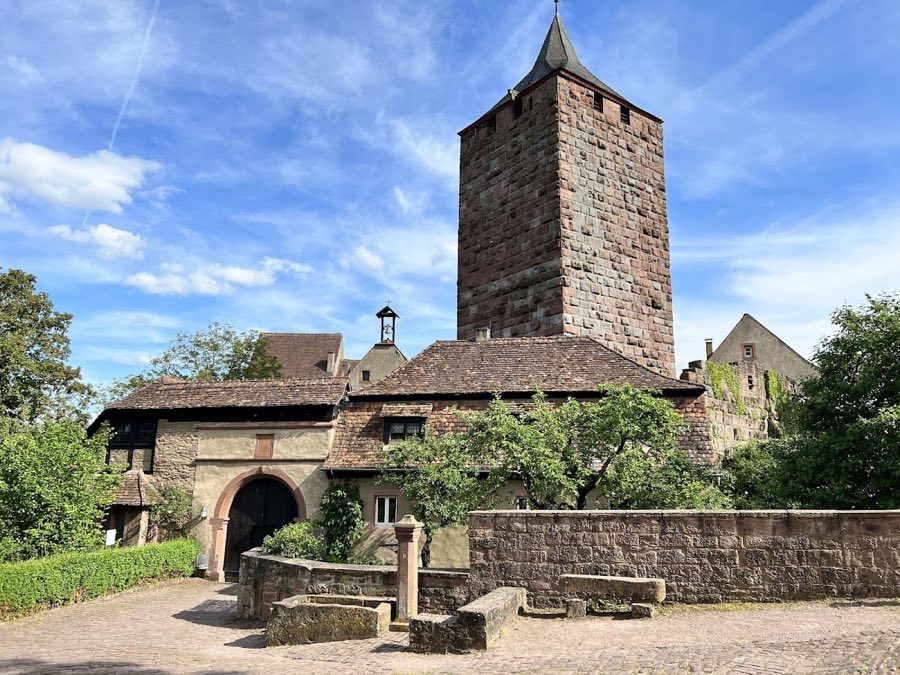
Burg Rothenfels
Germany
CastleRestoredFor events12th century

No. 15269
Castle · Germany
No. 15269 · 50.028 N, 9.796 E
Quick summary
Burg (Homburg, Gössenheim) is a castle in Gössenheim), Germany with origins associated with the 11th century.
See all castles in GermanyBurg, located in Homburg, Gössenheim, Germany, was erected by the Lords of Homburg who served the Bishopric of Würzburg.
The site first appears in a surviving record from 1170, which names a castellan, Dietrich von Hohenberg. A later tradition credits a foundation between 1028 and 1031 to Reinhard von Hohenberg of Burg Adolphsbühl, son of Arnold von Hohenstein, but that founding story cannot be proven and is considered a later invention; inscription stones once cited in support of the early date are no longer present.
The castle occupied a frontier position among the Bishopric of Würzburg, the Counts of Rieneck, the Counts of Henneberg and the Imperial Abbey of Fulda. A scion of the family, Dietrich von Homburg, served as Bishop of Würzburg from 1223 to 1225, showing the family’s close ties to the church administration.
The male line of the Hohenberg family ended in 1381 with Dietrich. His daughter Christine and her husband, Konrad IV von Bickenbach, inherited the Hohenberg estates and thereby brought the castle into the Bickenbach family, whose principal seat was Clingenburg. In 1469 the Bickenbachs sold these former Hohenberg holdings to the Bishopric of Würzburg, represented at the time by Prince-Bishop Rudolf II von Scherenberg, Duke of Franconia. In 1492 Burg became the administrative seat for the district called Homburg an der Werren and an official known as an Amtmann was posted there.
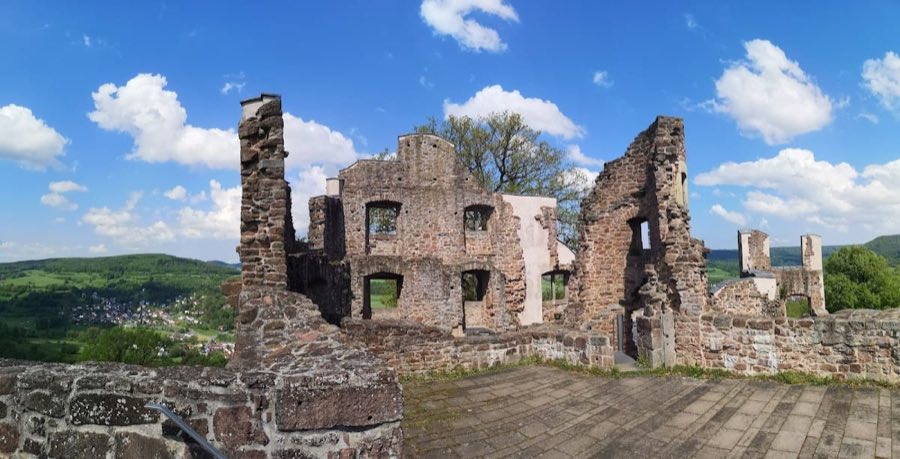
The castle was not harmed during the Peasants’ War of 1525. A fire in the manor house in 1680 began a long period of decline for the buildings. The site remains a ruin, and in October 2021 the standing remains were used as a location for a music video by the medieval-rock band Feuerschwanz.
Perched on a hilltop at about 300 metres above sea level, the complex is the ruin of a hill castle and ranks among the larger castle ruins in Franconia. The surviving plan shows a core stronghold with an outer bailey combined with a Zwinger, an enclosed outer courtyard formed between concentric defensive walls, indicating a layered defensive arrangement.
The Zwinger belongs to the Early Gothic period, dated to around 1235, and the area around it was enlarged from about 1470, reflecting later defensive improvements. These phases mark the site’s use as a fortified residence and defensive position over several centuries. Today the Zwinger area survives as part of the ruinous perimeter.
A manor house is recorded within the complex and was standing until a fire in 1680. That conflagration began the slow decay of the domestic buildings; the manor’s remains now lie in ruinous condition. Among the surviving carved stonework is a heraldic panel bearing the coat of arms of the Lords of Grumbach, preserved in situ as an imprint of later occupants or alliances. Inscription stones that had been cited in support of an earlier foundation are no longer present. The overall preservation state of Burg is fragmentary, with the layout and a number of structural elements still visible in their ruined form.
No. 54847
No. 86641
No. 60112
No. 73790
Comments
Comments for Burg (Homburg, Gössenheim) will require a verified account before posting.
We'll send a verification link before your first comment is published.