No. 50577
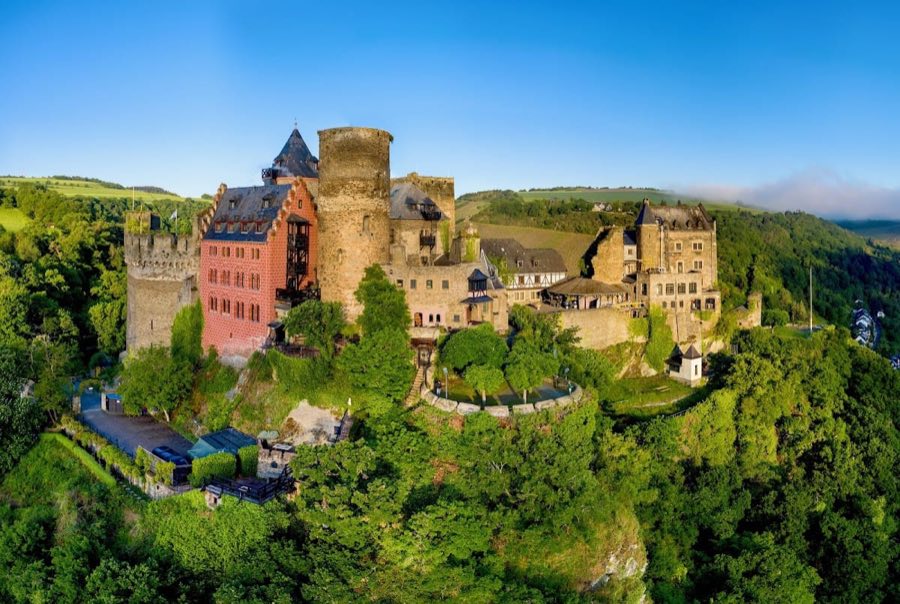
Schönburg Castle
Germany
CastleRuinFor rent12th century
No. 14297
Castle · Germany
No. 14297 · 50.086 N, 7.870 E
Quick summary
Burg Rheinberg is a castle in Germany with origins associated with the 5th century.
See all castles in GermanyBurg Rheinberg in Lorch, Germany, was originally established by the Archbishopric of Mainz.
A first defensive enclosure was probably raised around 1165 by the sitting archbishop, and in 1170 the site was granted as a fief to the Rheingraf family under Mainz authority. From roughly 1250 and into the early 1300s the ministerial von Heppenheft family, relatives of the Rheingraf household, acted as the castle’s appointed officials and guardians.
Conflict overtook the hill in 1279 when Archbishop Werner von Eppstein entered a feud with Rheingraf Siegfried von Rheinberg. Forces loyal to Mainz constructed two supplementary fortifications to the north and west, the Trutzburg Blideneck on higher ground about 500 metres away and the Aachener Schanze near the confluence of the Herrnsbach and the Wisper at about 330 metres elevation, from which Burg Rheinberg was subjected to artillery fire. Attackers took the castle in 1280 and the stronghold was largely ruined in that action.
The site was rebuilt in 1315, a campaign that included the construction of the present bergfried. In 1399 the castle passed into the hands of the Electoral Palatinate as a fief, and from about that time the complex was adapted into a jointly held residence occupied by several families. Over the following centuries Burg Rheinberg declined in military significance, fell into neglect and was finally uninhabited from the end of the eighteenth century, after which it deteriorated further.
Perched on a rocky spur above the Wisper valley at about 250 metres elevation, the ruins occupy a long, narrow platform separated from neighbouring ridges by the small valleys of two tributaries. The overall enclosure extends roughly sixty metres along the ridge and measures about twenty metres across. Surviving structural traces show the plan of a compact hill castle arranged along the rock outcrop.
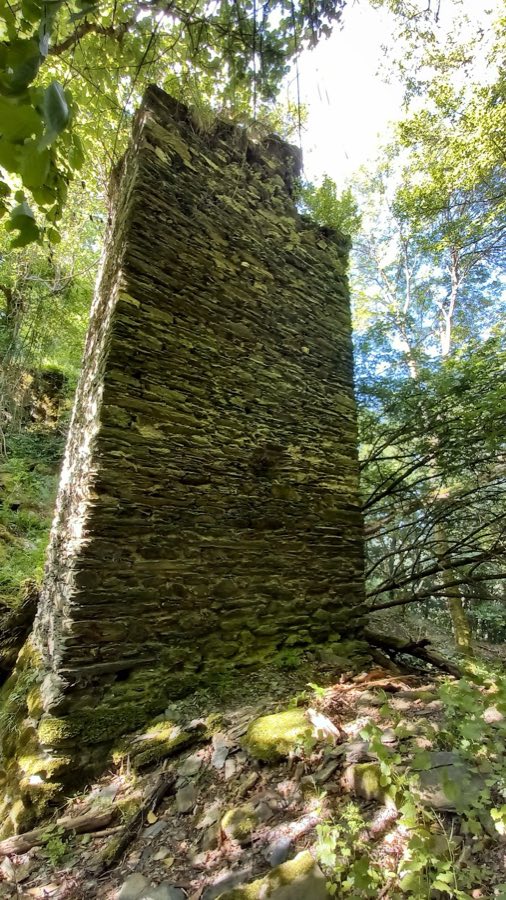
The bergfried stands on the southern edge of the site, set directly on a rock plinth. This tower dates to the rebuilding of 1315 and retains three internal levels, rising to a height of about thirteen metres. Remnants of the surrounding defensive wall remain in places and outline the former circuit of fortification.
Approach to the castle is from the north along a neck ditch that once separated the spur from the ridge, followed by passage through the main gate into the outer bailey. A path from that outer ward leads down into the inner courtyard, where the remains of the castle well lie somewhat lower than the outer area. These elements reflect the original sequence of access and the internal circulation of the stronghold.
On the eastern side a later-built battery tower strengthened the flank; this feature is now at risk of collapse. Traces of the residential ranges survive only as fragmentary walls and foundations and are difficult to interpret on the ground. The ruin sits within high forest, is prone to collapse and regarded as dangerous to enter, and is privately owned with access prohibited and no securing or preservation measures being undertaken.
No. 50577
No. 84796
No. 68035
No. 50597
Comments
Comments for Burg Rheinberg will require a verified account before posting.
We'll send a verification link before your first comment is published.