No. 14297
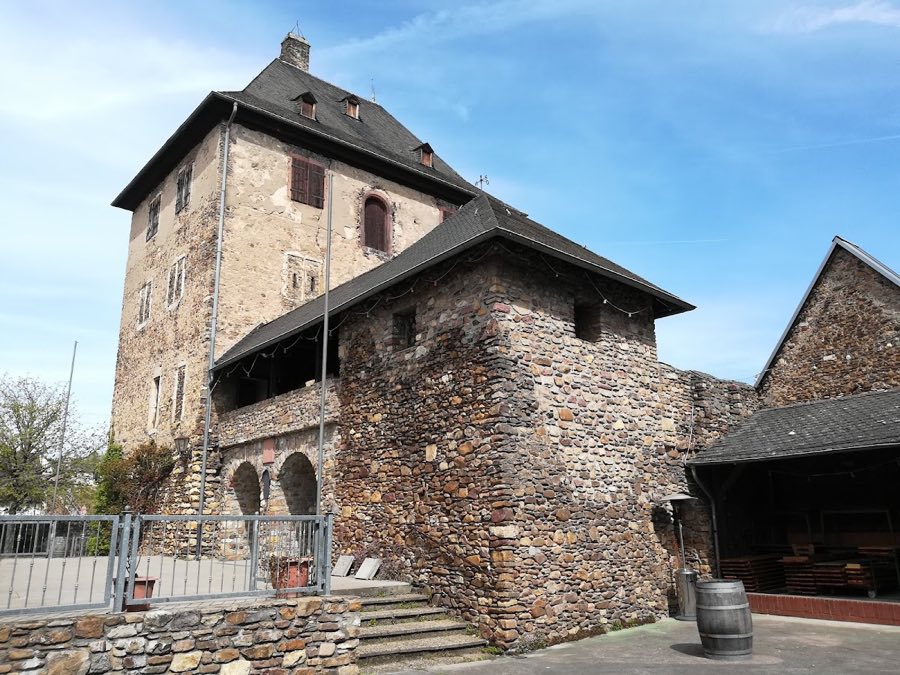
Burg Rheinberg
Germany
CastleRuin5th century
No. 50577
Castle · Germany
No. 50577 · 50.101 N, 7.733 E
For rent
Schönburg Castle is marked for bookable castle accommodation. Nightly pricing, sleeps count, stay rules, and amenities are displayed only when public operator data is available.
Rental type: Hotel / bookable stay, Short-stay rental
Short-term availability: Bookable accommodation signal
Quick summary
Schönburg Castle is a castle in Germany with origins associated with the 12th century.
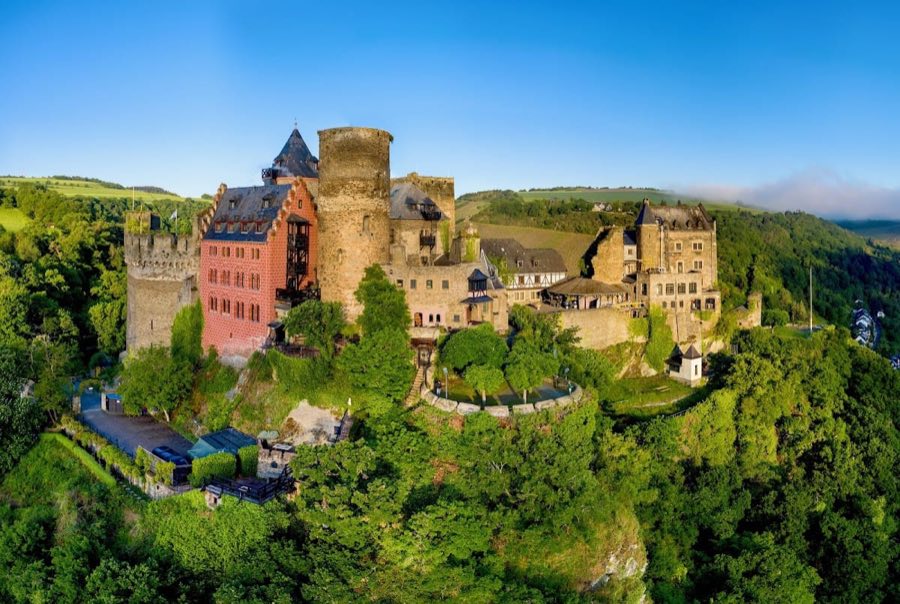
See all castles in GermanySchönburg Castle stands above the town of Oberwesel in the Upper Middle Rhine Valley, located in the modern German state of Rhineland-Palatinate. It was built in the first half of the 12th century, though its exact founder remains uncertain. Some sources suggest the Archbishop of Magdeburg may have commissioned it, while others propose it was established as an imperial castle.
The earliest recorded mention of Schönburg dates to 1149, when it was held as a fief by Hermann von Stahleck. Hermann is historically noted for murdering his rival Otto II of Rheineck at the castle. By the 14th century, the Electorate of Trier had gained control over the site. Throughout this period, the Lords of Schönburg, a ministerial family, managed the castle under various overlords, including the archbishop of Magdeburg, the emperor, and the archbishop of Trier.
By the mid-13th century, the Schönburg family had divided into several branches, each residing simultaneously within the castle due to joint inheritance, a practice known as Ganerbschaft. This arrangement led to Schönburg becoming a Ganerbenburg, or a castle shared by multiple co-owners. A 1340 record lists 95 co-owners, though not all lived on the premises. The castle was divided into three separate residential areas, each with its own defensive tower, or bergfried.
In the first half of the 14th century, the castle’s defenses were significantly enhanced with the construction of the “Hoher Mantel,” a massive shield wall. This fortification, likely built under the direction of Balduin of Trier, protected the castle’s most vulnerable side and featured a distinctive rounded arch frieze.
Schönburg’s medieval prominence ended in 1689 when French troops destroyed it during the War of the Grand Alliance, also known as the Pfälzischer Erbfolgekrieg. After the last Schönburg heir died in 1719, the ruined castle reverted to the Electorate of Trier.
The castle remained in ruins for nearly two centuries until the late 19th century. Between 1885 and 1901, T. J. Oakley Rhinelander, a German-American whose family had emigrated from the Rhineland in the late 18th century, undertook partial restoration efforts. In 1950, the town of Oberwesel reacquired the site. Subsequent rebuilding transformed the northern part into a youth hostel and the southern section into a hotel.
Historically, the Lords of Schönburg also governed Oberwesel and controlled customs rights along the Rhine River. One notable family member, Friedrich von Schönburg, known as “Marshall Schomberg,” was a prominent 17th-century military leader who served several European powers.
Schönburg Castle is situated on a steep hill composed of slate rock, overlooking Oberwesel and the Rhine Valley. The castle’s layout reflects its history as a Ganerbenburg, with three distinct residential complexes, each centered around its own bergfried, or defensive tower.
The most prominent defensive feature is the “Hoher Mantel,” a large shield wall constructed in the 14th century. This wall bends three times at obtuse angles, protecting the castle’s most exposed side. It includes two rows of blind arcades—decorative arches without openings—and arrow slits for defense. The courtyard is accessed along this shield wall.
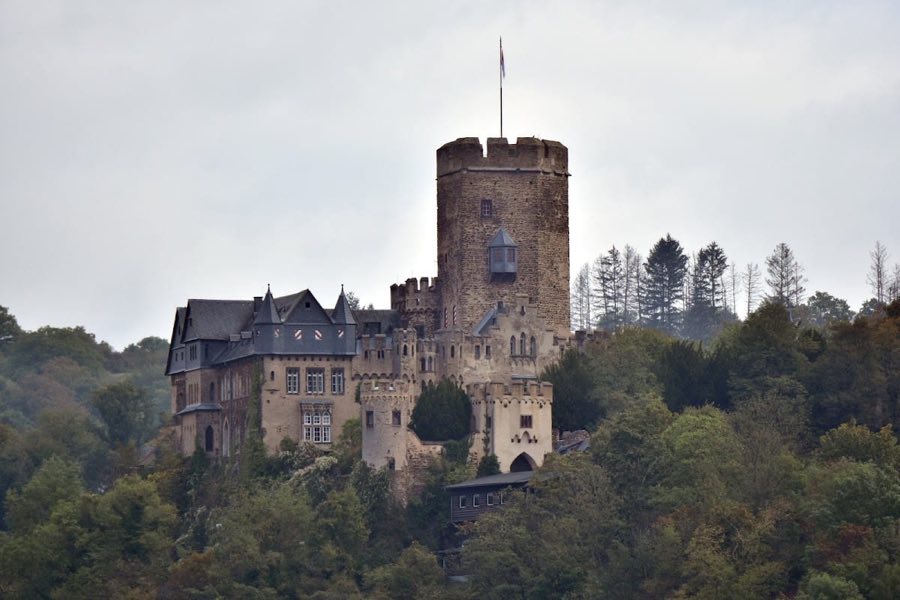
The southern residential area, known as the southern palas, was converted into a hotel. This section features Gothic-style window openings and red plaster with painted joints, reflecting historical designs. It includes a half-timbered building and one of the bergfriede called the Barbarossa Tower, named after Emperor Frederick Barbarossa, who visited the castle multiple times. The hotel interiors contain tapestries and antiques but are accessible only to guests. A public restaurant with an outdoor terrace offers views upriver toward Kaub and Burg Gutenfels.
The northern residential complex is entered through a large, square gate tower standing 25 meters high. This tower contains its own bergfried and houses a youth hostel operated by the Kolping organization. The palas here consists of two wings rebuilt in 1953, with further expansions and renovations through the late 20th century. The castle chapel was restored in Gothic style in 1983.
The third bergfried was not reconstructed. The castle’s walls and structures are built from masonry, with the hill itself formed of slate rock. Several half-timbered ancillary buildings remain on the site. The castle’s elevated position provides commanding views of the Rhine Valley, with two designated viewpoints nearby offering perspectives on Oberwesel and surrounding castles.
No. 14297
No. 84796
No. 49551
No. 68035
Comments
Comments for Schönburg Castle will require a verified account before posting.
We'll send a verification link before your first comment is published.