No. 13699
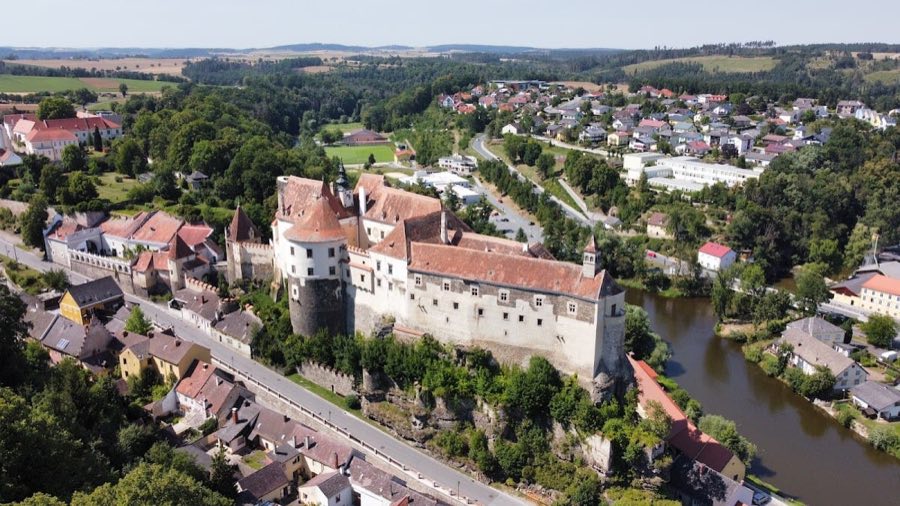
Burg Raabs an der Thaya
Austria
CastleRestored12th century
No. 96858
Castle · Austria
No. 96858 · 48.822 N, 15.533 E
Quick summary
Burgruine Kollmitz is a castle in Austria with origins associated with the 14th century.
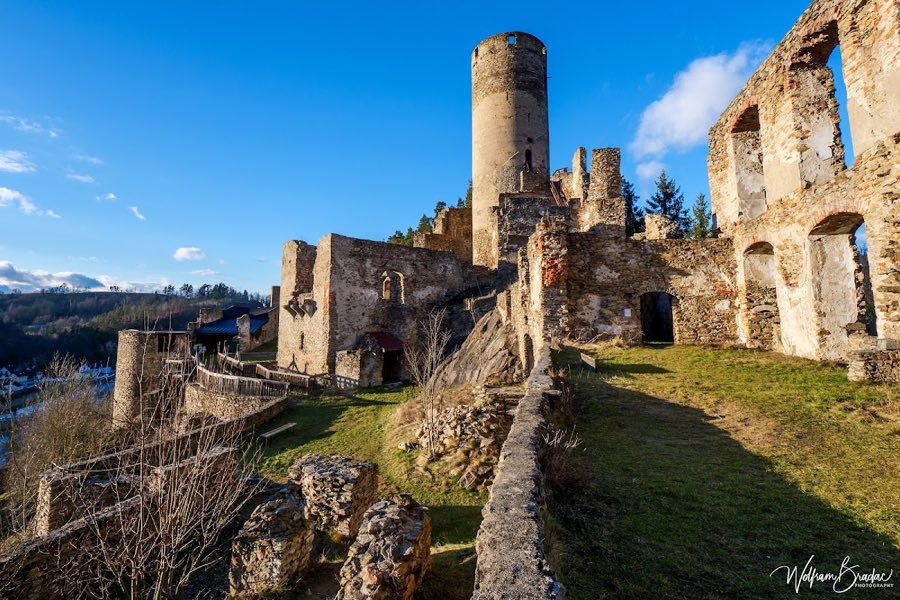
See all castles in AustriaBurgruine Kollmitz stands above the Thaya river in the municipality of Raabs an der Thaya, Austria, and was built by medieval feudal lords of the region.
A fortified site at Kollmitz appears in documents from the thirteenth century. The main tower’s timber was dated by tree-ring analysis to completion in 1319, showing substantial construction early in the fourteenth century. In that century the castle served an administrative role as the seat of a district court, with the district gallows located at Ludweis.
Ownership shifted among several noble families in the later medieval period, including the Wallseer, Winkel, Kratzer and Thyrna families, until 1411. From that year the barons of Hofkirchen held the site and made the castle their residence. In about 1450 a defensive earthwork known locally as the Bohemian Wall was built roughly 300 metres in front of the main stronghold, constructed against Georg of Podiebrad.
From around 1570 the nearby manor at Drösiedl was rebuilt in the Renaissance style, and Kollmitz remained closely linked with Drösiedl for roughly three centuries. Wolfgang von Hofkirchen is recorded as the last of his line at Kollmitz; the Habsburg authorities regarded him as a leader among Protestant nobles during the Counter-Reformation. He died in exile in Prague, with reported years of death given as either 1611 or 1616.
After Hofkirchen control ended the castle passed through new hands. In 1616 ownership is recorded under the Schütter family, followed by the Schubhardt family, and then Pernegg Abbey from 1693. In 1708 Franz Anton von Quarient und Raal, lord of Raabs, acquired the property. Under his ownership the buildings were allowed to fall into disuse and decay, and parts of the complex were later quarried for building stone. A local legend blames abandonment on a roof tax. In the modern period a preservation association founded in 1974 has taken responsibility for the ruin.
The castle occupies a rocky spur with the Thaya wrapping around it on three sides, giving the complex a naturally defended position. Massive stone curtain walls survive, built with large, roughly fitted blocks that present the appearance of very heavy masonry. Two rounded corner towers remain as part of these walls and mark the scale of the original enclosure, which once ranked among the larger medieval strongholds in this part of Austria.
A main tower, the bergfried or donjon, survives and its completion is dendrochronologically dated to 1319. The tower was built of dressed stone and served as the primary defensive strongpoint and last refuge. Nearby stands a semicircular gate tower that retains a pointed-arch gateway, indicating a controlled entrance approach, and the so-called Hunger Tower, a named rear defensive tower that remains as a fragmentary vertical structure.
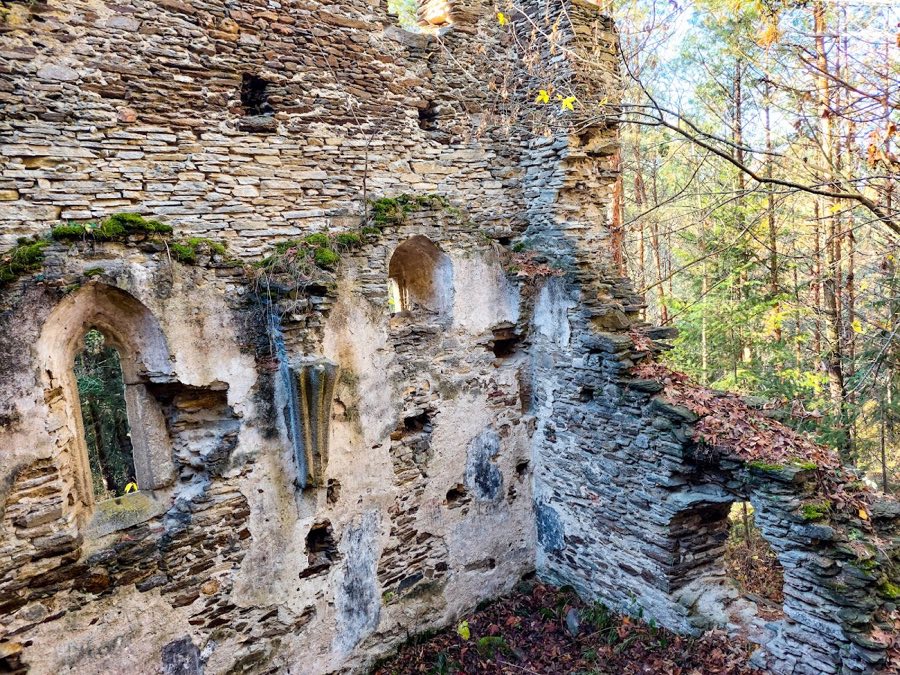
There are traces of a two-storey residential building and fragments of other domestic and service buildings within the ruin, built of the same stone as the defensive walls and now preserved as partial walls and foundations. In the northwest, a linear earth-and-stone work known as the Bohemian Wall runs for roughly 110 metres; it dates to around 1450 and was constructed as an outlying defensive line facing the direction of Georg of Podiebrad.
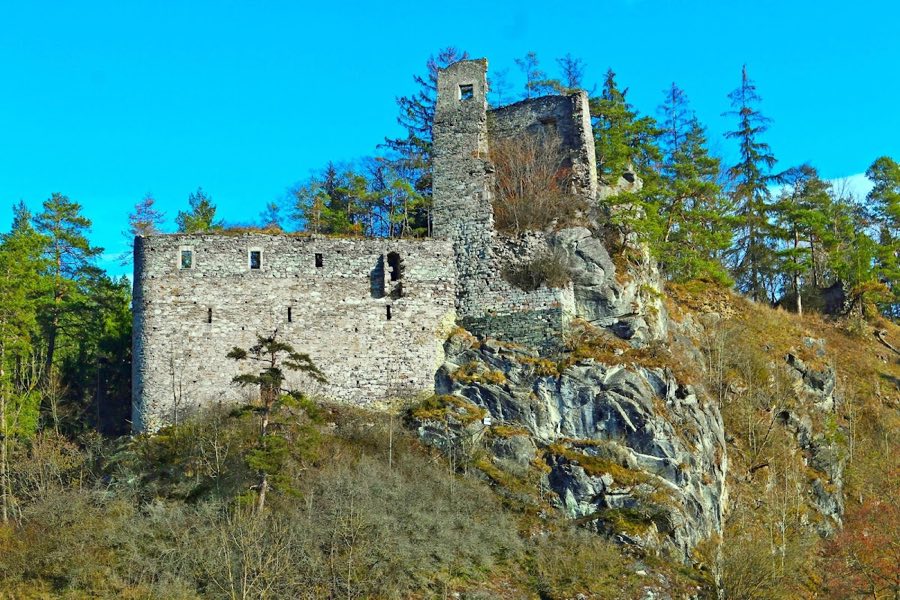
About 400 metres to the west across the valley lies an earlier fortified site, probably called Hauenstein, which was occupied for approximately 150 years before the present castle was established and subsequently abandoned. The ruined complex at Kollmitz today presents surviving masonry and tower elements, with sections that were later robbed for building stone. A seasonal snack station operates on the ruin in summer under the care of the preservation association.
No. 13699
No. 64535
No. 80080
No. 28179
Comments
Comments for Burgruine Kollmitz will require a verified account before posting.
We'll send a verification link before your first comment is published.