No. 45217
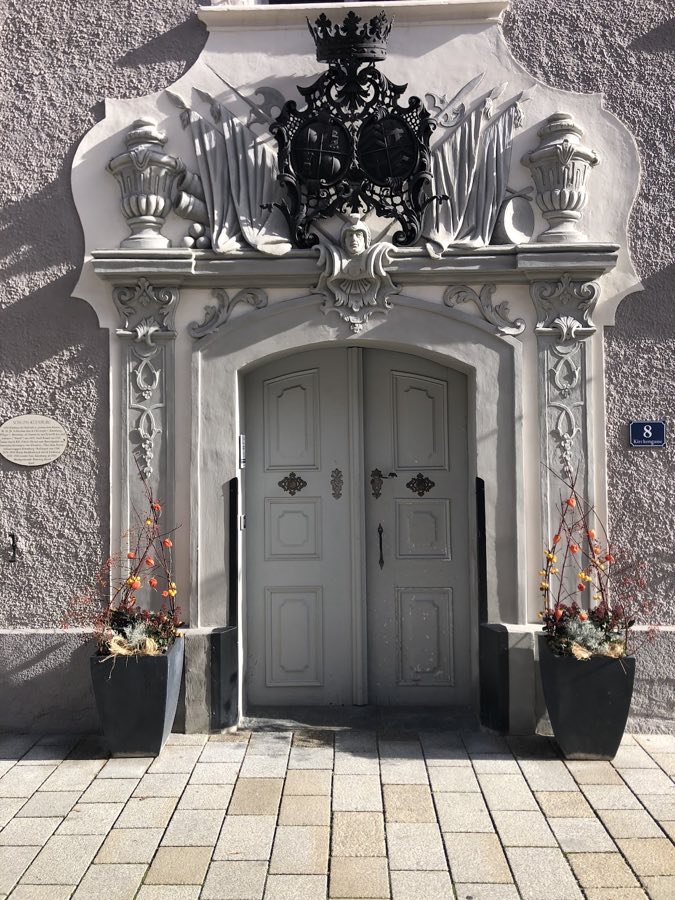
Schloss Kuenburg
Austria
PalaceIntact18th century
No. 22590
Castle · Austria
No. 22590 · 47.164 N, 13.803 E
Quick summary
Burgruine Thurnschall is a castle in Austria with origins associated with the 11th century.
See all castles in AustriaBurgruine Thurnschall stands in the municipality of Lessach, Austria, and was erected by medieval feudal authorities.
The Lessach valley first appears in documents from 1074 when tithes were recorded for the foundation of Admont Abbey. The castle itself is first named as Castrum Lessach at the start of the 1200s, when it belonged to Count Wilhelm of Heunberg. Excavated animal bones indicate active settlement of the fortification around 1200–1250.
In 1239 Count Wilhelm, with the approval of Duke Bernhard of Carinthia, handed over Thurnschall to Count Herrmann of Ortenburg. Three years later, in 1242, Herrmann sold the Lessach area together with the castle to Archbishop Eberhard II of Salzburg. After the transfer into Salzburg’s domain the fortress no longer served its earlier role guarding against incursions from Schladming, and it was allowed to decline.
Local officers associated with the site are named in documents: Pilgrim and Ortlieb in 1239, Waltherus in 1266, and Otto of Lessach in 1272; a Wolfgang of Lessach appears in records around 1400. In later centuries the ruin saw intermittent interventions. Initial stabilization began in 1914 but was suspended by the outbreak of World War I. Work to consolidate wall bases took place in 1975. In 1997 two historic objects were recovered, a knife blade and a support fork for heavy firearms dating to use from the mid-1500s. Archaeological excavation in 2002 revealed very thick stone walling. Today the ruin is owned by the Austrian Federal Forests and has been developed for visitor access. The site is linked in local tradition to the Thurnschallweibl, a figure said to guard treasure stored in the castle’s cellar.
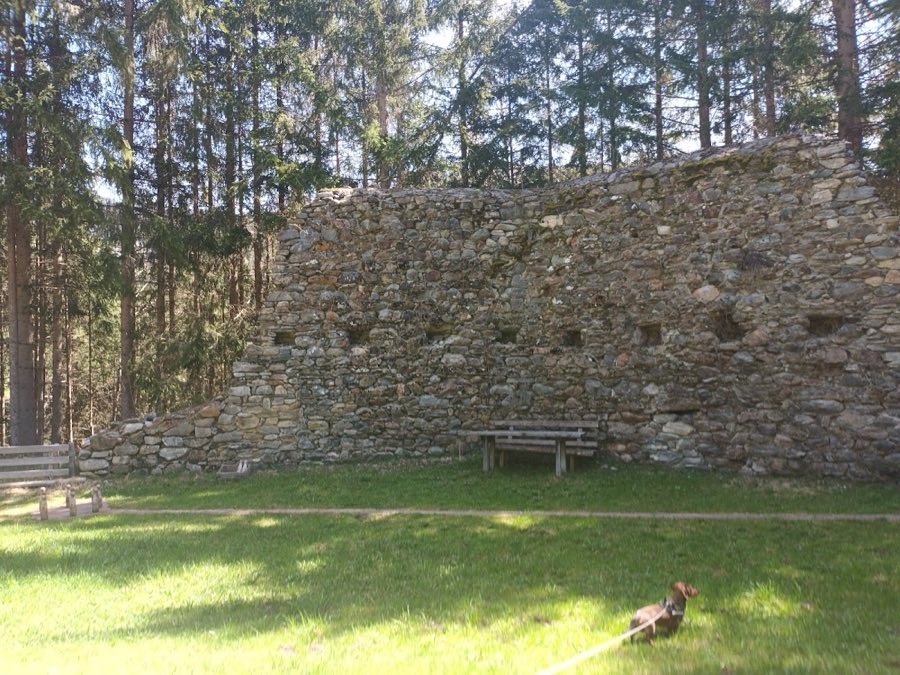
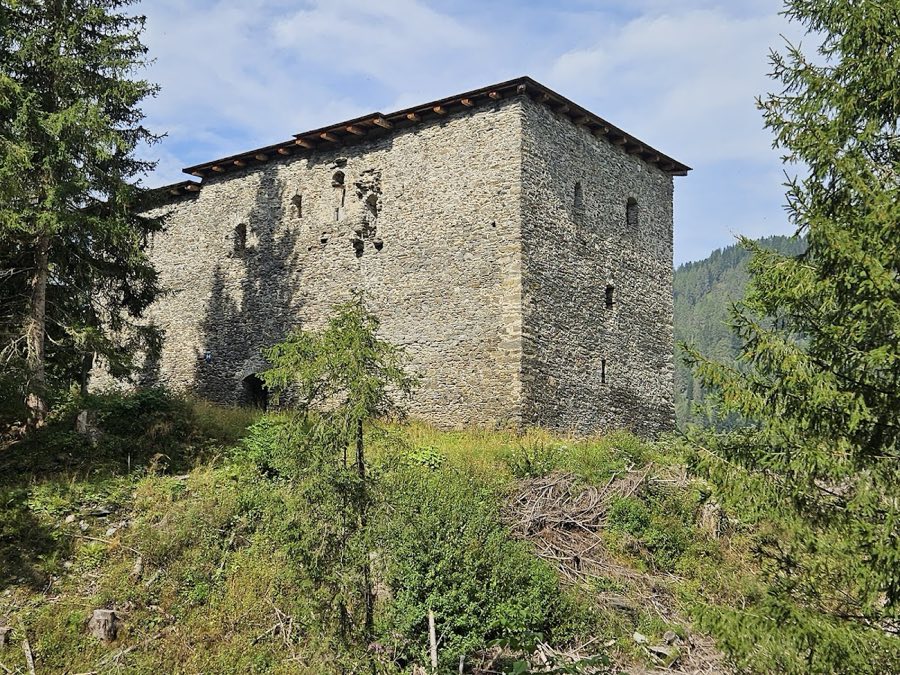
The ruin occupies a rocky hilltop in woodland on the west flank of the Lessach valley, reached from the valley road by a bridge and the old uphill path. The surviving fabric shows a compact plan with massive stone construction. Excavation revealed walling of exceptional thickness, exposed down to foundations, indicating substantial defensive masonry from the medieval period. Work in 2002 brought these broad sections of stone to light.
On the western side a polygonal tower rises to about eight metres where masonry survives above the slope. From this tower the remains of the enclosing wall run off at pointed angles, forming the defensive circuit. A long wall face above the steep decline to the Lessach stream stretches roughly eighteen metres and stands to about seven metres in height. Its stonework is built in coarse, layered courses that give a robust, roughly horizontal appearance.
Within the standing walls a circular open area lies at the plan’s center, framed by surviving masonry. At approximately three metres above the ground level in one wall a row of socket holes marks where timbers once supported an intermediate floor, evidence for multi-storey internal arrangements. On the west side of the circular space there was, until recently beneath a larger wall segment, an open breach leading down into an underground chamber; that gap connected the surface area to a subterranean room.
Archaeological fieldwork and rescue conservation have altered parts of the ruin. Early 20th-century stabilisation was interrupted, and later masonry-base consolidation was carried out to secure standing walls. Finds recovered from the site include a knife blade and a heavy firearm support fork, the latter reflecting activity or reuse at the site from the mid-1500s. A measured plan of the castle layout has been recorded, showing the tower, enclosing walls, and internal circular place as they remain today.
No. 45217
No. 28664
No. 84909
No. 83334
Comments
Comments for Burgruine Thurnschall will require a verified account before posting.
We'll send a verification link before your first comment is published.