
No. 32280
Saint-Lizier
France
PalaceRestored15th century
No. 64981
Castle · Spain
No. 64981 · 42.632 N, 1.116 E
Quick summary
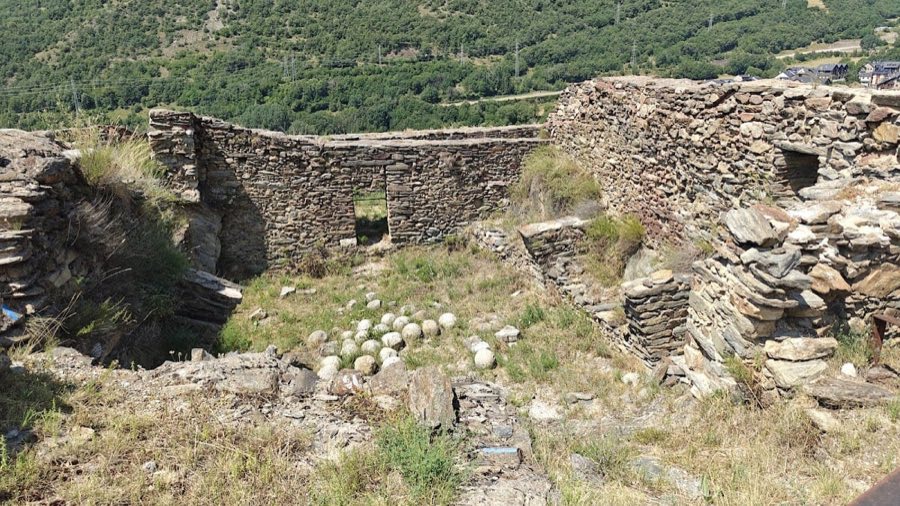
Castell de València d'Àneu is a castle in Spain with origins associated with the 18th century.
See all castles in SpainCastell de València d’Àneu is a medieval fortress located in the municipality of Alt Àneu, in modern-day Spain. It was constructed by the Catalan counts who ruled the region of Pallars during the Middle Ages, with its origins dating approximately to the 11th or 12th centuries. The castle stood prominently on a hill overseeing the Esterri d’Àneu valley, placed strategically between two rivers, the Noguera Pallaresa and Bonaigua.
The fortress was likely built under the authority of Count Sunyer I of Pallars and served as a summer residence for successive generations of the Pallars County’s ruling family, including its last count, Hug Roger III. Throughout the medieval period, the castle played an important role in controlling access to the Vall d’Aran, a crucial route in the Pyrenees. Its position made it a center for both defense and administration within this remote mountainous region.
In 1487, the castle came under siege by the forces of the Count of Cardona, acting on behalf of King Ferdinand the Catholic. At that time, Count Hug Roger III was away recruiting troops in France, and command of the fortress fell to his wife, Caterina Albert. Despite the siege, she maintained the defense until surrendering in July of that year. Contrary to later stories, historical records confirm that the castle was not destroyed by fire during this conflict.
The fortress continued to hold strategic significance through the early modern period. It witnessed military activity during several major conflicts, including the War of the Spanish Succession in the early 18th century, the War of the Reapers in the 17th century, various Carlist Wars in the 19th century, and even the Spanish Civil War in the 20th century. After the War of the Spanish Succession, King Philip V ordered the dismantling of many Catalan castles to reduce regional resistance, contributing to the castle’s decline.
During the Spanish Civil War, Nationalist forces fortified the site, installing anti-aircraft weaponry and defensive trenches to take advantage of its commanding location. Over time, the castle fell into ruin mainly because local residents gradually abandoned it, moving closer to the nearby church of Sant Andreu. Stones from the fortress were repurposed for building homes in the growing village, accelerating its physical deterioration.
Castell de València d’Àneu was designed as a fortified complex featuring two main areas enclosed by defensive walls. The upper section of the castle, often called the “recinte sobirà” or sovereign enclosure, formed the core fortress. It was protected by a deep moat on two sides and surrounded by an additional defensive wall on the other sides, creating a strong defensive perimeter. Within this space stood the keep, or tower of homage, which functioned as the last stronghold and residence of the lords.
This upper enclosure included key domestic and military structures, such as the lords’ kitchen and dining area, an armory for weapons storage, and dormitories for servants. Of particular interest was a specialized water basin located inside the fortress, used to breed river trout, which reflects the careful management of resources within the castle walls. This area also acted as a fortified plaza where inhabitants gathered for trade, social interaction, and refuge during attacks, hosting a market and serving as a communal forum for the local population.
Adjacent to the principal fortress was the lower enclosure, known as the “recinte jussà,” a rectangular fortified zone approximately 300 meters in length. This section housed the medieval village of València d’Àneu, containing residences, workshops, blacksmith forges, and a communal bread oven, representing the broader settlement that supported the castle’s needs. This lower enclosure was a later addition, constructed to provide extended protection amid frequent raids and banditry in periods of instability.
Today, only remnants of the castle’s walls remain due to centuries of stone removal by local inhabitants who reused the materials for building elsewhere, as well as natural weathering and deliberate demolitions ordered in the aftermath of regional conflicts. Photographic evidence preserves views of parts of the northern wall and captures the panoramic setting in which the fortress once dominated the landscape. These ruins continue to embody the site’s layered history as a center of medieval power, defense, and community life.
No. 32280
No. 66230
No. 26127
No. 56470
Comments
Comments for Castell de València d'Àneu will require a verified account before posting.
We'll send a verification link before your first comment is published.