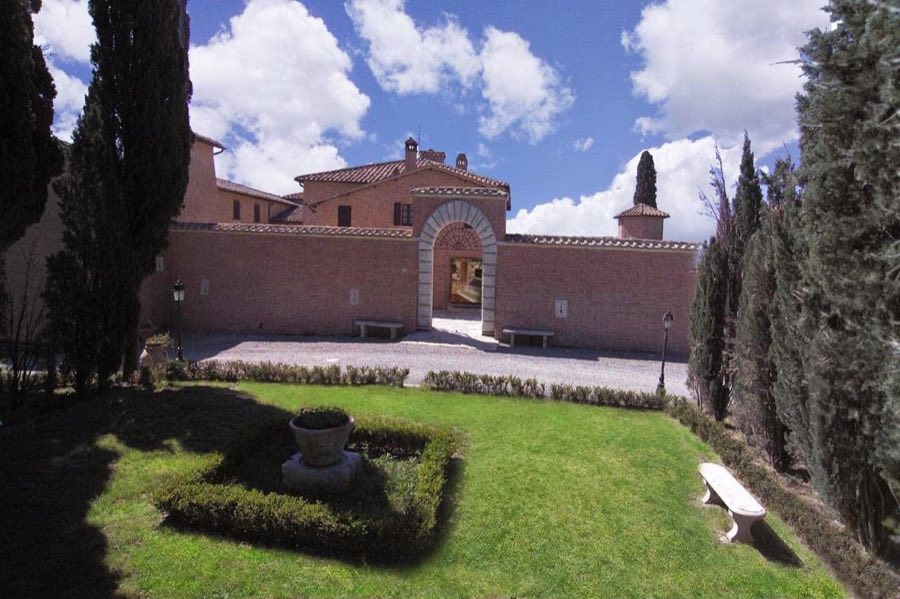
No. 70147
Castello di Leonina
Italy
CastleRuin15th century
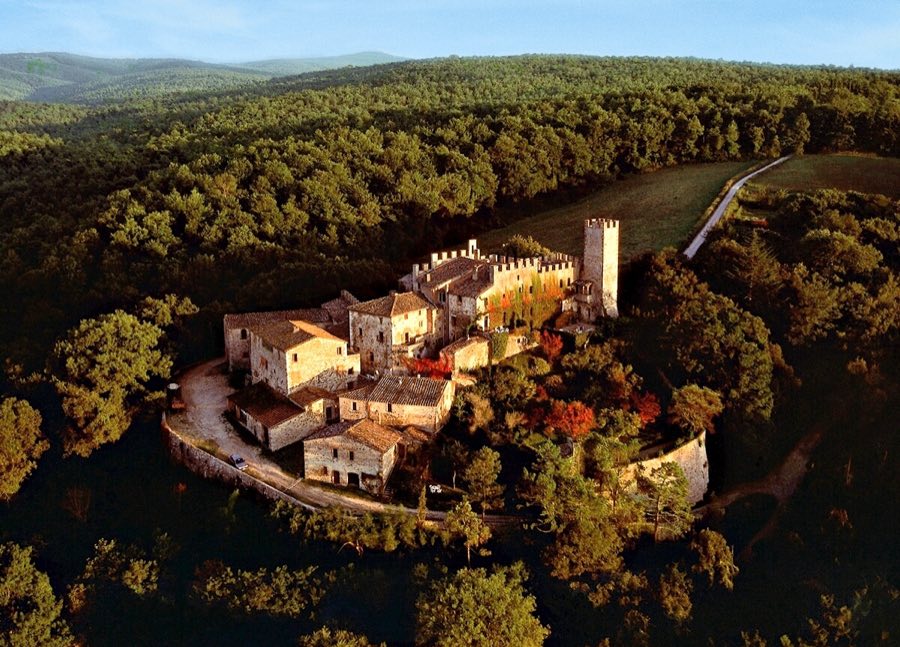
No. 85721
Castle · Italy
No. 85721 · 43.368 N, 11.547 E
Quick summary
Castello di Montalto is a castle in Italy with origins associated with the 13th century.
See all castles in ItalyCastello di Montalto stands in Castelnuovo Berardenga, Italy; its earliest tower was likely raised by the Longobards. The main body of the castle was erected toward the end of the first millennium by descendants of Winigis, the first count of Siena, and by his son Berard, whose name gave rise to the surrounding district known as Berardenga.
Documentary mentions of Montalto begin in the eleventh century. Population records show fluctuating fortunes: a 1202 census listed more than forty families in the castle court, a 1278 census recorded twenty-four families, a 1320 record counted sixty-three fiscal units, a 1422 document listed thirteen men, and a 1676 survey recorded seven hearths, about fifty people. The castle’s frontier position between Siena and Florence made it a frequent focus of military activity from the thirteenth through the fifteenth centuries.
In June 1208 the Battle of Montalto led to heavy casualties and, according to chronicles, the Florentines captured more than 1,200 prisoners, leaving the castle nearly destroyed. After that destruction, the Berardeschi sought financial help from Siena to repair and enlarge the walls. Siena provided garrisons, troops, munitions and money on multiple occasions; documented support appears for 1251 and further aid or supplies are recorded in 1402, 1431, 1452 and 1478. The castle endured a siege in 1479, fell under enemy occupation in 1526, and hosted a Sienese garrison in 1529.
In 1546 the government of Siena granted Montalto to Giovanni Palmieri on the condition that he defend it at his own cost. During the mid-sixteenth century Francesco and Scipione Palmieri carried out restorations from 1570 to 1572 and introduced Renaissance decorative features and fresco work between about 1570 and 1587; by 1583 the chapel had been whitened, floored and supplied with altar furnishings. In 1553 Florentine and imperial troops under the banner of Charles V occupied the castle and set it on fire. After the fall of Siena the estate remained in Palmieri ownership. Giuseppe Palmieri undertook neo-Gothic restorations in the mid-nineteenth century and provided an altarpiece in 1853. His son Antonio completed later works in 1908.
The last members of the Palmieri family transferred ownership in 1970 to Giovanni Coda Nunziante. Under Coda Nunziante and his wife the estate was managed organically and many former farmhouses were restored and adapted as holiday accommodations. The estate today covers about 270 hectares, of which roughly two-thirds are woodland, and the farm is certified organic, producing cereals, sunflowers, forage, canola, olives and honey. A local tale linked to the castle speaks of the “Dama blu,” the Blue Lady; her skull was kept until recently in a small turret room and was later interred, and tradition holds that her spirit haunts the place.
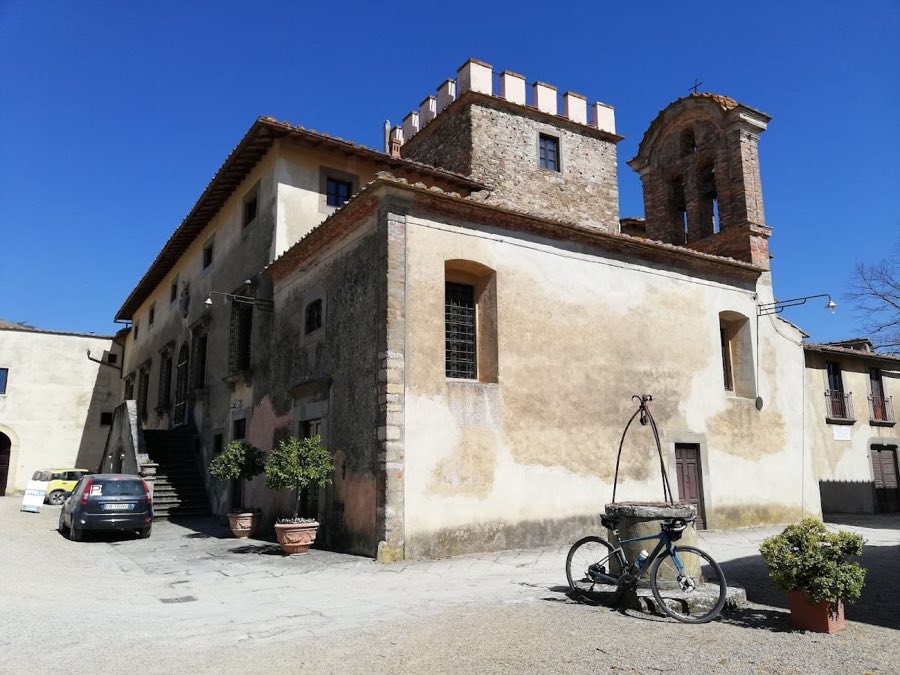
The complex occupies a hill that commands the upper reaches of the Ambra river and is arranged as a small fortified village surrounded by a stone-and-brick curtain wall. Entry is through an arched gateway surmounted by a turreted entrance tower fitted with machicolations, openings in the parapet used to drop objects on attackers. Passing this gate brings one into an internal courtyard that contains a central well. The curtain wall shows repeated traces of damage and repair from wartime episodes; nineteenth-century rebuilding raised sections of the defensive wall, and a new gate tower from that century provides the present entrance into the courtyard.
On the right side of the courtyard stands the church of San Martino, which was refashioned and furnished during the later sixteenth-century restorations and received an altarpiece in 1853. The inner wall of the entrance tower bears a large fresco that depicts Saint Martin sharing his cloak with a beggar; Antonio Palmieri added a further fresco over the lowered Sienese arch on the entrance tower during his work in the early twentieth century. A portico along the façade facing the courtyard dates to the Palmieri restorations of 1570–1572.
To the left of the courtyard a loggia of four arches opens into the Sala d’Armi, the Hall of Arms. That room contains a substantial fireplace and conserves a collection of lances, armor and weapons whose types date from the fourteenth century onward. The upper walls and the spaces between the capitals that support the wooden-beam ceiling are covered with frescoes showing coats of arms, depictions of estate farmsteads as they appeared in the sixteenth century, and scenes of hunting and agricultural work.
A prominent watchtower with a battered base rises above the complex; it retains crenellations and narrow defensive openings for observation and firing. Six additional buildings cluster within the walls to complete the fortified hamlet. Ground fill within the circuit has raised the inner ground level so that it now comes to within about one metre of the top of the interior wall, a feature that reflects successive phases of repair and reuse.
Later adaptations reflect changing functions and care for the estate. Sixteenth- and nineteenth-century restoration work left visible alterations to form and decoration, including Renaissance frescoes and neo-Gothic rebuilding of the watchtower to a height similar to the original. Several former agricultural buildings were restored and converted in the twentieth century, with one old granary adapted as a reception room and other modern amenities added as part of the estate’s reuse. Local tradition associates a Blue Lady with one of the turret rooms, where her skull was kept until recently and subsequently buried; that legend remains tied to the fabric and memory of the place.
No. 70147
No. 85487
No. 62943
No. 40041
Comments
Comments for Castello di Montalto will require a verified account before posting.
We'll send a verification link before your first comment is published.