No. 34923
Castello di Sarmato
Italy
CastleRestored10th century
No. 17290
No. 17290 · 45.026 N, 9.543 E
Quick summary
Castelmantova is a castle in Italy with origins associated with the 13th century.
See all castles in ItalyCastelmantova, in the municipality of Gragnano Trebbiense, Italy, began as a medieval fortified site, possibly established in the 13th century.
An early stronghold on this ground became involved in Guelf–Ghibelline fighting and in the 1220s was seized, plundered and burned by forces aligned with the Guelf faction; later observers record that that medieval structure no longer leaves visible traces. In the early 1400s Francesco Borla, who served as physician to the Duke of Milan, obtained the duke’s permission to rebuild a fortified residence on the same location.
During military operations in 1636 the castle was set on fire. The Borla family retained ownership until Giovanni Battista Borla died in 1636, after which the property passed to the Farnese ducal land administration, known as the Camera Ducale farnesiana. In 1658 that administration authorized sale to Giovanni Pietro Savini, with Giulia Del Sole acting as guardian for Savini’s children; in 1660 Giulia Del Sole transferred the property to Gian Giacomo Civardi, who set in motion reconstruction works.
The estate remained with the counts Civardi until 1854, when Giacomo Civardi sold it to Carlo Besini, a noble from Modena resident in Mantua; Besini renamed the complex Castelmantova. At the beginning of the twentieth century ownership passed to the Sutti-Guasconi family, who held it until 1925, when it was sold to Carlo Prati.
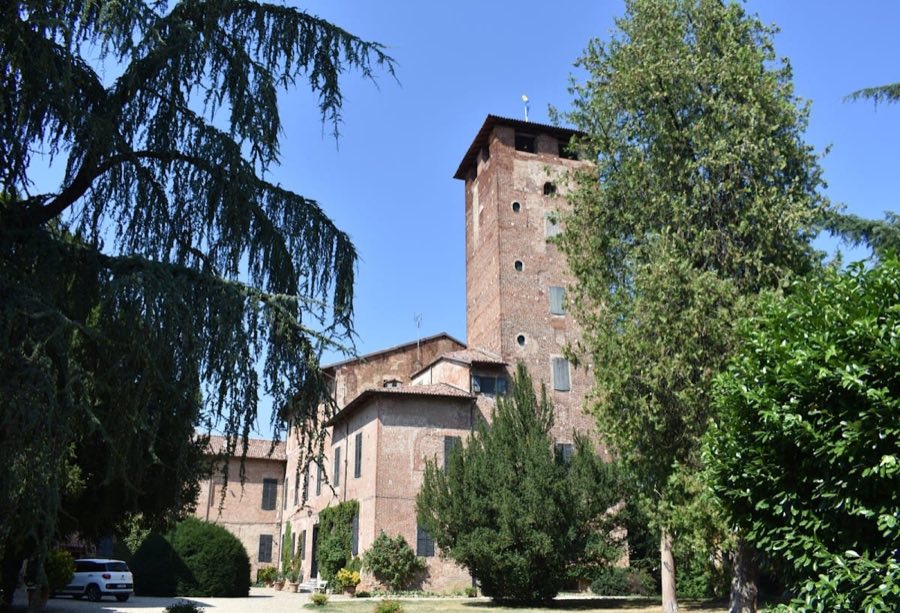
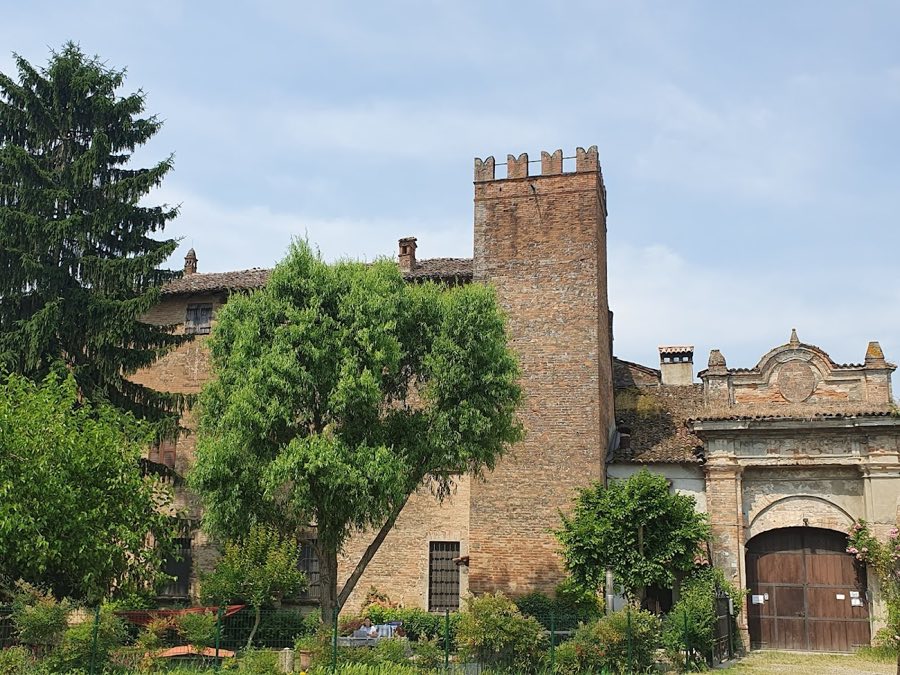
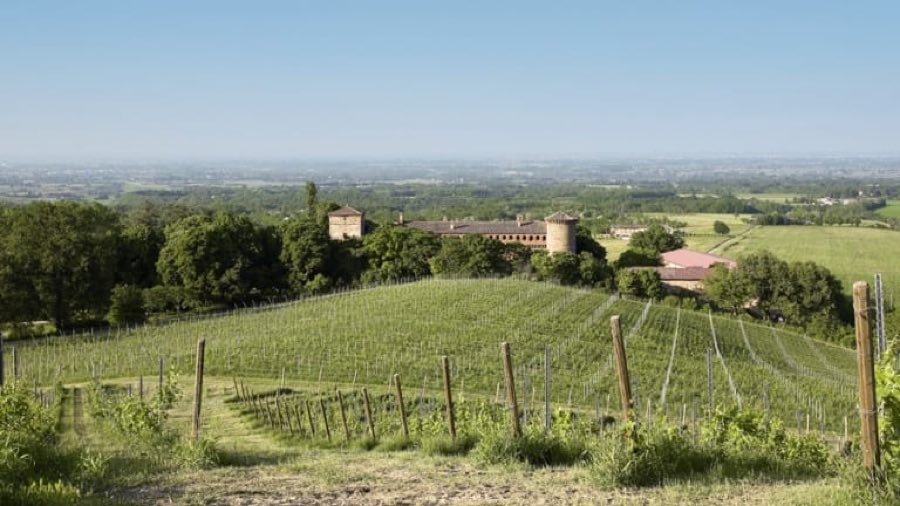
The site is laid out on a square plan and shows building phases from different eras, the result of extensive remodelling over time. Two towers occupy opposite corners along a diagonal axis. The complex sits in the open Po plain on the right bank of the Luretta stream and is set within a surrounding park that includes a Baroque chapel.
Elements surviving from the earlier castle include a small secondary gate, or postern, in the southern tower that once worked with a drawbridge; traces of that drawbridge survive and are cited as among the rare components that date back to the medieval building. Several gun ports are visible in the walls, and a section of a rounded projecting belt, a masonry band that runs along the line of the former moat, can be seen; records note that a moat ran along the south and east sides as late as the late eighteenth century.
The interior is organised around a courtyard bordered on three sides by a portico at ground level and a loggia above, present on both the ground and first floors. The bays between the courtyard columns are defined by Tuscan-style pilaster strips that carry two horizontal beams; the lower beam forms the parapet for the upper loggia while the upper beam supports the eaves cornice. These arranged elements reflect the building’s sequence of alteration and adaptation.
Within the park the Baroque chapel is notable for its façade, which is articulated by a double order of pilaster strips. The chapel interior preserves paintings by Giovan Battista Ferrari dated 1885, depicting members of the Besini family alongside scenes that include some peasants.
No. 34923
No. 52202
No. 55139
No. 39934
Comments
Comments for Castelmantova will require a verified account before posting.
We'll send a verification link before your first comment is published.