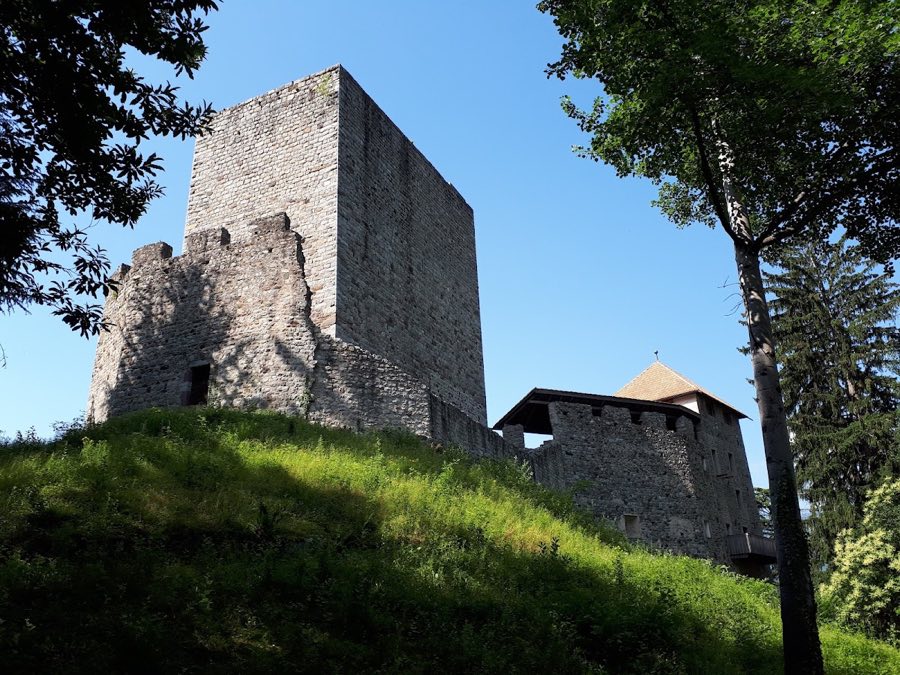
No. 14108
Castle Goyen
Italy
CastleRestored12th century
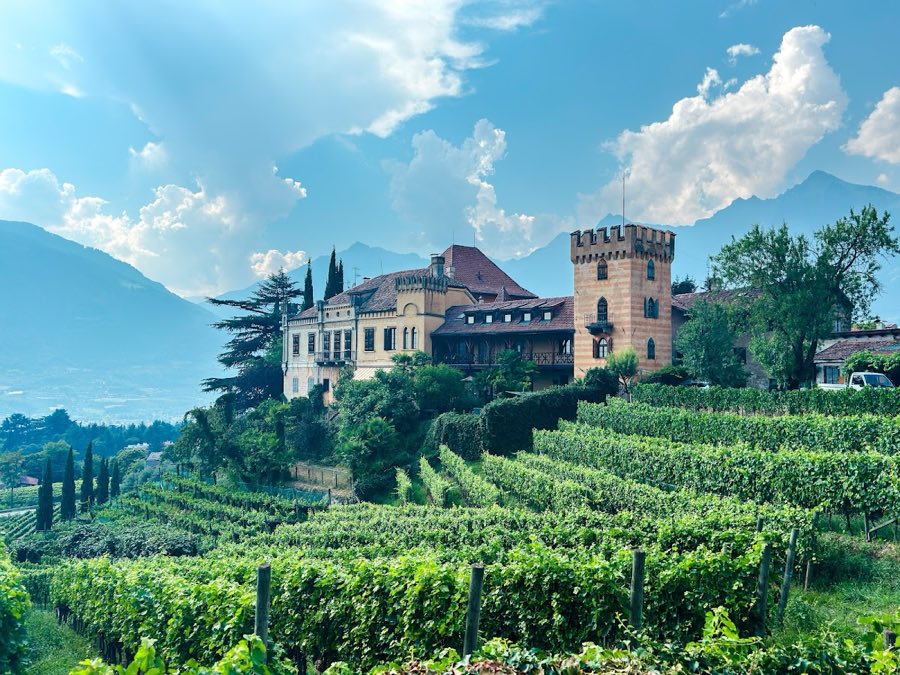
No. 72501
No. 72501 · 46.669 N, 11.191 E
For rent
Castle Labers is marked for bookable castle accommodation. Nightly pricing, sleeps count, stay rules, and amenities are displayed only when public operator data is available.
Rental type: Hotel / bookable stay, Short-stay rental
Short-term availability: Bookable accommodation signal
Quick summary
Castle Labers is a castle in Italy with origins associated with the 11th century.
See all castles in ItalyThe place now called Castle Labers lies within the municipality of Merano and is recorded under early Tyrolean ownership. A local Ulrich is said to have lived at the site around 1077–1082, and documentary forms of the name Laubers appear in the early twelfth century and again in 1185, indicating a long‑standing manorial holding. From the eleventh or twelfth century the site served as a seat of regional nobility. In 1278 the property passed to Christian von Angerheim and his son Heinrich undertook work that transformed the estate into a more clearly fortified complex, enlarging both its defensive and residential elements. In the early fifteenth century Jakob Auer is recorded as owner (1429, sometimes cited as 1428); records associate members of the Baumkircher family with the house in 1452 and 1462. By 1550 the chancellor Beatus Widmann is documented as holding the property.
The nineteenth century saw several changes of ownership: the Bombarden family appears in 1812, Richard Kirchlechner in 1823, and Leo von Klenze is recorded as acquiring the building in 1843. From 1885–86 Musch and Lun began converting the house for lodging and in 1891 the Dane Adolph Neubert purchased and adapted the property, after which it operated as a guesthouse and hotel; the writer Elisabeth Bürstenbinder lived there from 1896 until 1918. Late nineteenth‑century remodelling under Neubert produced the two corner towers and a broadly historicist, neo‑romantic appearance that shapes the building’s present silhouette.
After 8 September 1943 the house was requisitioned for wartime use and employed in connection with Operation Bernhard, the programme that produced counterfeit British banknotes. Friedrich Schwend has been named in association with the site’s role in circulating counterfeit pounds produced at Sachsenhausen, and substantial quantities of forged British currency were discovered at the house after the conflict. Following the war the property returned to commercial use as a hotel and has remained in private ownership; it is now recorded as a protected historic monument.
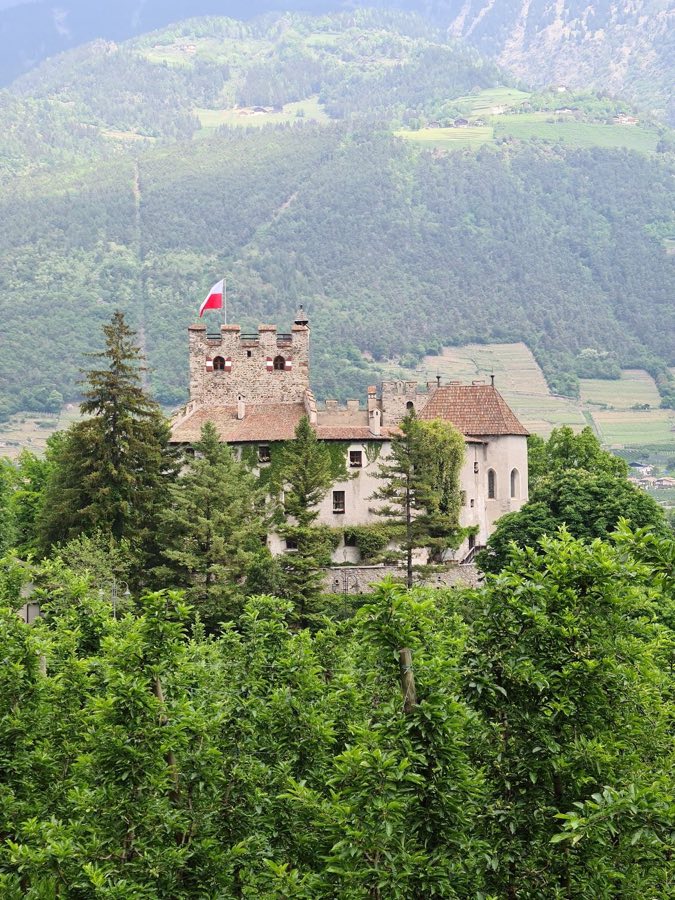
The complex stands on a slope above the valley near Merano and reads as a compact group of buildings dominated by a principal tower at the western corner. That tower rises three storeys from a rectangular base: its lower floors have plain rectangular openings while the upper storey displays paired round‑arched windows. A steep hipped roof with dormers and an ornamental ridge finishes the tower.
On the tower’s south side a wooden balcony projects beneath a simple shed roof and a timber corner bay with a pointed roof marks the southern corner of the main block. The upper storey of the main range is lined with evenly spaced rectangular windows set in moulded reveals and dormers puncture the roofline. The two corner towers visible today date to the late nineteenth‑century remodelling and contribute to the historicist, neo‑romantic character added in that period.
Medieval fabric survives beneath the later additions: substantial stone masonry in the cellar preserves original construction techniques in situ, and a chapel dedicated to St. Michael, dated to the fifteenth century, survives within the building. Later conversions have adapted and overlaid the medieval core, but the cellar masonry and the fifteenth‑century chapel provide the clearest physical links to the house’s earlier phases; the property is recorded under monument protection.
No. 14108
No. 49462
No. 71767
No. 83592
Comments
Comments for Castle Labers will require a verified account before posting.
We'll send a verification link before your first comment is published.