No. 63676
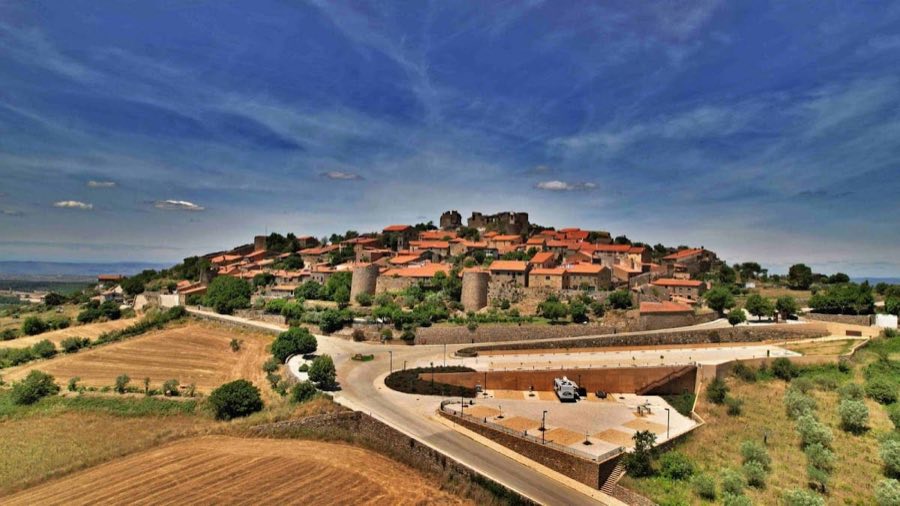
Castle of Castelo Rodrigo
Portugal
CastleRuin14th century
No. 87270
Castle · Portugal
No. 87270 · 40.777 N, 7.062 W
Quick summary
Castle of Pinhel is a castle in Portugal with origins associated with the 15th century.
See all castles in PortugalThe Castle of Pinhel stands in the municipality of Pinhel, Portugal, on a site originally occupied by a prehistoric fortified settlement. This early stronghold, known as a castro, is linked to either the Turduli people around 500 BCE or the Lusitanians, later coming under Roman influence to oversee a strategic crossing along a Roman road.
Following the decline of Roman authority in the region, the site lost prominence until the early years of Portugal’s foundation during the Christian Reconquest. King Afonso I, who ruled from 1112 to 1185, initiated the repopulation of Pinhel and strengthened its defensive position. His son, Sancho I, granted a royal charter to Pinhel sometime between 1189 and 1209, marking the foundation for medieval construction of the castle. Building works were largely completed under King Afonso II, who also issued a new charter in 1217, further defining the town’s legal and administrative status.
The territory including Pinhel was long disputed with the neighboring Kingdom of León, but was definitively recognized as Portuguese in the 1297 Treaty of Alcañices. Following this, King Denis I fortified the castle around 1282, enhancing its defenses by adding six towers and encircling walls.
During the Portuguese succession crisis from 1383 to 1385, Pinhel supported the Master of Aviz’s claim to the throne. This allegiance led to early attacks by Castilian forces, who pillaged the castle in 1385. The castle remained alert and strategically important through further Castilian incursions in 1396 and 1398.
The 15th century brought economic challenges and damage from further military engagements, including assaults led by figures such as Dom Gonçalo Coutinho. Still, under King Manuel I’s reign (1495–1521), Pinhel was granted a new charter in 1510 and the castle underwent significant remodeling to update its defenses and appearance.
In the 17th century, during the Restoration War which aimed to regain Portuguese independence from Spanish rule, the castle’s fortifications were modernized to accommodate artillery, featuring a new redoubt. At this time, Pinhel became a regional military hub overseeing nearby forts.
Pinhel was elevated to city status in 1770 under King Joseph I’s reign. During the Peninsular War, Napoleonic forces occupied the town and castle in 1810. In recognition of its historical importance, the castle was declared a National Monument in 1950. Conservation efforts started in 1999 under the National Institute for Architectural and Archaeological Heritage (IPPAR), prompted by concerns about water damage affecting the towers by 2002.
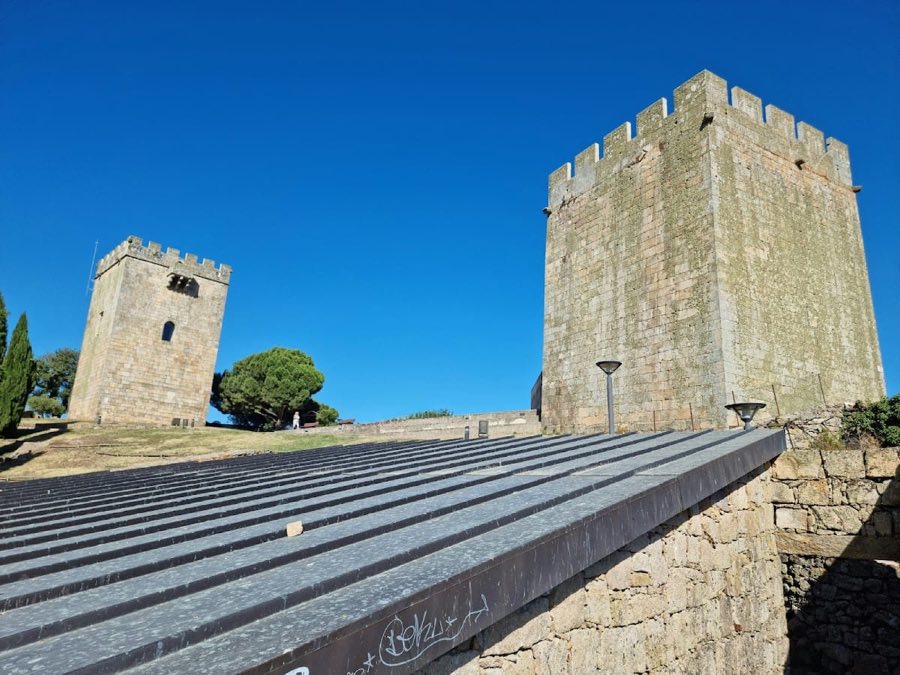
The Castle of Pinhel is perched around 600 meters above sea level on a hill overlooking the Côa River valley and the Serra da Marofa, enclosing the historic town center within its granite walls. The layout follows an oval plan, with defensive walls built from local granite encircling the hilltop.
Originally, the castle’s curtain wall was strengthened by six square towers, each standing near one of six main gates linking the castle to surrounding areas. These gates were named Porta de Santiago, Porta da Vila, Porta de São João, Porta de Marrocos, Porta de Alvacar, and Porta de Marialva. Of these towers, only two remain visible today. Porta de Santiago is notable for its round arch, an architectural detail that contrasts with the otherwise squared gateways.
Inside the castle’s courtyard stand two crenellated towers. The taller one on the eastern side, known as the keep, dates from the late 13th century, constructed during King Denis I’s reign and later renovated under King Manuel I. This keep features stone gargoyles designed to direct rainwater away from the walls, balconies supported by projecting stone brackets called corbels, and a machicolation system—openings between the supporting corbels that allowed defenders to drop objects or pour liquids on attackers below. The entrance shows pointed arch doors, a medieval style shape, along with narrow arrow slits shaped like crosses, allowing defenders to shoot arrows while being protected. The battlements on top are rectangular and solid, providing defensive cover. Below the battlements, a set of windows can be seen, including a twin window decorated in the Manueline style—a Portuguese late Gothic architectural style featuring naturalistic motifs—engraved on the lintel, or horizontal support above the window.
Inside the keep, a large hall displays vaulting with ribs—arched stone supports that strengthen the ceiling—dating from the period of King Manuel I, illustrating architectural advances of that era.
The western tower within the castle was once used as a prison. This square-shaped tower retains a pointed-arch window from that historic function, shedding light on the castle’s role beyond mere military defense.
Water supply was crucial for the castle, and three cisterns—underground reservoirs—located near the Porta da Vila and Porta de Santiago ensured a reliable source of potable water for inhabitants during sieges.
These features collectively illustrate the castle’s strategic importance and evolving defensive architecture from its medieval origins through early modern adaptations. Restoration efforts have focused on preserving these key elements, especially the towers vulnerable to weather-related damage.
No. 63676
No. 40104
No. 68292
No. 86650
Comments
Comments for Castle of Pinhel will require a verified account before posting.
We'll send a verification link before your first comment is published.