No. 24561
Bramafam Tower
Italy
CastleRuin13th century

No. 74445
Castle · Italy
No. 74445 · 45.722 N, 7.326 E
Quick summary
Charvensod Castle is a castle in Italy with origins associated with the 14th century.
See all castles in ItalyCharvensod Castle, in the municipality of Charvensod, Italy, is a medieval site whose original builder is not known.
The site appears in surviving documents for the first time in 1305, identified as the bishop’s house at Charvensod. For centuries it served as the summer residence and retreat of successive bishops of Aosta and was commonly referred to as the Bishop’s Castle. In the early 1300s Arduce (Ardizzone) de Pont-Saint-Martin spent time at the residence in 1324, 1326 and 1327, and he left the property by will dated 6 March 1327. A bishop named Éméric is recorded at the house in 1368, and Jean-Geoffroy Gignod is recorded there in 1590.
During the plague years of 1629 to 1631 the bishop’s residence was used as the seat of the local government body called the Conseil des Commis (Consiglio dei Commessi), where officials met and took decisions. In the 1700s Bishop François-Amédée Milliet d’Arvillars carried out a programme of beautification at the site after his ordination in the period between 1718 and 1720.
In the mid-1800s, amid conflicts between Swiss cantons, the castle sheltered the exile Fillier, provost of the Congregation of the Great St Bernard; he was likely the last cleric to live there. Following the 1868 expropriation of many church properties by the newly formed Kingdom of Italy, local families purchased the castle and adapted it for agricultural use. In 1971 the building was remodelled and covered with plaster to convert it into a residential house; one account states this work proceeded without municipal permission, while another states municipal authorization was given.
The site survives as a ruined and heavily reworked medieval complex, with only limited original fabric remaining. The plan once enclosed a defended courtyard, and the later alterations and conversions have changed much of the earlier appearance. The surviving fragments show the footprint of a fortified residence closely linked to the nearby parish church of Charvensod.
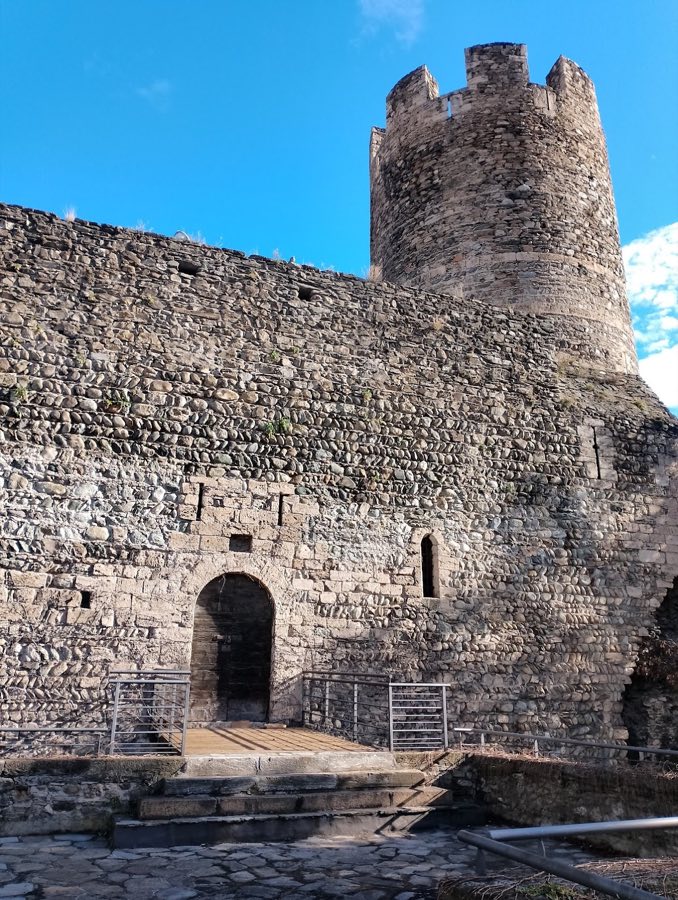
A stretch of the enclosing wall still stands and marks part of the former boundary of the site. This surviving curtain preserved the line of the castle’s defenses and is now fragmentary, indicating where the enclosure ran around the building complex. Over time the wall has been altered as the property passed into private hands and was put to agricultural and later residential use.
In the northwest sector there are the remains of a small circular turret dated to the 14th century, identified as part of the castle’s former defensive apparatus. The turret survives only as ruinous masonry, but its position and form link it directly to the medieval fortification system that once protected the residence.
One original angled corner tower is reported to survive, retaining the characteristic position and orientation of a defensive corner. This tower remains in situ in a fragmentary condition and is one of the principal elements that testify to the site’s medieval defensive character.
The nearby medieval tower called La Tornettaz, located between the main village and Pont-Suaz, formed part of a network of signal towers that were in visual contact with several fortified sites, including Charvensod. This relationship places the castle within a local communication and defensive landscape. The building fabric that is visible today bears the traces of successive uses, including its conversion to agricultural functions in the 19th century and the 1971 remodelling and plastering that altered the outer surfaces.
No. 24561
No. 85633
No. 37531
No. 33455
Comments
Comments for Charvensod Castle will require a verified account before posting.
We'll send a verification link before your first comment is published.