No. 38601
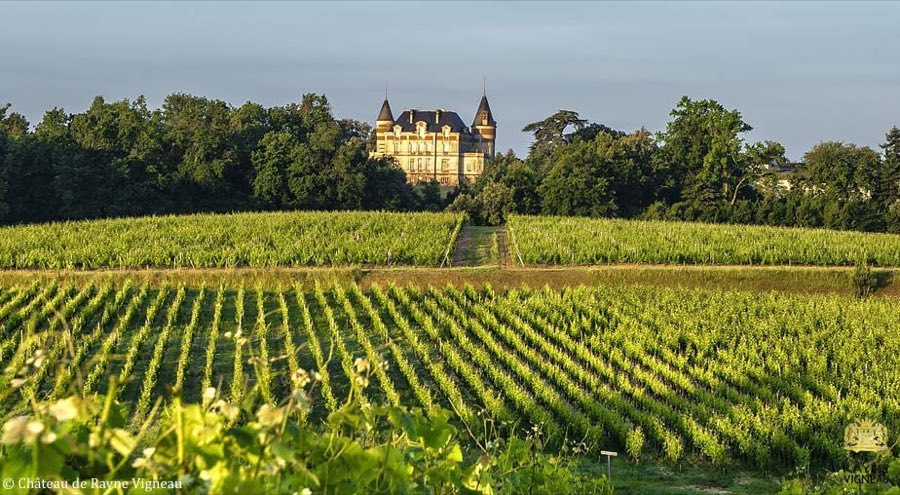
Château de Rayne-Vigneau
France
ChâteauIntact17th century
No. 24395
No. 24395 · 44.565 N, 0.297 W
Quick summary
Château de Malle is a château in France with origins associated with the 17th century.
See all castles in FranceChâteau de Malle, in Preignac, France, is a historic wine estate and château built by a Bordeaux bourgeois and merchant at the turn of the 17th century, with architecture that blends classical order and Renaissance inspiration. Its origins in the late 1500s and the completed château of the early 1600s established the site as a producer of white wines that entered regional and international markets. The estate’s Sauternes received the rank of Second Growth in the Bordeaux 1855 classification, and the main buildings and grounds have been placed under national heritage protection, reflecting centuries of continuous wine-making and family ownership.
The first house on the site was constructed in 1598 by Arnaud de Malle; that structure survives and today serves as the estate’s boutique. In the early 1600s Jacques de Malle, president of the Parliament of Bordeaux, erected the present château and began systematic production of white wine. A mid-17th century record notes the 1643 harvest amounted to 54 tonneaux and two barriques, showing substantial output for that period.
Ownership passed into the Lur-Saluces family when Jeanne de Malle married Alexandre-Eutrope de Lur-Saluces, baron of Fargues and count of Uza. Alexandre-Eutrope laid out formal gardens and placed his coat of arms of three crescents on the façades. Pierre de Lur-Saluces inherited in 1754, followed in 1780 by Claude Henri de Lur-Saluces, who bore the title seigneur de Malle and was executed by guillotine on 24 December 1793 at Place Nationale in Bordeaux as a victim of revolutionary measures against the aristocracy. In 1793 Louis-Alexandre-Eugène, a royalist deputy for Gironde, assumed the seigneurial title.
Ferdinand-Eugène became owner in 1842 and passed the estate to his son Henri, who served as a senator of Gironde. It was under Henri’s stewardship that the château’s Sauternes achieved its 1855 Second Growth status. In response to the phylloxera crisis, Pierre de Lur-Saluces reduced the vineyard from about 40 hectares to roughly 15 hectares and in 1937 bequeathed the property to his sister Adélaïde; the estate later passed to Augustine Léontine Mathilde d’Auzac de Campanac.
After the Second World War the estate came under Pierre de Bournazel, count de Lespinasse de Bournazel. A severe frost in 1956 destroyed the vineyard and necessitated replanting, and in 1959 he established the Commandery of Bontemps of Sauternes and Barsac. Following his death in 1985 his widow Nancy de Bournazel managed the domain with their sons. By 2018 the house and vines had fallen into disuse, with the last commercial vintage dated 2016. In April 2024 Luc Planty, formerly director of Château Guiraud, and his wife Clémence purchased the estate for several million euros, the first transfer outside hereditary succession; they initiated conversion to organic agriculture and reopened parts of the property.
A note of alternate dating appears in one account that places the château’s erection at the start of the 18th century. Figures for the estate’s vineyard holdings also vary: one record traces 38 hectares of vines on the property since 1666, roughly divided between Sauternes and Graves, while other statements ascribe a total of 50 hectares across the communes of Preignac, Toulenne and Fargues, split into 28 hectares in Sauternes, 3 hectares of white Graves and 20 hectares of red Graves.
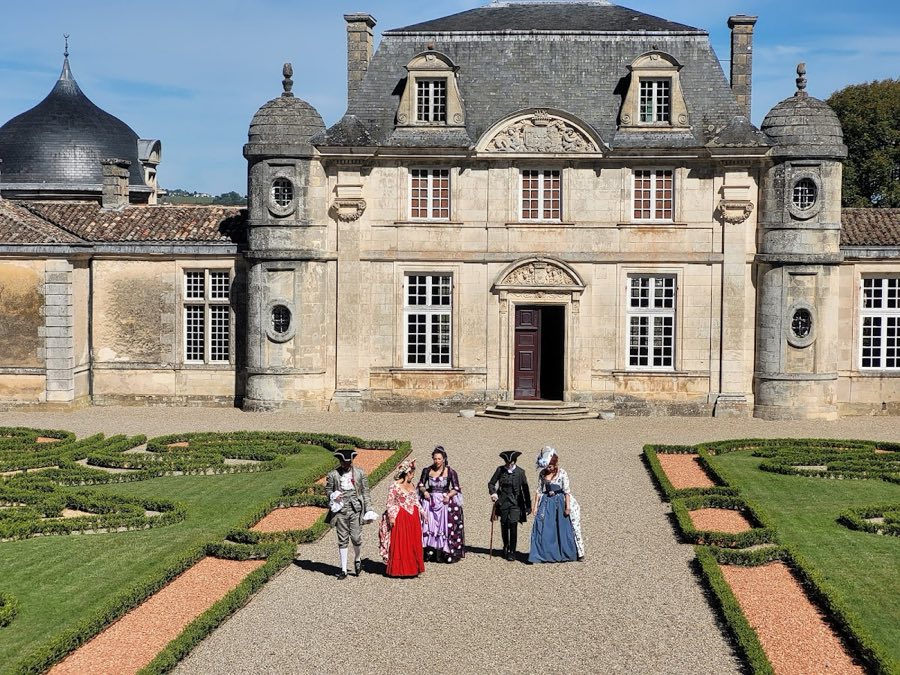
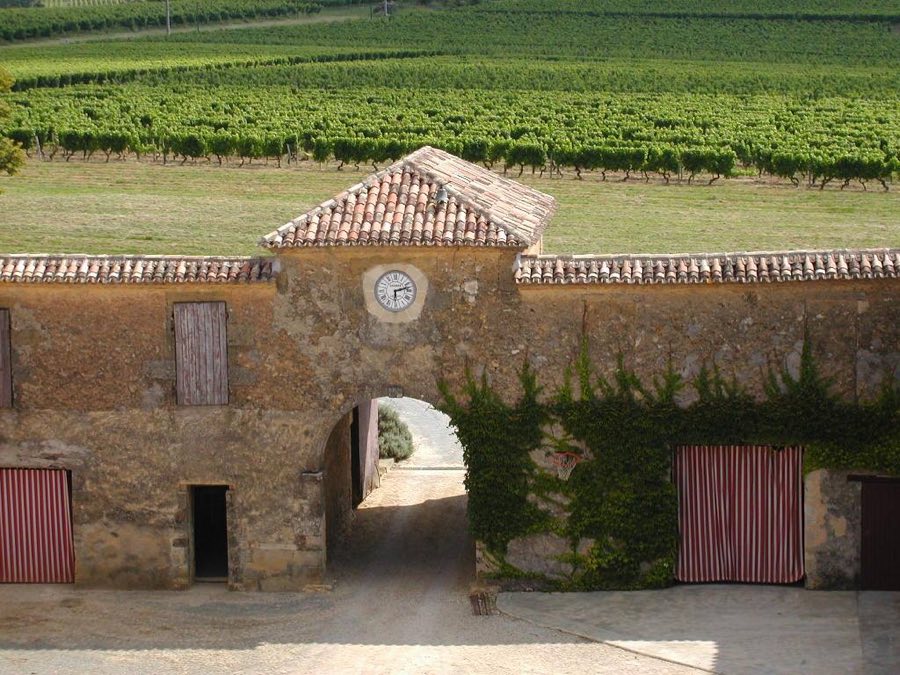
The château opens through a gate into a formal entrance courtyard (cour d’honneur), marked by pilasters and framed on three sides by the main living block (the central building) and two returning wings that end in towers. The ensemble combines classical proportions with Renaissance motifs and has been protected as a national historic monument since 8 September 1949. The façades bear a heraldic device of three crescents, placed there by Alexandre-Eutrope de Lur-Saluces.
The gardens extend the architectural composition into planted terraces in an Italian style, covering about six hectares. They include basins and groupings of statuary that celebrate vineyard labour and winemaking alongside figures drawn from Greek myth, such as Cephalus, Aurora, Cupid, Aphrodite or Venus, Adonis and Flora. Many of these statues were carved by Italian sculptors brought to the estate in the early 18th century. The park is arranged on a broad central axis with two principal terraces lined with statues and ornamental vases.
East of the first terrace a small open-air theatre features painted or carved characters from the Italian commedia dell’arte, including Pantalone, Scaramouche and Harlequin. A stairway from this level rises to a second terrace where sculpted figures personify the elements of earth, wind, air and fire. The gardens themselves carry heritage status, having been listed as a historic monument since 2 December 1943 and recognised as a notable garden with the Jardin Remarquable designation in 2005.
Vineyard infrastructure has seen notable mid-20th century intervention. In the post-war period Pierre de Bournazel rebuilt the fermentation cellar as part of repairs to the estate’s buildings and viticultural facilities. The earlier dwelling of 1598 remains on site and has been adapted for commercial use. Recorded vineyard extents vary for the present and historic holdings, with statements of either 38 hectares of vines split between Sauternes and Graves or a total holding of 50 hectares across Preignac, Toulenne and Fargues, allocated as 28 hectares Sauternes, 3 hectares white Graves and 20 hectares red Graves.
No. 38601
No. 42456
No. 57209
No. 83898
Comments
Comments for Château de Malle will require a verified account before posting.
We'll send a verification link before your first comment is published.