No. 50220
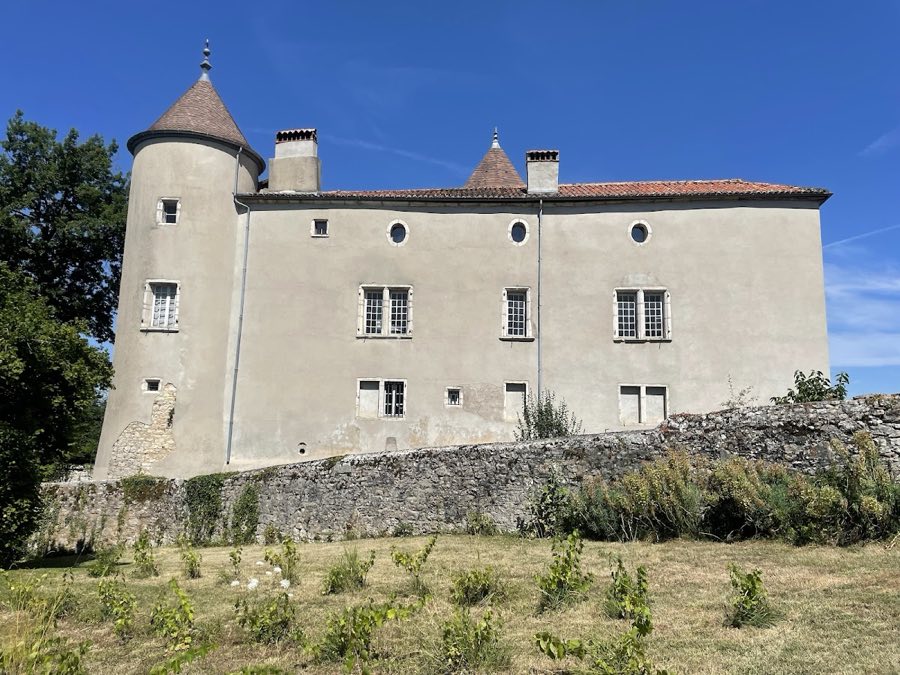
Château de Chenavel
France
ChâteauRestored14th century
No. 80054
Château · France
No. 80054 · 46.100 N, 5.143 E
For events
Château de Varax is marked as a château or castle venue lead. Capacity, indoor/outdoor spaces, catering rules, and accommodation options are published only after public verification.
Event types: Private events, Cultural gatherings, Filming and photography
Quick summary
Château de Varax is a château in France with origins associated with the 13th century.
See all castles in FranceChâteau de Varax stands in La Grande Courbe, Brée, France, on a site showing traces of Gallo-Roman occupation and later developed by medieval local lords.
Evidence of very early activity near the hill emerged in the nineteenth century with Gallo-Roman finds made along the former national road. By the twelfth century a village and a church dedicated to Saint Paul were recorded, both dependent on the chapter of Saint-Paul in Lyon.
By the mid-thirteenth century the place had been transformed into a fortified site: an artificial mound with an attached lower courtyard served as the core of a seigneurie that originally belonged to the sires of Bâgé. In the first half of that century Hugues d’Anthon and his son Étienne held the fief under the overlordship of the counts of Savoy. In 1243 Count Amédée of Savoy confirmed the seigneurie as an augmentation of fief to Étienne, lord of Thoire-Villars.
The castle took part in the region’s conflicts. Savoyard forces seized it in 1332 during the war with the dauphins of Viennois. The seigneurie again did homage to the count of Savoy in 1369, and in 1393 the place appears in records under the Latin name castrum et villa de Varas. Family members using the name Varax are documented in the later medieval period, including Ulrich around 1250–1272 and Gaspard II, who was created first count of Varax in February 1460.
In 1463 the count of Savoy seized the château amid fighting between Bresse and Dombes. Hugues de la Palud later held the countship of Varax; he served as counselor and chamberlain to the duke of Burgundy, was appointed marshal of Savoy around 1492, and became lieutenant-general in Dauphiné for Charles VIII around 1494. During the later sixteenth century the site suffered decisive violence when troops of Biron sacked and dismantled the castle in 1593. A 1595 inventory recorded the castle and its associated buildings as ruined and noted wide destruction in the adjoining borough; by 1650 the estate was again described as ruined.
Ownership passed through several hands after those events. Louis XIII confiscated the land from François de Rye‑La Palud and granted it to Gaspard de la Croix, who on 4 May 1641 transferred it to Christine‑Claire de Haraucourt. Pierre Perrachon acquired Varax in June 1655, and the estate was sold on 20 February 1720 to Étienne de Rivérieulx. Jean‑Claude de Rivérieulx de Varax resumed the fief on 18 May 1772 and is recorded as the last seigneur; his goods were pillaged and he was executed on 5 January 1794 on the Place des Terreaux in Lyon. In the twentieth century the château received partial legal protection as a monument historique by arrêté of 29 September 1981, covering the façades and roofs of the château (with the exception of the west façade of the building that has four modern openings) and the outbuildings.
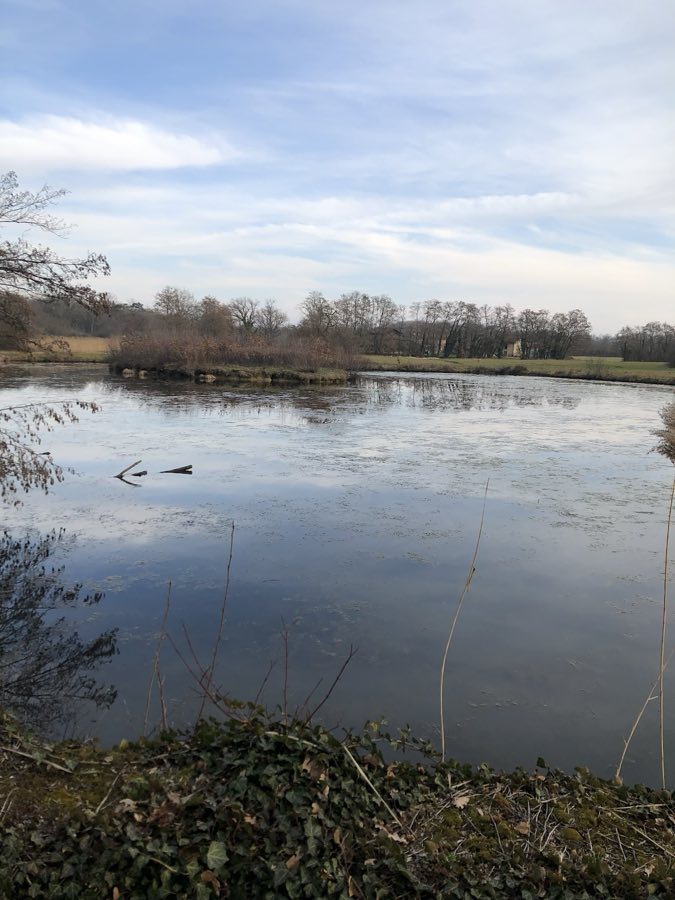
The site combines an early artificial mound set amid the ponds of the Dombes with a later brick medieval castle built on the lower enclosure. The earliest fortified phase, established by the mid-thirteenth century, used a raised motte and an adjoining courtyard as its defensive heart. The motte has a circular base measuring 38 metres across, an oval summit approximately 13 by 15 metres, and rises 5.50 metres above the surrounding ground; very wet ground nearby suggests a surrounding ditch probably once existed.
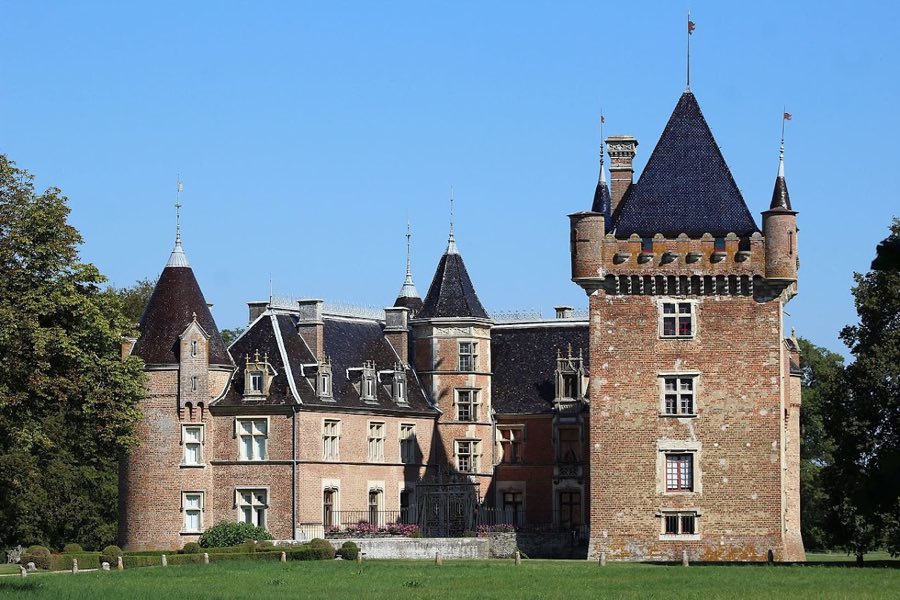
The medieval castle erected on the former lower court was constructed in brick and, in its complete form, comprised five large towers linked by surrounding walls and defended by ditches. A 1595 inventory of the place lists a drawbridge, defensive ditches, the five main towers, a dovecote, and a barn, and records these elements as ruined at that moment. Over the following centuries the site was heavily altered after the late sixteenth‑century destruction and later remakings, so that much of the original plan was changed.
At present two surviving wings of the original castle remain, set at right angles to form an L-shape around a courtyard; these are the principal visible fragments of the medieval residence. The oldest parts still standing lie to the north, where two square towers guard a small side gate and are approached from the exterior by the line of the former drawbridge. These northern towers are attributed to the fourteenth century and represent the earliest extant masonry of the castle.
South of the main building the former enclosed borough’s defensive line survives in altered form, its trace incorporated into farm buildings. Those agricultural structures are arranged on a semi-circular plan that follows the old lower court, and their elevations show vestiges of defensive features reused in later construction. Nineteenth-century finds of Gallo-Roman material along the nearby former national road attest to much earlier occupation of the area, but the standing remnants on the hill are principally medieval in date and character.
No. 50220
No. 10482

No. 85687
No. 18778
Comments
Comments for Château de Varax will require a verified account before posting.
We'll send a verification link before your first comment is published.