No. 22810
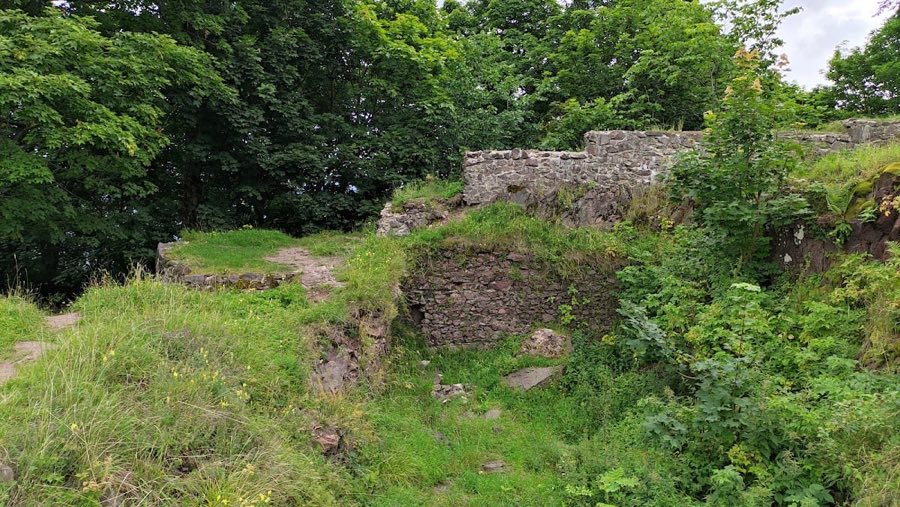
Rogowiec Castle
Poland
CastleRuin12th century
No. 69107
Castle · Poland
No. 69107 · 50.750 N, 16.411 E
Quick summary
Grodno Castle is a castle in Poland with origins associated with the 14th century.
See all castles in PolandGrodno Castle, located in the municipality of Zagórze Śląskie, Poland, was established by the Piast dynasty and served as a crucial fortress in the borderlands between Polish and Bohemian lands. Positioned on Choina Mountain near the Czech border, it was constructed to defend the nearby ducal residence in Świdnica from potential Bohemian incursions.
The origins of Grodno Castle, initially known as Kynsburg, trace back to the late 13th or early 14th century, with its founding attributed to Bolesław I the Strict, Duke of Świdnica-Jawor. The earliest written mention appears in 1315, identifying a castellan lord of Haugwic, which refers to the castle. For much of the 14th century, the fortress remained under the control of the Świdnica-Jawor Piasts. However, when this local Piast line ended in 1392, the castle came under the authority of the Bohemian Crown.
During the 15th century, Grodno Castle experienced a period of instability. It was held by various noble families through pawn agreements and became a stronghold for robber barons amid the upheaval of the Hussite Wars. This turbulent phase marked a decline in the castle’s military and political significance.
A substantial transformation occurred between 1545 and 1587 when the von Logau family undertook a Renaissance-style rebuilding, turning the fortress into an elegant noble residence rather than solely a military stronghold. However, the castle’s fortunes declined during the Thirty Years’ War in the 17th century when Swedish forces captured and partially destroyed it. Despite this, Grodno was repaired and maintained into the late 18th century.
By the late 1700s, the castle ceased functioning as a noble residence and gradually fell into ruin. In the 19th century, local peasants purchased the property intending to dismantle it for building materials. These plans were halted by preservation advocates like Professor Johann Gustaw Gottlieb Büsching, who began efforts to stabilize and partially restore the structure, emphasizing its picturesque, romantic ruin rather than a full reconstruction.
In 1904, Grodno Castle opened to the public as a museum, showcasing collections that included historic furniture, paintings, weapons, and armor. Unfortunately, at the close of World War II, the castle’s collections suffered extensive looting. Since 1965, the site has functioned as a regional museum, and from 2009 onward it belongs to the nearby town of Walim, which manages cultural activities at the castle. The name of the castle evolved over time from its original Slavic root linked to the word for coniferous trees (“choina”), was adapted into German as Kynsburg, and finally received the modern Polish name Grodno in 1965.
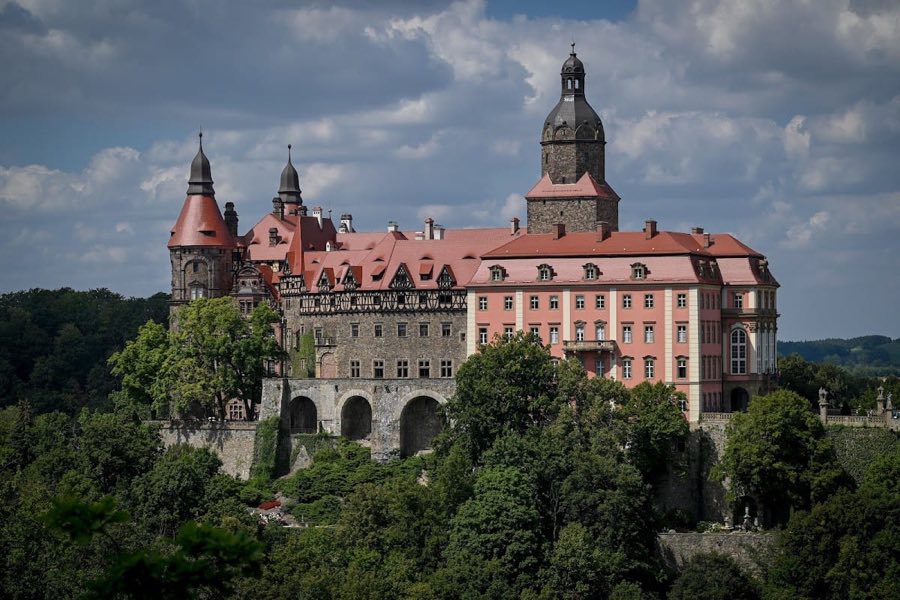
Grodno Castle is a stone fortress perched atop Choina Mountain, originally the largest castle in the Silesian region. Its layout stretches about 170 meters in length, encompassing an overall perimeter close to 400 meters. The castle is divided into two main parts: an upper medieval core and a later Renaissance expansion.
The oldest section, the upper castle, covers roughly 950 square meters on a narrow polygonal rock outcrop naturally defended by steep ravines and the Bystrzyca River valley below. This area includes an imposing defensive tower on the southern side, a gate fortified with a wooden drawbridge spanning a dry moat at the southeastern corner, and two stone residential palaces that adjoin the outer walls. The large courtyard here contains a water cistern hewn directly from the rock. Several smaller defensive towers are positioned along the curtain walls, and wooden economic buildings once stood within the courtyard, though these no longer survive.
The Renaissance period brought significant additions led by the von Logau family. They constructed an extended gatehouse featuring an outer gate and living quarters above, as well as an octagonal upper story atop the main defensive tower, reflecting the stylistic trends of the time. Around the medieval core, a new outer ring of walls was erected, strengthened by bastions for improved defense. The castle’s lower bailey, or outer castle, was enlarged into a narrow, elongated courtyard protected by five bastion towers.
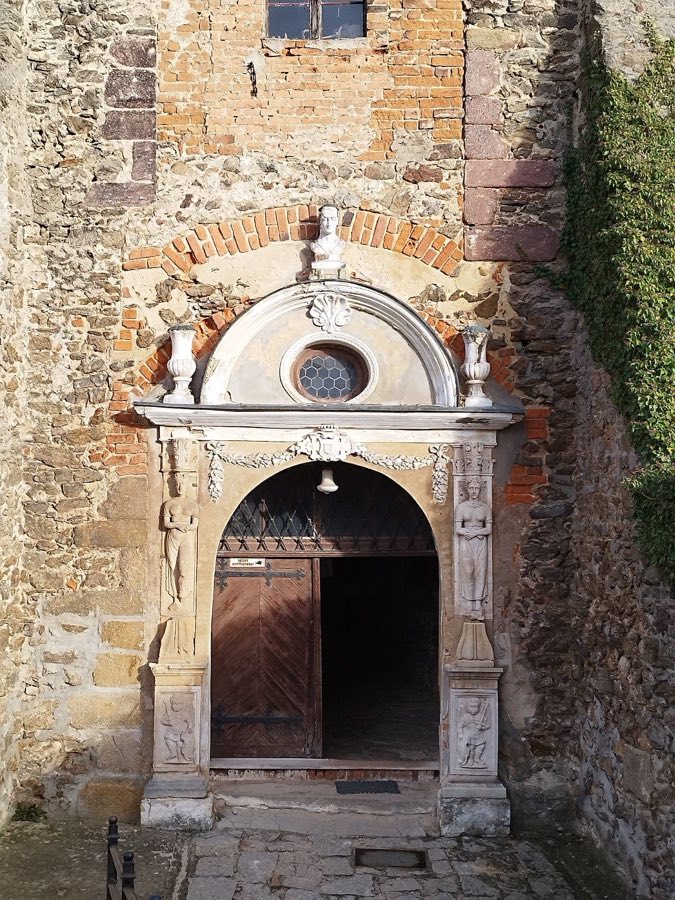
Among the lower castle’s most remarkable features is the northwest curtain wall, which includes a two-story gatehouse richly decorated with colorful sgraffito—a technique of layering and scratching plaster to reveal plant, geometric, and figurative designs dating to about 1570. The castle’s facades display artistically crafted gables, dormer windows, and parapets, as well as sandstone Renaissance portals. One notable portal bears the imperial eagle emblem associated with Emperor Maximilian II, marking the castle’s connection to broader European aristocratic networks.
The castle walls themselves are topped with crenellations for archers and strengthened by stone buttresses at corners. A small quadrangular tower stands on the southern curtain wall, while a gate tower equipped with a portcullis—an iron or wooden grille that could be lowered to block entry—is located in the southwest corner.
Within the lower castle area, archaeological evidence remains of functional buildings such as a bakery and bathhouse, which supported castle life. Though many of these structures have been lost over time, their foundations provide insight into daily operations.
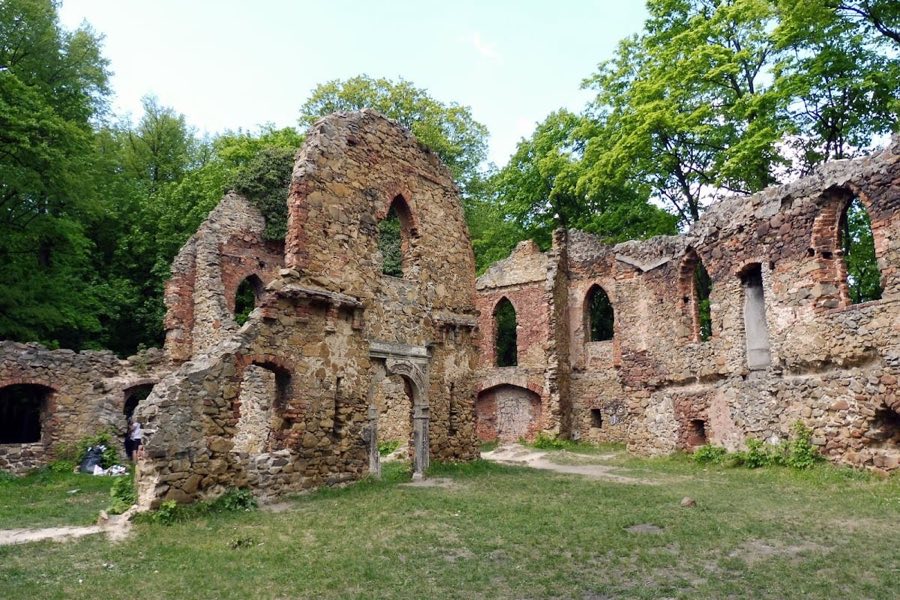
The castle underwent partial collapses in the late 18th century, notably affecting the southern wing of the upper castle and parts of the courtyard. Nineteenth-century restoration efforts focused on stabilizing the castle’s walls, repairing roofs, and partially renewing the sgraffito decorations and other architectural details. Despite these interventions, the upper castle still exists as a partially roofed ruin with some window openings missing.
From its main tower, the castle commands wide views across the Owl Mountains and surrounding forests. Today, Grodno Castle houses a museum exhibiting archaeological finds alongside historical furniture, paintings from the 18th and 19th centuries, arms, and other artifacts connected to its long history.
No. 22810
No. 51048
No. 30071
No. 75330
Comments
Comments for Grodno Castle will require a verified account before posting.
We'll send a verification link before your first comment is published.