No. 69654
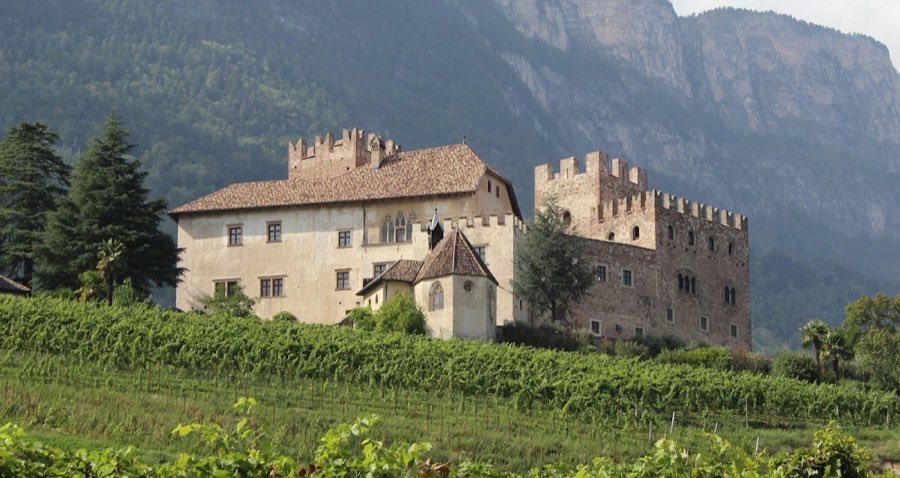
Castle Freudenstein
Italy
CastleRestored12th century
No. 46075
Castle · Italy
No. 46075 · 46.493 N, 11.242 E
Quick summary
Hocheppan Castle is a castle in Italy with origins associated with the 19th century.
See all castles in ItalyHocheppan Castle is located in the municipality of Appiano sulla strada del vino in present-day Italy. The site has been occupied for around two millennia, with its origins tracing back to the ancient Rhaetian tribes who once inhabited the region. Archaeological discoveries confirm that the location was fortified as early as 2,000 years ago, predating the medieval fortress known today.
The medieval stronghold itself was probably constructed shortly after the year 1200. The earliest known written record dates to 1211, where it appears under the Latin name “in castro de Epan.” This suggests the castle was established by Count Ulrich II of Appiano (also known as Eppan) to serve as a defensive stronghold, replacing an earlier family seat near San Paolo-Appiano. This initial seat is commonly believed to correspond with Freudenstein Castle. Historical accounts link Freudenstein to a significant event in 1158 when it was destroyed after the Appiano counts ambushed a papal embassy. The punitive expedition was led by Henry the Lion, who was the Duke of Saxony at the time. Following this, Hocheppan was rebuilt to reinforce the family’s position atop a naturally defensible rocky spur.
By 1315, the castle came under the ownership of the Counts of Tyrol. From then on, it was granted as a fief to several noble families, including the Counts Fuchs von Fuchsberg. During this period, Hocheppan also assumed an administrative role as the center of a judicial district, a function documented in 1490. The governance of this district was later regulated by a statute dating from 1650, reflecting the castle’s sustained importance in local administration.
In the 19th century, ownership shifted to Martin Teimer von Wildau in 1834. Subsequently, the Counts Enzenberg acquired the castle in 1911 and initiated efforts to consolidate its ruins and partially restore its structures. More recently, in 2016, the municipality of Appiano purchased the castle for about 3.5 million euros, recognizing its cultural and historical value. Throughout its history, Hocheppan Castle has been regarded as a key medieval fortification in South Tyrol.
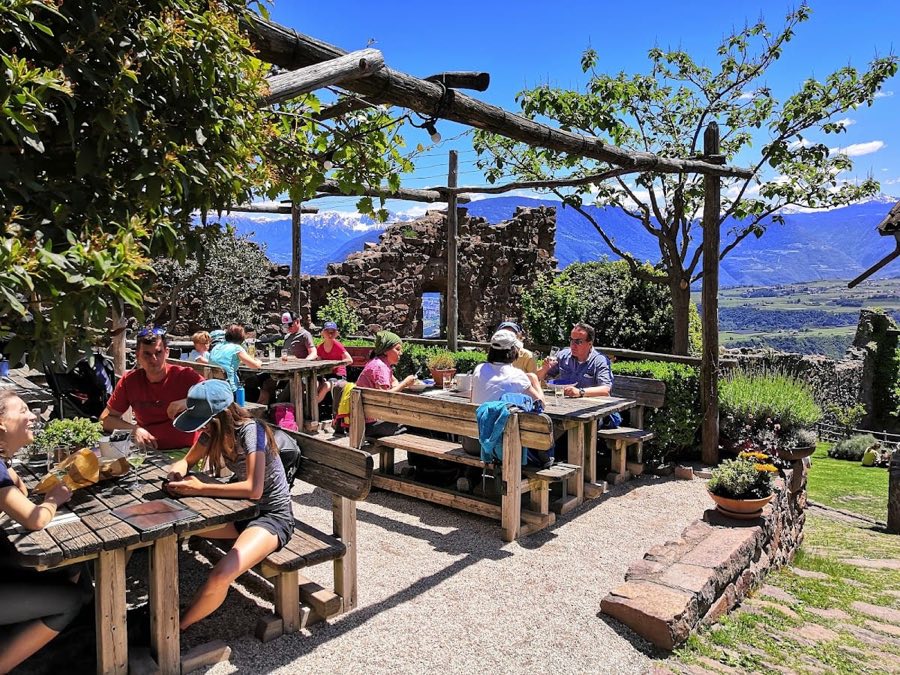
Hocheppan Castle occupies a commanding position on a steep rocky outcrop overlooking the village of Missian and the broad Adige valley. From this vantage point, the fortress provides strategic views not only of the surrounding landscape but also of several other medieval castles situated along both sides of the river. The complex grew over several centuries, visibly layering defensive additions as military technology and architectural styles evolved.
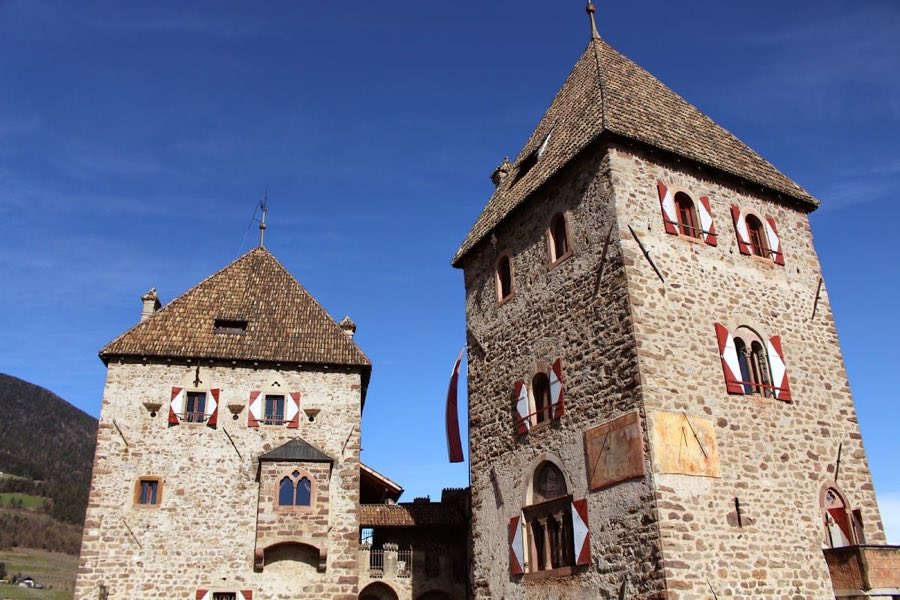
The castle’s northern gate is protected by an intricate series of foreworks and guard towers that primarily date from the late Middle Ages, especially the 16th century. These outer defenses reflect advances in military architecture, designed to complicate direct assaults. Among the fortified elements is an exterior semicircular tower, known as a rondel, which opens toward the castle’s interior. This design accommodated the use of firearms, incorporating early adaptations to gunpowder weaponry.
At the heart of the castle stands a rare pentagonal bergfried—a tall, main defensive tower uncommon in Tyrol. This tower had suffered damage from a deep crack in its masonry but has been carefully restored to preserve its structural integrity. Nearby, the castle palace still shows considerable preservation, offering insight into the residential and administrative spaces that once operated within the fortress.
One of the castle’s most distinctive features is its chapel, a small rectangular building that predates the main fortress, having been built in 1131. Rather than standing apart, the chapel was later incorporated into the castle’s overall structure. Architecturally, it is notable for having three apses—semi-circular or polygonal recesses usually housing altars—embedded within the thickness of one of its short walls, alongside a side entrance. Inside, the chapel contains some of the finest Romanesque frescoes in Tyrol. These murals mix sacred biblical scenes with secular imagery. The exterior frescoes have been interpreted as possibly illustrating the legend of King Theodoric, a figure from medieval Germanic lore. Meanwhile, the chapel’s interior walls depict various biblical narratives, including cycles of the Wise and Foolish Virgins from the New Testament, emphasizing both religious instruction and artistic heritage.
Outside the main castle precinct, roughly a ten-minute walk away, stands the Kreideturm or Chalk Tower. This 13th-century tower is a tall, quadrangular structure coated in white plaster, with an elevated entrance designed for defensive purposes. A second arched opening once provided access to a wooden battlement walkway, which has not survived. Surrounding the tower are vestiges of a small ring wall that likely formed a defensive enclosure. Historically, the Kreideturm functioned as a strategic outpost and signal tower, utilizing chalk fires to send messages visible for many kilometers.
Today, the ruins of Hocheppan Castle have undergone consolidation and partial restoration, safeguarding these remarkable features. Inside the castle stands an open-air refreshment point, and keys held there provide access to the well-preserved Romanesque chapel, allowing for close appreciation of this rare architectural and artistic treasure.
No. 69654
No. 70259
No. 11186
No. 26236
Comments
Comments for Hocheppan Castle will require a verified account before posting.
We'll send a verification link before your first comment is published.