No. 11186
Haselburg Castle
Italy
CastleRuin13th century
No. 26236
Castle · Italy
No. 26236 · 46.503 N, 11.350 E
For events
Maretsch Castle, Bolzano is marked as a château or castle venue lead. Capacity, indoor/outdoor spaces, catering rules, and accommodation options are published only after public verification.
Event types: Private events, Cultural gatherings, Filming and photography
Quick summary
Maretsch Castle, Bolzano is a castle in Bolzano, Italy with origins associated with the 13th century.
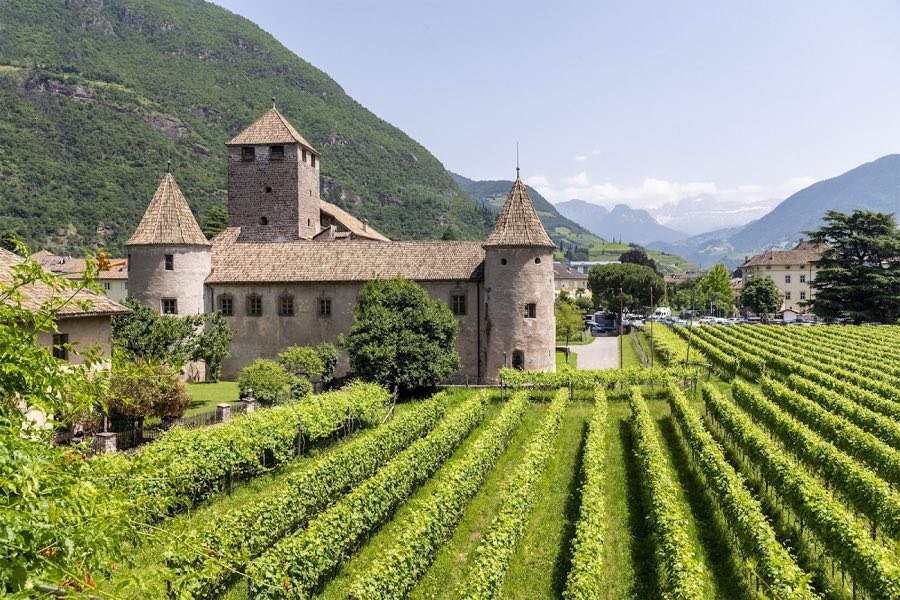
See all castles in ItalyMaretsch Castle in Bolzano, Italy, is a medieval lowland castle whose oldest core dates to the 13th century and which was reshaped into a Renaissance palace-like residence in the mid-16th century. The site first appears in records as Moretes around 1180–1190, and it developed through a sequence of noble and religious owners, gaining artistic decoration and administrative uses that secured its place in the town’s history.
Origins and medieval growth. The family name Maretsch is recorded in 1275 with Heinrich von Maretsch, a ministerial of Count Meinhard II of Gorizia–Tyrol. The massive bergfried (keep, a tall defensive tower) belongs to the 1200s. From the 1300s onward the complex underwent successive enlargements under different hands. Documentary mentions identify the place as Maretsch near Bolzano in 1431 and as Maretsch above Bolzano in 1438. Older writings attributed an early fortress to Berthold of Bolzano around 1194, but Berthold is not actually connected with construction.
Renaissance transformation. Between 1558 and 1570 Lukas Römer, acting for the local branch of the Teutonic Order, oversaw a large rebuilding that gave the compound its present palace-like appearance and introduced extensive Renaissance wall painting. In recognition of these works the Römer family received a baronial title from Archduke Ferdinand II of Austria.
Seventeenth-century alterations and later ownership. The property passed by marriage into the Hendl family and came into Ulrich von Hendl’s hands in 1612. He carried out notable embellishments from 1629 to 1634, and the main portal and the western half of the building date to that phase. In 1657 the castle was sold to the Cistercian abbey of Stams and in 1658 it passed to Archbishop Guidobald von Thun and Hohenstein; members of the Thun family retained ownership until 1851.
Military and administrative uses, nineteenth to early twentieth century. Karl, Count Thun sold the estate on 19 February 1851 to Countess Anna Sarnthein, who then let it to the state for use as an arsenal, and the building functioned as an arms depot for decades. Inheritance brought the site to the Toggenburg family in 1894. In 1918 the castle provided military quarters. After South Tyrol became part of Italy, parts of the Innsbruck archive for the region were moved to Maretsch in 1919 and the castle served for a long period as the Bolzano State Archive.
Twentieth-century restorations and contemporary role. The structure underwent restoration in 1930–1931. By 1972 it was judged dilapidated and archival holdings were transferred until the regional library facilities were completed. The Toggenburg family sold the property in 1974 to the local tourism authority, which carried out extensive structural work and fresco conservation in the late twentieth century. Today the municipality entrusts management to the Foundation Bozner Schlösser (Foundation of Bolzano Castles) and the building serves as a venue for conferences and events; access is seasonal or by appointment. One description places the castle within the historic town centre and emphasizes its character as a residence rather than a primarily defensive stronghold.
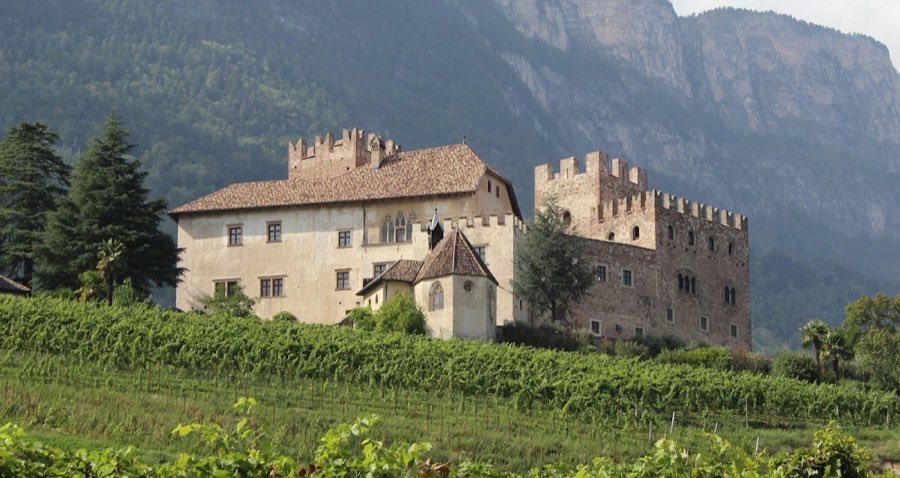
The complex occupies a compact site within Bolzano’s inner urban area, close to the Talfer promenade and set among vineyard terraces. The plan centres on a thick medieval bergfried (keep, a tall defensive tower) from the 1200s, around which later wings and defensive works were arranged. The overall character is that of a lowland castle, adapted over centuries from fortified core to residential palace.
Surrounding the core there is a continuous defensive wall with a raised defensive walkway, and the parapets feature swallow-tail crenellations. A moat and bridge marked the original enclosure and provided controlled access. Mid-16th-century rebuilding added four round external towers of unequal height and diameter; these round towers are integrated into the outer line and reflect the transformation carried out in the Renaissance phase.
The interior received major decorative schemes during the Römer renovations, with large fresco cycles concentrated in the knights’ hall, within some towers, and in the chapel. These cycles present biblical subjects and heraldic imagery, and the painters are anonymous, attributed to a circle linked with Archduke Sigismund. The main entrance and the rebuilt western half of the building date to the refurbishment by the von Hendl family between 1629 and 1634.
Surface detail includes a Sator palindrome (word square reading same both ways) carved on a tower wall that incorporates the Lord’s Prayer and the symbols alpha and omega. The exterior fabric survived the Napoleonic wars without major external damage, while many interior ceilings and painted surfaces decayed during long periods of vacancy; later interventions in 1930–1931 and further conservation in the late twentieth century stabilised structure and recovered painted decoration. Today the castle’s principal walls and frescoed rooms stand conserved after those restoration campaigns.
No. 11186
No. 38745
No. 46075
No. 69654
Comments
Comments for Maretsch Castle, Bolzano will require a verified account before posting.
We'll send a verification link before your first comment is published.