No. 56088
Ekebyhov Castle
Sweden
Manor houseIntact17th century
No. 94339
Castle · Sweden
No. 94339 · 59.051 N, 17.666 E
Quick summary
Hörningsholm Castle is a castle in Sweden with origins associated with the 15th century.
See all castles in SwedenHörningsholm Castle stands on Mörkö, Sweden, and was established by members of the medieval Swedish nobility.
The place began as a farmstead by 1260 when it belonged to Karl Ulfsson, who later entered the Teutonic Order and died at the Battle of Durbe; in his will he left several farms to the Teutonic Order, and the estate may at one time have been under that order’s control. Earlier records give the site the name Symondöö. In 1308 the property belonged to Duke Erik Magnusson and thereafter passed among noble families that include Örnfot, Sture, and Gyllenstierna.
By the late 15th century the land was held by Erengisle Nilsson, who died in 1469; his widow sold the estate to Nils Bosson Sture, who most likely began construction of a fortified residence at the end of that century. The stone foundations and basements that remain today belong to the building phase begun at that time. Over the following decades the Sture family enlarged the site, transforming it into a late medieval to Renaissance castle notable for its scale and complexity for a private stronghold, comparable in size and importance to royal castles.
During the Swedish War of Liberation a force of 70 Danish soldiers occupied and plundered the castle in 1520; they were expelled by troops loyal to Gustav Vasa. In the latter half of the 1600s the Swedish government considered acquiring the property as part of national defence planning. In 1719 Russian troops burned the castle to the ground during the Russian pillaging campaign of 1719–1721.
No rebuilding began until 1746 after the estate was sold to Nils Bonde af Björnö, who had been taken prisoner at the Surrender at Perevolochna. Work overseen to completion in 1752 followed designs by the architect Carl Hårleman, and the estate has remained in the Bonde family since the mid-18th century; a member of that family, Carl Bonde, is recorded as owner in 2014. The house underwent renovation under Ivar Tengbom in 1919–1920, and after a serious fire on 18 February 1950 it was repaired again.
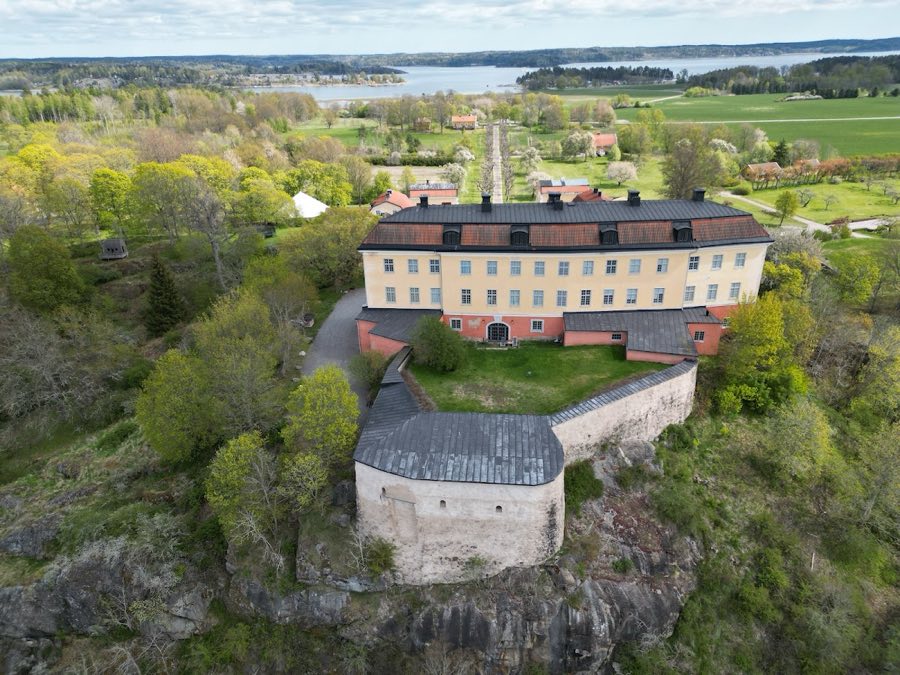
The castle occupies a cliff or hill with broad views across a Baltic Sea inlet toward Södertälje and originally stood on a small nearby island that later became joined to Mörkö by post-glacial land uplift. The medieval enclosure was formed by two stone buildings linked by curtain walls and reinforced by at least two towers, creating a defended courtyard.
Surviving below-ground work and early masonry belong to the late 15th-century phase. Heavy stone foundations and basement walls show the footprint of the medieval complex, and cellars and surviving ramparts from that period remain visible. During the mid-18th-century rebuilding some of those defensive earthworks were altered and made into a terrace as part of the new layout.
A dungeon was uncovered in 1824 beneath the floor of a basement chamber; it had functioned as a prison and investigators found semi-decomposed human remains within the space. This discovery records a grim use of the lower vaults in the castle’s past.
The visible house today reflects the 18th-century reconstruction carried out to the designs of Carl Hårleman. He removed most medieval superstructures and created a building inspired by French Rococo principles, producing a relatively symmetrical composition that includes two square, single-storey wings. Interior movable and decorative items associated with the estate include the Bonde family’s art collection, fine tiled stoves, and a large private library. The building received conservation work in 1919–1920 and was repaired following the major fire in 1950.
No. 56088
No. 34330
No. 53319
No. 72413
Comments
Comments for Hörningsholm Castle will require a verified account before posting.
We'll send a verification link before your first comment is published.