No. 34673
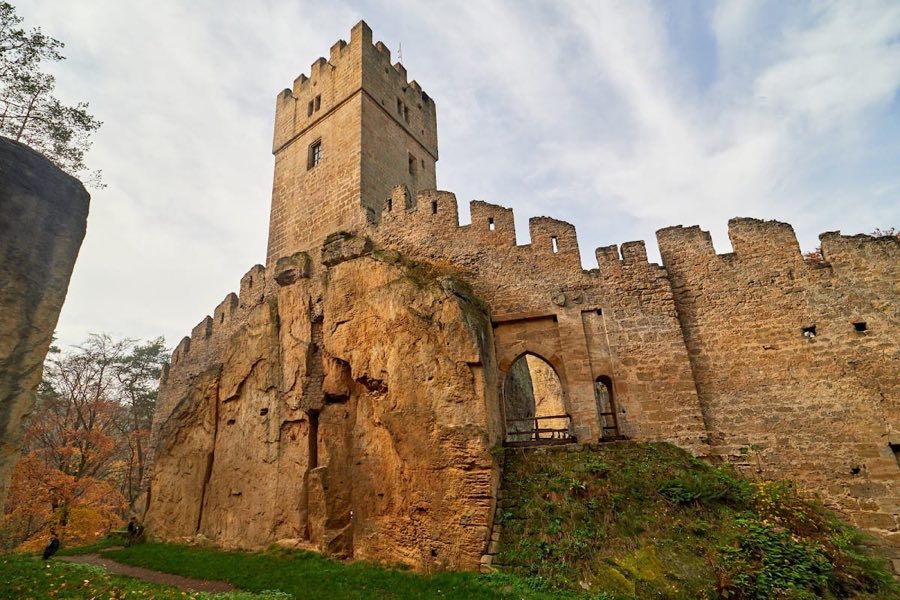
Helfenburk Castle
Czechia
CastleRuin14th century

No. 23764
Castle · Czechia
No. 23764 · 50.606 N, 14.394 E
Quick summary
Hřídelík is a castle in Czechia with origins associated with the 13th century.
See all castles in CzechiaHřídelík is a rock castle situated near the village of Blíževedly in the Czech Republic. It was constructed by medieval Central European settlers, likely under the influence of the Prague bishopric, reflecting the church’s territorial and administrative interests in the Bohemian region.
The site’s origins trace back to the late 13th century, with archaeological evidence suggesting settlement before 1300. The earliest documented individual linked to the location is Martin of Hřídelík, named in 1292 as the burgrave, or castle administrator, responsible for overseeing the nearby village of Blíževedly. The castle itself appears in written records by 1334, confirming its existence and function within the ecclesiastical domain. During this period, Hřídelík served primarily as an administrative center and a prison managed by the Prague archdiocese. Notably, in 1395, the castle held clerics who had been convicted by church courts, emphasizing its role in enforcing ecclesiastical law.
Following the acquisition of the nearby Helfenburk castle by the church in 1375, Hřídelík’s strategic significance diminished. This loss of importance became more pronounced during the Hussite Wars, a series of religious conflicts in the early 15th century that led to widespread destruction and turmoil in Bohemia. The castle suffered damage during these wars and was subsequently abandoned. Over time, the ruins came to be known locally as the “Old House” (Starý dům), marking its decline from a functioning stronghold to a historical relic.
In the early 19th century, Bishop Augustin Hille attempted to repurpose the site by constructing a small brick summer house, or letohrádek, atop the castle ruins. This structure, however, was short-lived and fell into disuse shortly afterward. Further changes in the 20th century saw the site cleared by innkeeper Franz Josef Pietzsch in 1906, who sought to operate a summer tavern there, a venture that similarly did not endure. Before the onset of World War I, the rock caves of Hřídelík were adapted for practical uses such as drying spaces, while the surrounding slopes were cultivated with hop gardens, shifting the site’s use from defensive and administrative purposes to agricultural and local economic activities.
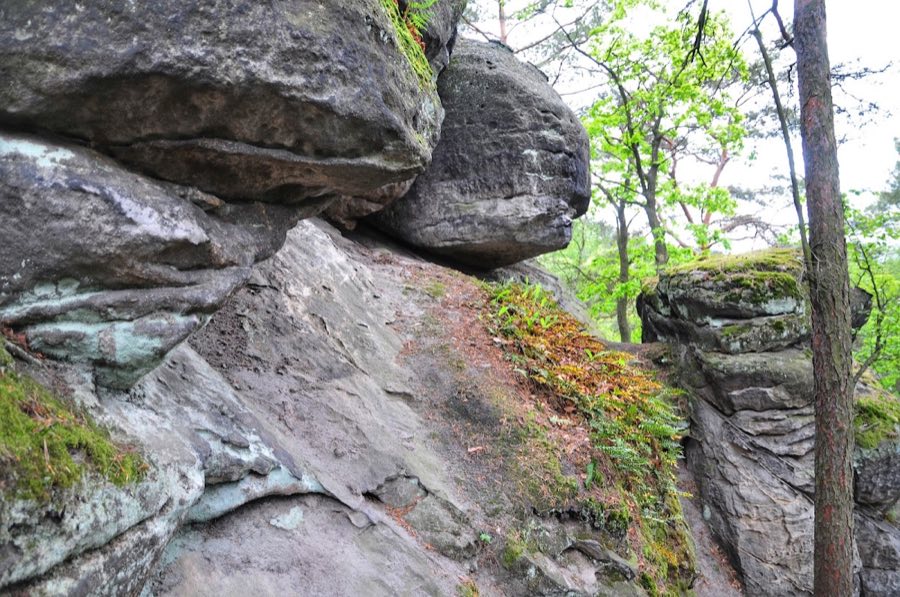
Hřídelík occupies a steep sandstone rock rising approximately 362 meters above sea level, with its layout adapted to the natural formation. The castle’s core features a small upper plateau enclosed by a surviving ring wall, which reaches about half a meter in height. Within this enclosure are remnants of walls that once defined a rectangular palace, indicating a compact but well-structured design suited to the rocky terrain.
Access to the palace area was uniquely secured by an 18-meter-long underground corridor carved into the rock, featuring a Gothic arch profile. This bent passage would have served defensive purposes by controlling entry and providing shelter from attack. The southeastern section of the rock includes partially hewn galleries and natural overhangs, which may have functioned as covered spaces for various uses, such as storage or shelter, hinting at the adaptive use of the rocky environment during the castle’s occupation.
Originally, the castle’s fortifications included a moat surrounding the site, the outline of which has since become overgrown with old fruit trees, marking the former defensive boundary in the landscape. Only limited fragments of the exterior walls remain today, emphasizing the ruinous state of the structure after centuries of neglect and the impacts of warfare.
The 19th-century summer house erected by Bishop Augustin Hille was built from brick masonry atop the ruins. This later construction, representing a shift from military use to leisure, survived only until about 1850 before also falling into ruin. The entire site is recognized as a rock castle, a category of fortress built into natural stone formations, and is protected as a cultural monument by the Czech Republic. Although located near the Kokořínsko – Máchův kraj Protected Landscape Area, Hřídelík itself lies outside the boundaries of this conservation zone.
No. 34673
No. 60518
No. 23643
No. 27100
Comments
Comments for Hřídelík will require a verified account before posting.
We'll send a verification link before your first comment is published.