No. 33483
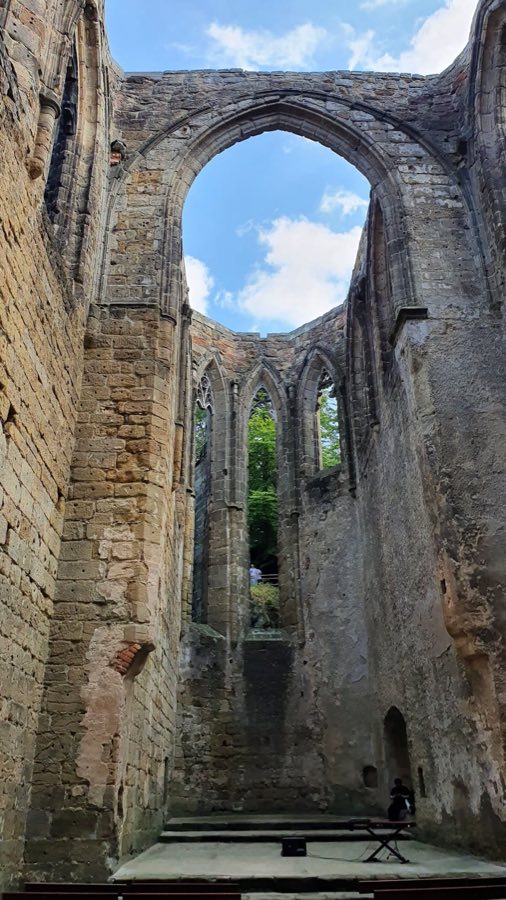
Burg Oybin
Germany
CastleRuinFor events13th century
No. 84786
Castle · Germany
No. 84786 · 50.835 N, 14.792 E
Quick summary
Karlsfried is a castle in Germany with origins associated with the 14th century.
See all castles in GermanyKarlsfried stands in Zittau, Germany, and was built in 1357 by order of Emperor Karl IV under imperial authority, with construction carried out by the burgrave Ulrich Tista von Liebstein.
From its founding the site was established not as a noble residence but as a fortified toll station on the Gabler Straße, the trade road that linked Prague via Gabel to Zittau. Merchants passing this route paid tolls at the castle; the complex provided shelter and escort services for traders rather than serving as a permanent home.
In 1364 the city of Zittau took the castle as tenant, agreeing a payment of 300 Schock Prager Groschen. Control of the place later changed hands in 1412 when Landvogt Hinko Berka von Dubá assumed authority over the fortress. The castle faced military action during the Hussite wars; it resisted a siege in 1421 but was set on fire in a second attack in January 1424.
After the destruction in 1424 the fortress was rebuilt under Emperor Sigismund. A subsequent proprietor, Jan von Wartenberg, used the stronghold as a base for raids. Because of those activities the city of Zittau bought the site in 1442 and ordered the castle to be razed. Over the following centuries much of the ruined fabric was removed and put to other uses; stones were quarried from the site in 1690 for building the Lückendorf church, and further demolition took place in 1721 to provide material for construction in Zittau.
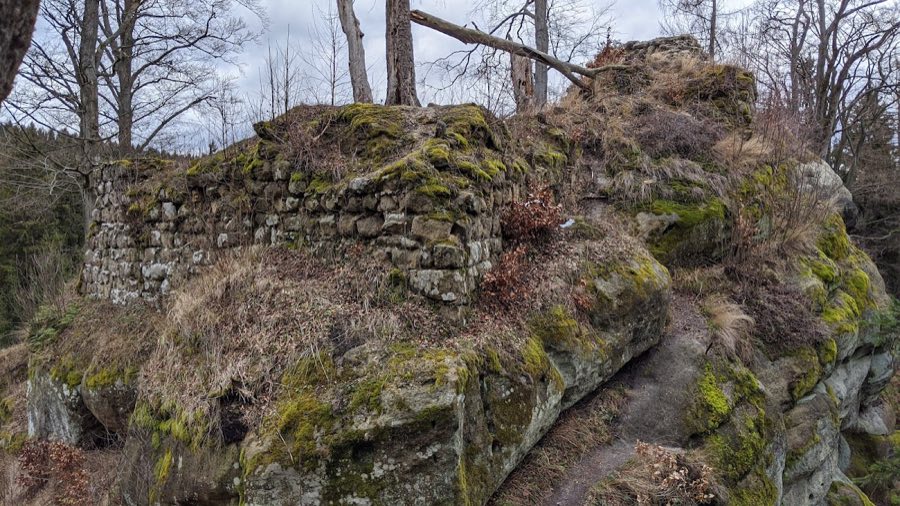
Karlsfried occupies a rocky spur in the Zittau Mountains about halfway between Eichgraben and Lückendorf, above the road that crosses the Stoßsattel between Straßberg and Heideberg. The ruin is a hill castle whose remains are concentrated on that rocky outcrop and whose defensive position controlled the line of the historic road below.
Surviving masonry on the spur includes the remains of an entrance tower and a small palas, both elements belonging to the medieval phase begun in 1357. Fragments of these structures show the layout of the original gate complex and the principal building range. A square bergfried, the tower that formed part of the castle’s vertical profile, also survives in a fragmentary form and stands beside the palas remains.
Below the spur a deliberate rampart or wall crosses the valley. This barrier was designed to make the sunken tracks, the hollow ways created where the road had been diverted, impassable to hostile movement, forming a deliberate valley barrier tied to the castle’s defensive scheme.
Much of the site’s stonework has been removed and reused over time. Large amounts of masonry were quarried from the ruin for new building work, including stones taken in 1690 for the church at Lückendorf, and further material recovered in 1721 for use in Zittau. Today the entrance tower, the palas fragments and the square tower remain as the principal in situ evidence of the medieval complex, while the valley rampart is still visible below the hill.
No. 33483

No. 70035
No. 54860
No. 36829
Comments
Comments for Karlsfried will require a verified account before posting.
We'll send a verification link before your first comment is published.