No. 84786
Karlsfried
Germany
CastleRuin14th century
No. 54860
Castle · Czechia
No. 54860 · 50.777 N, 14.788 E
For events
Lemberk Castle is marked as a château or castle venue lead. Capacity, indoor/outdoor spaces, catering rules, and accommodation options are published only after public verification.
Event types: Private events, Cultural gatherings, Filming and photography
Quick summary
Lemberk Castle is a castle in Czechia with origins associated with the 13th century.
See all castles in CzechiaLemberk Castle is located near the village of Lvová, in what is now the Czech Republic. It was established during the 13th century by the Bohemian nobility as a stronghold within the medieval Kingdom of Bohemia.
The castle was founded around the year 1240 by Havel of Lemberk, a nobleman from the Markvartic family who served under Kings Wenceslaus I and Přemysl Otakar II. It was built as a fortress guarding a key trade route linking Bohemia to Žitava, serving both military and administrative functions. The noble family who took the castle’s name was intimately connected with it during this early medieval period. Notably, Zdislava of Lemberk lived here in the first half of the 13th century. She later became renowned for her charity, supporting hospitals and the poor, and was beatified and canonized centuries later, reflecting her lasting spiritual legacy.
The earliest available written documents note the existence of Lemberk in the 1240s, including a record from 1249 in which Havel incorporated the castle’s name into his title, indicating its importance as a seat of power. Over the following centuries, ownership shifted through several noble families. Around 1400, the castle passed from the Lemberk family to the Wartenbergs, then to the Berkas of Dubá clan in the 1430s. In 1471, it became the possession of the Elsnic family, and later it changed hands again to owners such as the Donín family and Vilém of Ilburk by 1518.
During the early 16th century, the castle and its estates experienced decline, with parts of the fortress falling into neglect or partial abandonment. However, it underwent significant revitalization in the mid-16th century under Jindřich Berka of Dubá who began remodeling the medieval stronghold into a Renaissance-style chateau. This transformation continued into the early 17th century, when the Donín family added a second floor to parts of the structure. The castle’s fortifications were further enhanced after the Thirty Years’ War by the Bredas family, who added bastions and made Baroque-style modifications including the construction of a chapel and a knights’ hall.
In 1726, the castle estate came into the hands of Count Filip Josef of Gallas and later descended within this lineage to the Clam-Gallas family, who held it until 1930. Following this period, the Auersperg family assumed ownership until 1945, when the property was confiscated by the Czechoslovak state under the Beneš decrees after World War II. Prior to its wartime seizure by Nazi authorities in 1941, the castle was still inhabited. Following its transfer to state control, the site was used as a museum dedicated to rural culture starting from 1951. Although it later fell into disrepair and closed in the mid-1970s, efforts have since been made to restore the castle.
The castle grounds have hosted exhibitions of modern glass art and displays honoring Saint Zdislava, reflecting its continued cultural role connected to its historical figures. Additionally, the site has served as a venue for concerts and theatrical events, linking its rich past with contemporary artistic expression.
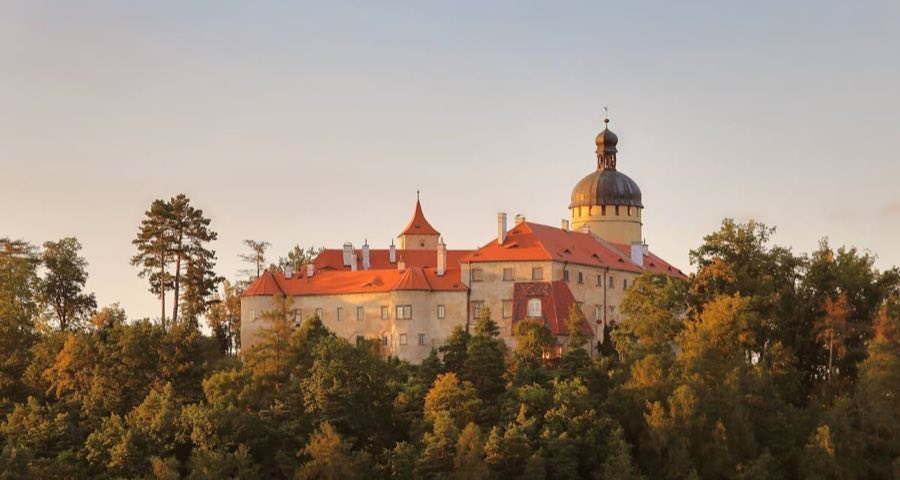
Lemberk Castle occupies a rocky outcrop overlooking the Panenský potok stream valley near Lvová. The site combines medieval fortress elements with Renaissance and Baroque architecture, reflecting its long history of modifications and adaptations.
The most intact part of the original medieval castle is a cylindrical bergfried tower, approximately 8.5 meters in external diameter. This defensive tower features a polygonal base creating a diamond-shaped interior floor above the courtyard level, with the basement located below ground and inaccessible. The tower’s entrance was originally positioned on the northeast side, high above the courtyard, requiring a ladder for access. Later, during the Baroque period, a ground-level doorway was added featuring a segmental vault. Within the tower, a circular vaulted chamber is found at the original entrance level, connected by a staircase embedded within the wall thickness that leads to upper floors. The uppermost level may have had a battlement walkway accessible through a pointed arch doorway. The tower today is crowned by a metal dome-shaped roof dating to 1754, crafted in the Baroque style.
Archaeological investigations have confirmed that a rectangular palace once stood on the southern side of the castle complex, though this structure no longer remains due to Renaissance-era rebuilding. The castle’s fortifications were enhanced after the Thirty Years’ War by the addition of two bastions constructed by the Bredas family.
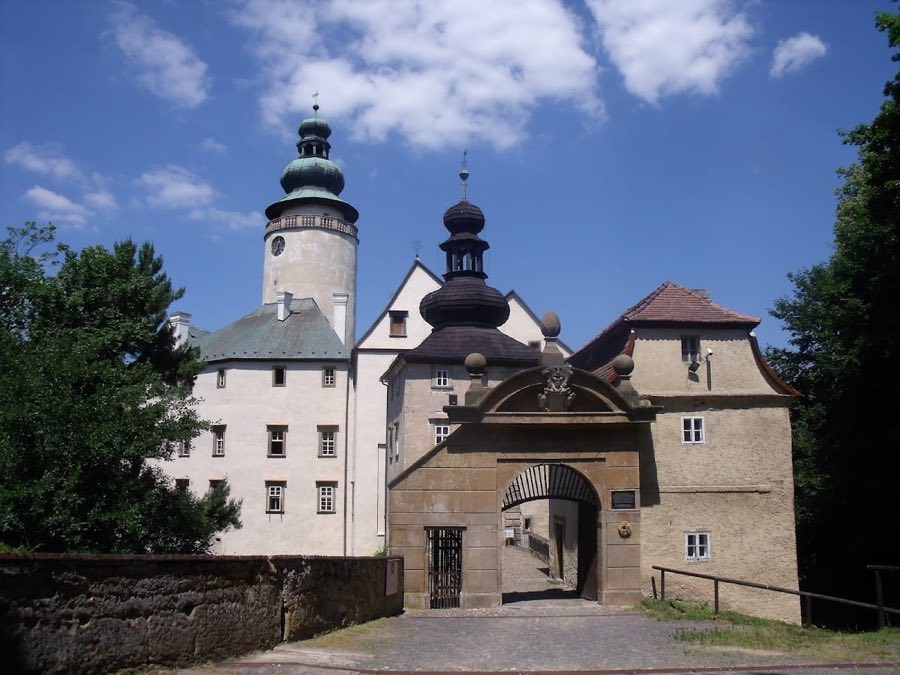
The Renaissance chateau portion includes a wing built shortly after 1550, later expanded with a second floor in the early 1600s. Inside, visitors can find the richly decorated “Hall of Fables,” distinguished by a wooden coffered ceiling illustrating scenes from Aesop’s fables painted around 1610. The main entrance into the castle complex is an early Baroque two-part gate leading into an enclosed area. Access to the core of the castle is gained through a Renaissance portal set into a tower topped by a shingled onion dome. This tower’s lower walls are decorated with sgraffito rustication, a technique involving scratched plasterwork creating a textured visual effect, while the upper floor was originally framed with half-timbered construction.
Most of the castle’s windows are rectangular and feature ornate stucco frames from the late 17th century. The ground-floor facades are adorned with stucco pilasters that once held portrait busts, indicating an emphasis on decorative grandeur. The west wing contains four rooms with 17th-century stucco ceiling decorations, carefully restored in the early 20th century by the artist Jan Dukát. Among these rooms, a dining hall preserves a coffered ceiling illustrating motifs from Aesop’s fables.
In the north wing, the core space is a barrel-vaulted hall decorated with stucco cartouches and ceiling paintings on canvas. Sixteen frescoes portraying scenes related to the Thirty Years’ War hang on the walls here. These paintings were unfortunately damaged by overpainting in the 19th century but still testify to the castle’s historical narrative. Adjacent to the bergfried stands the rectangular Chapel of the Holy Spirit, suiting the castle’s religious functions. This chapel includes side oratories and is lavishly decorated with early Baroque stuccoes featuring both ornamental and figural designs. Its ceiling paintings of Christ’s Ascension and the Assumption of Mary date from the 19th century, created over earlier Baroque frescoes.
The castle complex also contains remnants of a former farmyard, now in ruin, and a Baroque well situated within the courtyard. A surrounding park includes two fountains dating from the 17th and 18th centuries, adding to the site’s historical ambiance. Nearby lies the Bredovský letohrádek, or Breda summerhouse, and a protected avenue of linden trees leading toward the neighboring villages of Markvartice and Markvart, which traces a historical route connected to the castle’s origins.
Beneath the castle is a network of sandstone cellars and a 35-meter tunnel, historically used for mining iron ore. These cellars were also utilized during the 17th century for storing wine and housing brewing equipment. On the castle grounds, visitors can find Baroque sculptures and mythological statues attributed to the sculptor Matthias Bernard Braun. Over the historic “Zdislava’s spring,” a water source of local significance, a pavilion was constructed in 1862.
Today, Lemberk Castle’s surviving structures reflect the layered architectural and historical phases spanning from medieval fortress through Renaissance noble residence to Baroque refinement, preserving the story of its evolving function and significance through centuries.
No. 84786
No. 22298
No. 33483
No. 70035
Comments
Comments for Lemberk Castle will require a verified account before posting.
We'll send a verification link before your first comment is published.