No. 38568
Brechin Castle
United Kingdom
CastleIntactFor sale13th century
No. 30886
Palace · United Kingdom
No. 30886 · 56.704 N, 2.599 W
Quick summary
Kinnaird Castle is a palace in United Kingdom with origins associated with the 14th century.
See all castles in United KingdomKinnaird Castle is situated near the town of Brechin in Scotland. The site has long-standing ties to Scottish history, originally established by the Clan Carnegie, a prominent Scottish family.
The origin of the castle lies in a mansion constructed during the 14th century, with the first recorded mention of a castle on the property dating to 1409, when the estate came under the ownership of Clan Carnegie. During the mid-15th century, in the aftermath of the Battle of Brechin, the castle suffered a destructive attack in 1452. Alexander Lindsay, the 4th Earl of Crawford, set fire to the castle as retribution because Clan Carnegie supported King James II of Scotland in the conflict. Following this event, the castle was rebuilt, becoming a notable residence in the region.
Throughout the 17th century, Kinnaird Castle hosted several important historical figures. King James VI of Scotland visited the estate in 1617, while later in the century, Kings Charles I and Charles II were also guests. James Graham, the 1st Marquess of Montrose, resided at Kinnaird Castle for a period of three years starting in 1629, linking the site to key political and military developments of the time.
In the early 18th century, during the Jacobite rising of 1715, the castle again became a focal point in Scotland’s turbulent history when James Francis Edward Stuart, known as the Old Pretender, stayed there during the harsh winter of 1715. Due to the clan’s support of this Jacobite cause, the estate was confiscated by the British Crown shortly after the rebellion.
Architectural transformation occurred in 1791 when James Playfair redesigned the castle into a large residence reflecting contemporary tastes. Ownership returned to Clan Carnegie in 1855, after which the property underwent further remodeling by architect David Bryce, who favored the Victorian baronial style that was popular in the 19th century. In 1921, the castle was heavily damaged by fire; subsequent repairs were undertaken to restore parts of the structure.
The castle has remained the principal home of the Carnegie family, who hold the title Earls of Southesk, for over six centuries. Today, Kinnaird Castle is recognized for its historical and architectural significance, being listed as a Category B historic building in Scotland. Its surrounding gardens are also noted for their design and are included in the national Inventory of Gardens and Designed Landscapes.
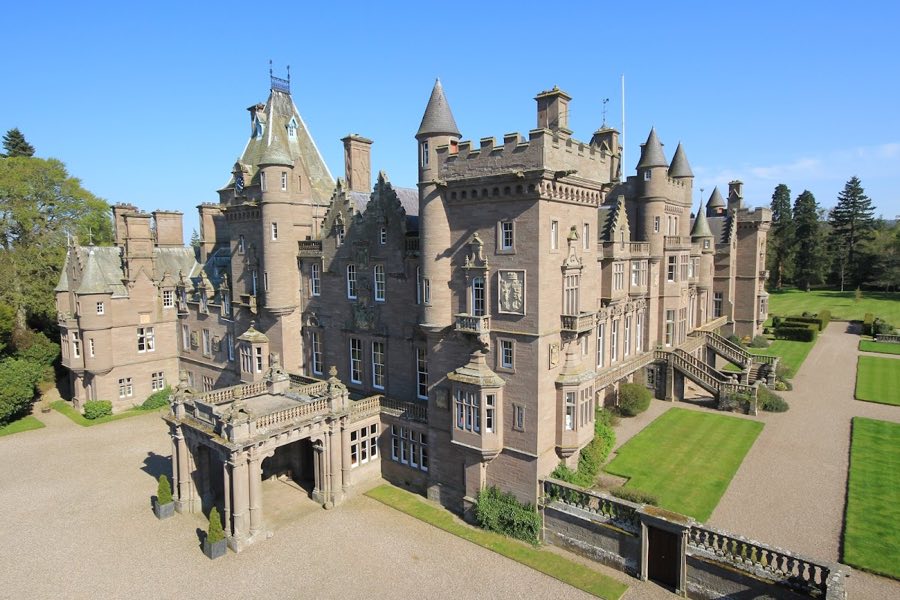
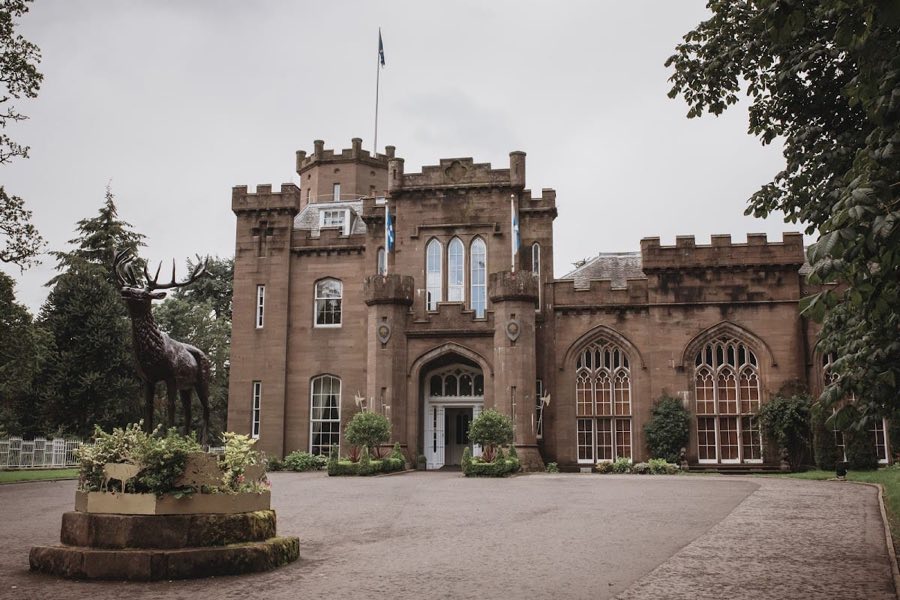
Kinnaird Castle is currently a three-storey country house laid out on a square ground plan, with an open courtyard at the rear that contains stables, illustrating the blend of residential and functional elements typical of such estates. One of the defining features of the west façade is a central tower accented by tourelles—small turrets that project from the walls often for decorative effect—flanked by two additional square-plan towers, giving the building a characteristic silhouette associated with Victorian baronial style.
On the north side of the building, a porch supported by columns provides an entrance, reflecting later architectural tastes in the castle’s evolution. Importantly, elements of the original 15th-century tower house remain preserved within the south wing, connecting the modern residence directly to its medieval origins through surviving masonry and structural fabric.
While extensive remodeling and rebuilding have altered much of the castle’s appearance over time, especially following the fire damage in the early 20th century, these historic components and the overall layout contribute to the estate’s architectural significance. Kinnaird Castle’s designation as a Category B listed building confirms its regional importance and the value of the preserved medieval elements alongside later Victorian adaptations. The castle’s setting within carefully maintained grounds also adds to its historical character, with the landscape holding national recognition for its designed features.
No. 38568
No. 67549
No. 98750
No. 13142
Comments
Comments for Kinnaird Castle will require a verified account before posting.
We'll send a verification link before your first comment is published.