No. 73708
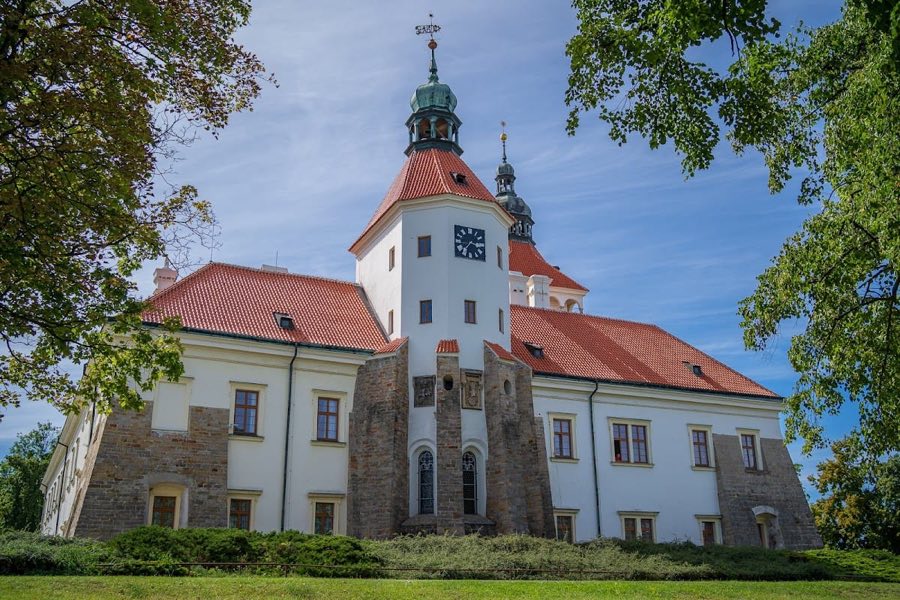
Smečno Castle
Czechia
ChâteauRestored15th century

No. 73410
Palace · Czechia
No. 73410 · 50.124 N, 13.956 E
For events
Lány Castle is marked as a château or castle venue lead. Capacity, indoor/outdoor spaces, catering rules, and accommodation options are published only after public verification.
Event types: Private events, Cultural gatherings, Filming and photography
Quick summary
Lány Castle is a palace in Czechia with origins associated with the 15th century.
See all castles in CzechiaLány Castle in Lány, Czechia, began as a medieval stronghold built by local Bohemian nobility and by the late 15th century stood on the present site in a form that later allowed Renaissance transformation. The building acquired special national importance in the 20th century when it became the presidential summer residence of Czechoslovakia, hosting state visits and major political events, and later continued as an official residence under successive Czech presidents.
A wooden fortress appears in records from 1392, held by a local landowner named Hašek of Lány. During the 1500s the estate passed through several noble hands, including the Žejdlice family by 1528 and Jiří Bořita of Martinice in 1581, before coming under imperial administration in 1589. In 1592 the site was rebuilt as a Renaissance one‑storey summer hunting house with a U‑shaped plan, decorative plasterwork, and surrounding moats. This conversion gave the building a civilian, leisure function tied to noble hunting traditions.
In the 17th and 18th centuries the house was reshaped to reflect changing taste and ownership. The simple Renaissance form received Baroque alterations during the 1600s. In 1730 an additional floor was added under the Wallenstein family, and between 1748 and 1752 a church dedicated to the Holy Name of Jesus was built or enlarged in a rococo manner and linked to the castle by a passage. Ownership changed again in the late 1600s and early 1700s, and from the early 18th century the Fürstenberg princely family held the estate until the state purchase in 1921.
The 1800s brought further modification and estate reworking. Substantial structural changes took place under Prince Carl Egon II Zu Fürstenberg between 1821 and 1825, including the addition of upper storeys and a new entrance on the north side. Mid‑century works closed the defensive moat and removed the outer wall in 1849–1850. In 1861 new stables and greenhouses in the then‑fashionable neo‑Gothic style were erected, and attic living spaces were enlarged around 1902–1903.
The Czechoslovak state acquired the estate in July 1921, purchasing the castle with park and annexes as a presidential summer residence. The transaction covered some 5,000 hectares including forests and church patronage, with the castle, park and outbuildings assigned a specific valuation within the overall price. The government immediately commissioned adaptations by architect Jože Plečnik, and intensive reconstruction ran from 15 July to 6 August 1921 using several hundred permanent workers and additional subcontractors at a declared cost. President Tomáš Garrigue Masaryk personally approved the proposed changes and then used the castle as his country home for many years, living there almost continuously after his resignation in 1935 until his death in 1937; he was buried in the nearby municipal cemetery. Security during his residence was provided by Czechoslovak legionaries.
On 16 December 1921 the Treaty of Lány, sometimes called the Treaty of Prague, was signed at the castle during a visit by the Austrian president and chancellor, confirming friendly relations between Czechoslovakia and Austria. During the Second World War the castle was used intermittently by the Protectorate president Emil Hácha. After the war it served as a summer residence for communist leaders, including Klement Gottwald, and for later presidents of the Czech Republic.
From 1 January 1949 the estate’s forest administration was separated administratively. In 1960 the state farm at Lány was transferred to the University of Agriculture, and the castle and forest offices were run together under a single administration. Following the end of communist rule, the castle interiors were restored and the building returned to use by post‑communist presidents, including Václav Havel, Václav Klaus and Miloš Zeman. The grounds hosted the 2019 summit of the Visegrád Group, and the official inauguration of Prime Minister Petr Fiala took place at the castle on 17 December 2021 while the president was convalescing. The castle, the adjoining church and the surrounding park are protected as a cultural monument of the Czech Republic. Since 1 March 2023 parts of the first floor have been open to the public, and the park, church and greenhouse are accessible.
The site preserves a sequence of fabric from a medieval wooden stronghold through Renaissance, Baroque and later alterations, set within an English‑style park and former hunting enclosure. The overall plan evolved from a fortified site with moats into a multi‑storey country residence surrounded by parkland and service buildings.
Archaeological and building evidence shows the earliest phase as a wooden fortress first named in 1392. In 1592 the complex was rebuilt as a one‑storey Renaissance summer hunting house laid out in a U shape, with decorative sgraffito, a scratched plaster technique used for exterior ornament, and protective moats around the building. Later work in the 1600s applied Baroque styling across the Renaissance core, and in 1730 the house gained an extra floor, altering its silhouette and internal arrangements.
The church of the Holy Name of Jesus dates to 1748–1752 and stands attached to the castle by a covered passage. The church was executed in a rococo manner and forms an integrated component of the castle precinct, serving as the estate chapel and linked to the residential quarters by direct access.
Nineteenth‑century changes reshaped the castle’s defensive footprint and service areas. The moats were filled and the outer enclosure wall removed in 1849–1850, transforming the castle from a defended manor into open grounds. In 1861 a new range of neo‑Gothic stables and a greenhouse complex were built to support the estate’s agricultural and horticultural functions. Around 1902–1903 the upper living spaces were enlarged and mansard attic areas were created or extended, producing the roofline described in early‑20th‑century accounts.
Work carried out in 1921 for presidential use left a clear layer of modern interventions. Jože Plečnik reworked park features and the pond setting and installed a sculptural fountain on the pond, composed of five Doric columns topped with lion heads symbolizing Bohemia, Moravia, Silesia, Slovakia and Carpathian Ruthenia. The 1921 program also modernised services with electric lighting, telegraph and telephone offices, heating rooms and three passenger lifts, and it transformed the interior layout to support official functions: ground floor rooms for administration, kitchens and staff; a first floor for ceremonial reception rooms including a smoking room with hunting murals, a music room, a ladies’ salon and a large dining room; upper floors laid out as private family bedrooms and guest suites with en‑suite facilities.
Outbuildings around the castle were extensively altered in the 1921 campaign. Much of the older stable complex was demolished and rebuilt, barracks for guards were added to accommodate a detachment of 40, staff apartments and dining rooms were provided, and a large reading room and recreation space were installed. The greenhouse, shooting gallery and farm workshops received repair and upgrading as part of the estate’s conversion to state use.
The landscaped surroundings retain the Bahňák pond within an English park, and a large palm greenhouse formerly used as a winter garden remains as part of the horticultural ensemble. The castle adjoins the Lány game preserve, once bounded by a game fence enclosing almost 10,000 hectares and later by a 27‑kilometre wall erected in 1787. Many of the surviving buildings and landscape elements have been conserved or restored, the site is protected as a national cultural monument, and visitor access is now provided to parts of the first floor, the park, the church and the greenhouse.
No. 73708
No. 54679
No. 84316
No. 50523
Comments
Comments for Lány Castle will require a verified account before posting.
We'll send a verification link before your first comment is published.