
No. 73410
Lány Castle
Czechia
PalaceRestoredFor events15th century
No. 73708
No. 73708 · 50.189 N, 14.037 E
Quick summary
Smečno Castle is a château in Czechia with origins associated with the 15th century.
See all castles in CzechiaSmečno Castle is located in the municipality of Smečno in the present-day Czech Republic. Its origins trace back to the medieval period when it was established by Gothic builders. The first written record dates to 1252, noting the site as a fortress under the ownership of the nobleman Boleslav of Smečno.
In 1322, the estate came under the control of Vítek from what became known as the Kamenický family of Smečno. Later, between 1416 and 1418, the Martinic family acquired the fortress and maintained possession for nearly five centuries. During the mid-15th century, Bořita II of Martinic, serving as court marshal to Kings Ladislaus the Posthumous and George of Poděbrady, oversaw a transformation of the fortress. It was rebuilt into a late Gothic castle before 1460, signaling an important phase of development for the property.
The settlement around the castle grew in stature over the early 16th century. It was promoted to a market town in 1510 and subsequently gained full town status in 1515. In 1522, Hynek Bořita of Martinic, a prominent family member, attained the position of highest regional judge, reflecting the estate’s growing political significance.
Around 1586, Jiří Bořita of Martinic initiated a significant architectural overhaul, converting much of the old fortress into a Renaissance-style chateau. This renovation preserved only parts of the original medieval towers, marking a shift to a more residential and representative character.
Following the upheaval of the Thirty Years’ War (1618–1648), the castle underwent further reconstruction beginning in 1630. Additional modifications and the creation of landscaped grounds occurred in the mid-18th century. This period included the construction of a Baroque sala terrena, a type of garden pavilion or summer hall.
In the 20th century, from 1950 until 1955, the castle served a very different purpose. It housed the 57th Auxiliary Technical Battalion, which consisted of laborers compelled to work in nearby mines during this time.
Today, the entire castle complex, along with its surrounding park and sculptural elements, is legally protected as a national cultural monument of the Czech Republic, recognizing its long historical and architectural heritage.
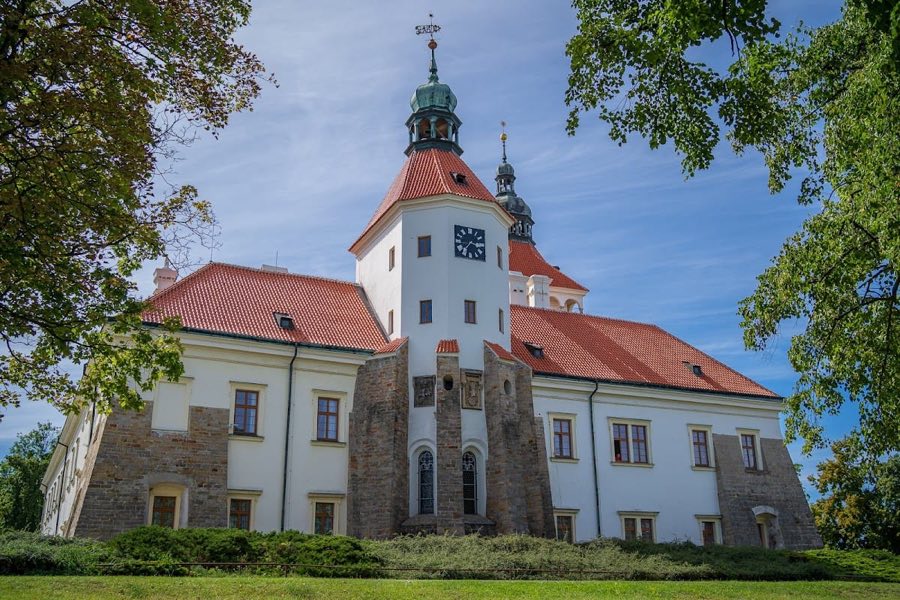
Smečno Castle is composed of four one-story wings arranged around a roughly rectangular courtyard. This courtyard is encircled by a moat that was originally filled with water. The southwestern corner of the complex retains what is likely the lower portion of an original tower dating back to the medieval fortress phase. The castle chapel, featuring a polygonal apse, also dates from the Gothic period, providing a direct link to the site’s earliest constructions.
The northern wing is notable for its massive square entrance tower, which includes a gallery and Renaissance-style arcades beneath the roof. The castle’s main entrance lies on the ground floor of this tower, accessible by a bridge crossing the moat. The entrance itself is marked by an ornately decorated portal, and the corners of the building are emphasized by large pilasters, adding structural strength and visual emphasis.
On the eastern wing stands a polygonal tower supported by external buttresses. This tower houses the Chapel of St. Anne, built around 1460. The chapel’s design features a rectangular main space (nave) with a pentagonal apse, covered by a net vault—a type of stone ceiling with a complex, web-like framework. Stone keystones within the vault display the coats of arms belonging to Bořita of Martinic and his wife, Anna of Kunvald, connecting the architecture to historical family patrons. The chapel contains a late Gothic altarpiece adorned with relief carvings of St. Anne and other saints, with painted images of saints decorating the altarpiece’s reverse side.
Inside the castle, a large hall on the upper floor is distinguished by a stucco ceiling, while the corridor in the southern wing showcases Renaissance painted ceilings. In contrast, the eastern wing features a painted beam ceiling, illustrating the castle’s array of decorative interior styles resulting from different phases of construction and renovation.
The surrounding castle park is styled in the English garden tradition and includes several 18th-century sculptures depicting figures such as Pomona (goddess of fruit), Flora (goddess of flowers), Samson, and Hercules. Two obelisks from the 18th century flank the entrance to this park, marking the transition from natural landscape to formal garden.
One of the castle’s most remarkable features is the Baroque sala terrena, likely the work of architect Kilian Ignaz Dientzenhofer from the second quarter of the 18th century. This two-story structure has a mansard roof and a richly adorned three-bay risalit—an architectural projection—with a gable on its northern face. The interior vault is a barrel vault, featuring a fresco painted around 1745 by Jan Karel Kovář, adding artistic richness to the space.
The entire complex is approached through a monumental entrance framed by two obelisks and reached by a double-armed balustraded staircase. A metal gate guards this access, flanked by sandstone statues of Pomona and Flora, reinforcing the thematic connection between the garden elements and the castle’s decorative program. These combined architectural and sculptural elements provide a comprehensive picture of the site’s development from its medieval fortress origins to an elegant Renaissance and Baroque residence with extensive landscaped grounds.
No. 73410
No. 80425
No. 60931
No. 18596
Comments
Comments for Smečno Castle will require a verified account before posting.
We'll send a verification link before your first comment is published.