
No. 43479
Chřenovice Castle
Czechia
CastleRuin14th century
No. 77193
Château · Czechia
No. 77193 · 49.697 N, 15.280 E
Quick summary
Ledeč nad Sázavou Castle is a château in Czechia with origins associated with the 13th century.
See all castles in CzechiaLedeč nad Sázavou Castle is located in the town of Ledeč nad Sázavou in the modern Czech Republic. It was built by medieval Bohemian nobility during the early centuries of the Kingdom of Bohemia. The site’s origins trace back to the first half of the 13th century, with the knight Slavek of Ledeč likely responsible for founding the castle. Historical records from 1262 mention Slavek’s confirmation by King Přemysl Otakar II to hold the first market in nearby Hněvkovice, indicating the emerging significance of the settlement around the castle. Prior to the castle’s establishment, a smaller settlement likely existed near the Church of Saints Peter and Paul close by.
Ownership of the castle was notably held by the Ledeč family from Říčany, documented from 1367. Over generations, the castle passed through various members of this family, including the Mikuláš brothers. A tragic event marked this period in 1509, when Sophie of Sovinec, spouse of Burian Ledecký, died along with two children after a floor gave way during a social dance within the castle walls. This incident remains one of the historically recorded personal tragedies associated with the site.
The mid-16th century saw significant architectural transformation under Zdeněk Meziříčský of Lomnice, who reshaped the castle into a Renaissance chateau, reflecting broader cultural and stylistic shifts of the era. As the centuries progressed, the castle’s ownership shifted through several noble families, including the influential Trčka of Lípa, and later the Lobkowicz, Enkenfurt, and Thun-Hohenstein families.
In 1753, Empress Maria Theresa acquired the castle. During the Seven Years’ War in the mid-18th century, the castle served a military role as a cavalry barracks, illustrating its strategic use beyond noble residence. Shortly after the war, in 1763, Maria Theresa donated the property to the Theresian Institute of Noble Ladies, an institution that maintained ownership until the land reforms of the 20th century.
The castle endured damage in 1879 when a fire swept through, prompting partial repairs but delaying full restoration well into the 20th century. Throughout the modern era, the castle adapted to new functions, including office and housing space under state forestry management. Since 1999, the local town authorities have taken stewardship of the castle, undertaking restoration efforts such as uncovering and restoring a historic sundial in 2015. Between 1999 and 2018, the castle has also served as a location for numerous Czech and international film productions.
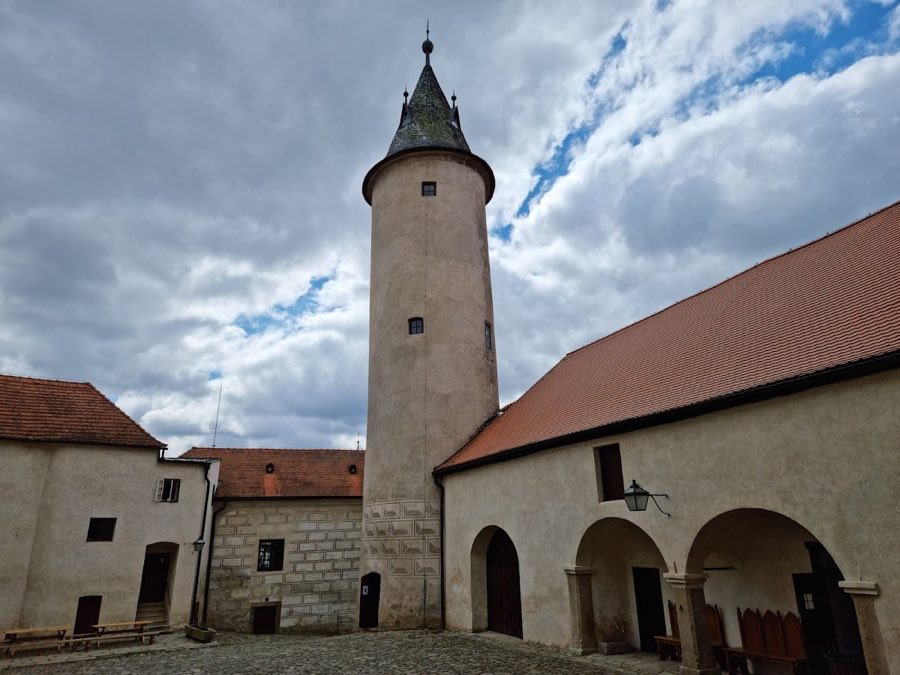
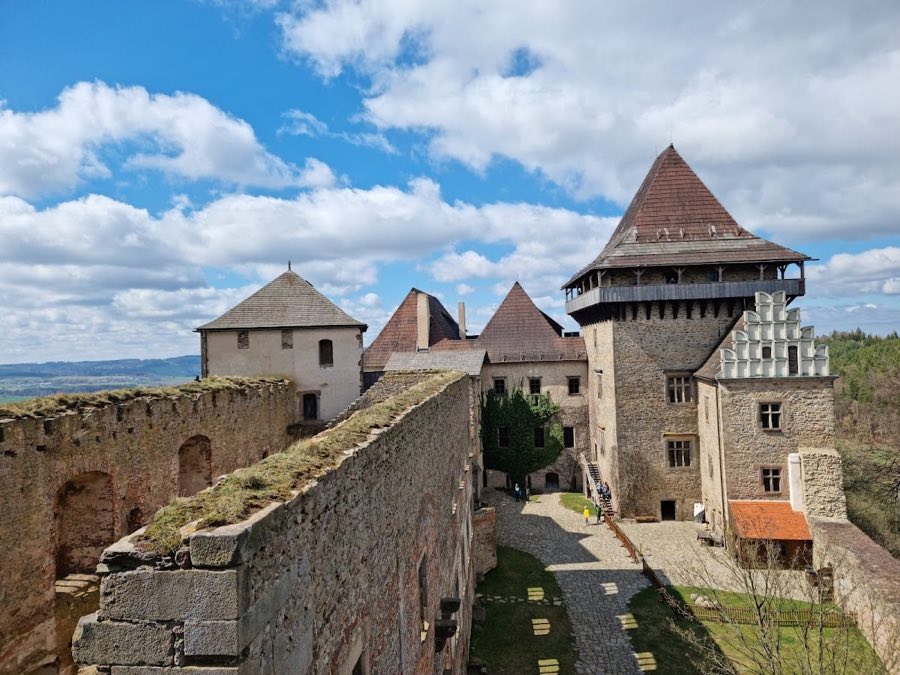
Ledeč nad Sázavou Castle presents as a sizeable three-story palace complex that evolved over several centuries, embodying the transformation from medieval fortress to Renaissance chateau. Its original form was of the bergfried type, characterized by a tall, slender round tower known as a bergfried, which functioned as a defensive stronghold and lookout. Alongside this tower was a three-room palace featuring a curved outer wall on the eastern side, forming part of the early residential quarters.
Entry to the castle initially occurred from the west, starting with a path running along the southern flank of the palace. This route led to the first courtyard, called the outer ward. From there, a secondary entrance at the foot of the bergfried permitted access into the castle’s inner core, securing the main living and defensive areas.
Significant renovations in the latter half of the 15th century expanded the castle’s fortifications. The castle became a through-fortress, a design where gates allowed passage from one side of the complex to the other. New gates were established on both the west and northeast sides, connected by a continuous defensive wall, or curtain wall, strengthened by two inward-facing semicircular bastions—rounded protrusions allowing defenders to cover adjacent walls.
Residential spaces within the core of the castle were enlarged during this phase, and by the early 16th century, a “small palace” was constructed to enhance living accommodations. Further enhancements were undertaken in 1636 by Baron Adrian von Enkevort, who added a new gate and two pentagonal bastions that contributed to the castle’s layered defenses.
Later, at the end of the 17th century, the Thun family expanded the complex, including the erection of a chapel dedicated to the Assumption of the Virgin Mary. This religious addition reflected both spiritual devotion and the importance of private chapels within noble residences.
Following the fire of 1879, repairs resulted in modifying the castle’s west wing on the second courtyard by reducing the building’s original two stories to one. Additionally, portions of the outer fortifications suffered losses in 1903 due to railway construction activities, altering the castle’s defensive perimeter.
Today, the castle houses a museum featuring several exhibition circuits. These include displays on regional history and a recreated 1950s retro apartment, exhibits showcasing the region’s tradition of historical clockmaking and glass production, and a children’s area called “Medvídkové království.” Visitors can also explore the Jaroslav Foglar Museum and ascend the castle’s tower. Notably, recent restoration work uncovered a sundial that had been concealed beneath layers of plaster, which has since been carefully restored, preserving another tangible link to the castle’s rich past.
No. 43479
No. 93628
No. 69353
No. 64714
Comments
Comments for Ledeč nad Sázavou Castle will require a verified account before posting.
We'll send a verification link before your first comment is published.