No. 88532
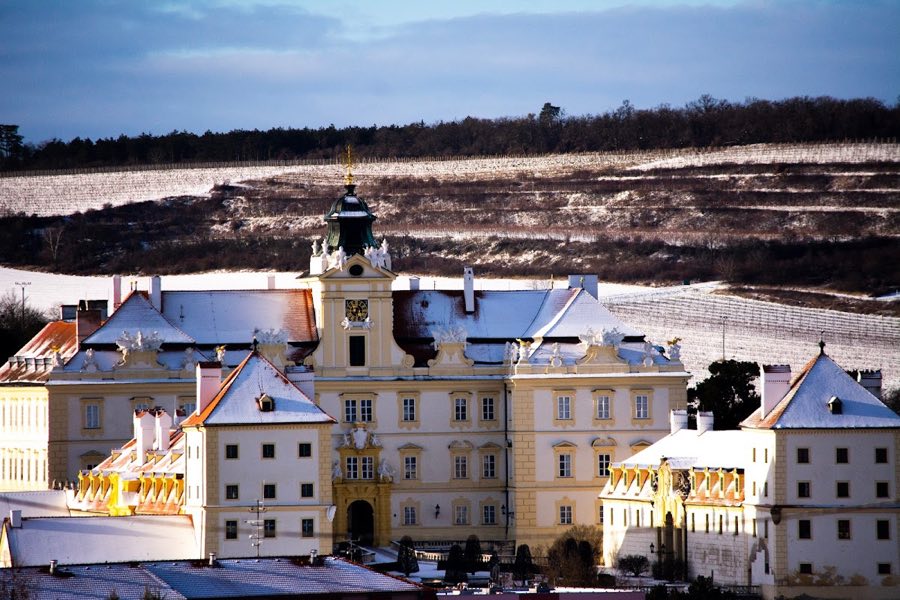
Valtice Castle
Czechia
PalaceRestored12th century
No. 59572
Castle · Czechia
No. 59572 · 48.801 N, 16.806 E
Quick summary
Lednice Castle is a castle in Czechia with origins associated with the 19th century.
See all castles in CzechiaLednice Castle in Lednice, Czechia began as a small fortified bridge stronghold built in 1222 by the local nobles Adamar and Lippert to guard the crossing over the Dyje River.
The site first appears under the German name Eissgrube between 1222 and 1414 and became known as Lednice from about 1412, a name linked to the cold waters of the river.
From the medieval period onward the place gained importance as the centre of an estate that later belonged for centuries to a leading noble family and formed, together with nearby Valtice, a unified country seat important for regional princely residence and landscape design.
In 1249 King Wenceslaus I of Bohemia granted the small fortress to the Austrian noble Siegfried Sirotka.
The property entered the ownership of the princely House of Liechtenstein in 1332.
The Liechtensteins purchased the neighbouring Valtice Castle in 1395 and thereafter treated Lednice and Valtice as a single territorial and representative ensemble.
During the 1500s the medieval stronghold was pulled down and replaced with a Renaissance palace under the patronage of Hartmann Liechtenstein.
The building suffered heavy damage during the Thirty Years’ War, when Swedish troops attacked the site.
After the conflict the family carried out extensive rebuilding, transforming the damaged compound into a Baroque residence in a programme led by the prominent Baroque architect Johann Bernhard Fischer von Erlach, with later work continued by another architect, and the Baroque campaign extended until about 1730.
Modifications continued through the later 1700s and into the 19th century; in 1815 the castle’s side wings were taken down.
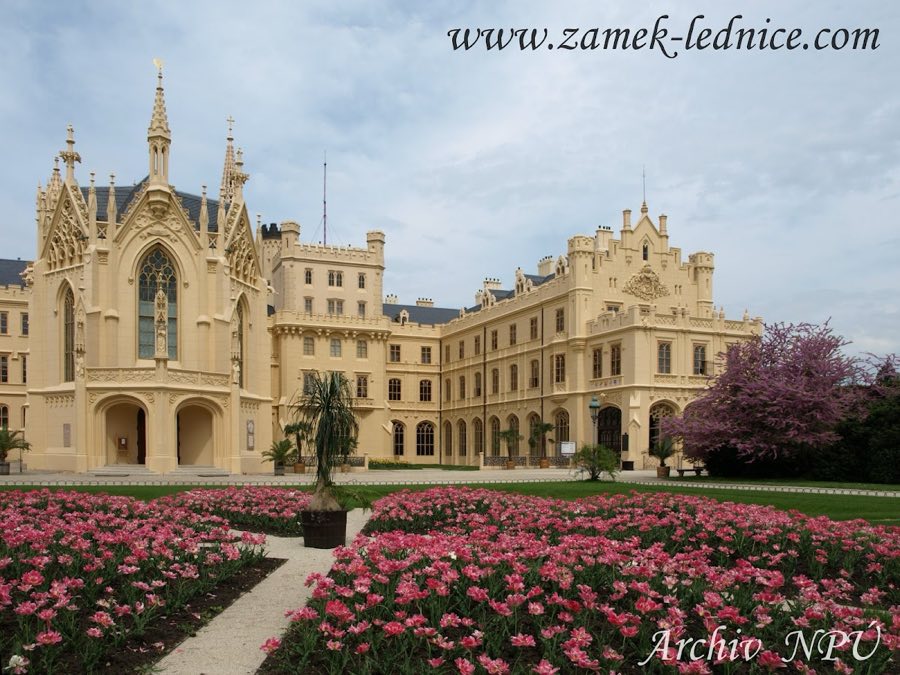
Prince Alois II inherited the property in 1837 and, favouring English tastes, had the palace remodelled in a neo‑Gothic, Tudor‑type manner between about 1846 and 1858.
That rebuilding generally preserved the older Baroque walls while remaking façades, towers and interiors in the historicizing Gothic mode.
A large glass Palm Greenhouse, erected between 1843 and 1848, was physically linked to the main building during this period and became an integral part of the winter garden complex.
After the Second World War the Liechtenstein family left Czechoslovakia amid accusations of links to the fascist regime and removed many valuables.
The estate was nationalized in 1945 and passed into state care under the Czech Ministry of Culture through the National Heritage Institute.
Efforts after 1989 by Prince Hans‑Adam II to recover the property did not succeed.
The broader Lednice–Valtice cultural landscape, which includes Lednice Castle and its designed parkland, was inscribed on the UNESCO World Heritage List in 1996.
The castle sits beside the Dyje River within an English‑style park laid out in the 19th century, where avenues and long sightlines connect the palace to its landscape.
A straight avenue about seven kilometres long aligns the site toward Valtice Castle.
In order to shape ponds, islands and raised garden ground, the riverbed was redirected and new water areas were formed, producing the large parkland around the palace.
The castle pond and the adjacent Lednické rybníky form a water complex that was declared a national nature reserve in 1953.
The park contains a rich arboreal collection, recorded as comprising 614 different tree and shrub varieties.
Many constructed landscape features survive within the grounds, including designed vistas and a sequence of picturesque staffage buildings that punctuate walkways and clearings.
The Palm Greenhouse, built between 1843 and 1848, is a monumental glasshouse roughly 92 metres long, 13 metres wide and 10 metres high, and it shelters tropical and subtropical plants such as fruiting date and banana palms.
It was physically attached to the main palace to form an extensive covered winter garden.
The Palm Greenhouse remains a prominent glazed structure directly connected to the residence.
One of the oldest preserved parts of the complex is the stables and the riding hall, a large service block begun in the Baroque rebuilding after the Thirty Years’ War and associated with work by Johann Bernhard Fischer von Erlach and later completion by another architect.
These service buildings survive as substantial masonry ranges that originally housed horses and an indoor riding arena.
The main building preserves the palimpsest of its development: medieval foundations gave way to a 16th‑century Renaissance plan, later Baroque remodelling and, finally, mid‑19th‑century neo‑Gothic façades.
During the 1800s the exterior received Gothicizing additions — balconies, pointed and round arches, towers and decorative tracery — while much of the earlier Baroque masonry remained at core.
Interior fittings from the 19th century include a spiral staircase carved from a single oak tree dated 1851 and period heating and bathroom installations that provided hot air and running hot water.
Ground‑floor representative rooms are arranged in suites that reflect the princely household’s layout.
These include an entrance vestibule and a sequence of salons and chambers described as the hunting salon, Blue Room, ladies’ bedroom, Chinese Room, Knights’ Hall, dining room, library, turquoise reception hall, red smoking salon and blue dance hall.
Princely apartments occupy the upper floors and were used as family living quarters until 1945.
The park contains a collection of follies and ancillary buildings executed across the late 18th and 19th centuries.
Notable examples include a Roman‑style aqueduct with a grotto, a building identified as the New Bathhouse, a small Musen Temple, a Minaret completed in 1804 and a pavilion called the Hansenburg finished in 1808.
A late‑18th‑century Chinese pavilion is recorded for 1795 but was taken down in 1882.
These structures survive in varying states and remain legible as elements of the designed landscape.
No. 88532
No. 38351
No. 72656
No. 50117
Comments
Comments for Lednice Castle will require a verified account before posting.
We'll send a verification link before your first comment is published.