No. 21445
Castello di Procoio
Italy
CastleRestoredFor events12th century
No. 41206
Castle · Italy
No. 41206 · 43.125 N, 12.229 E
For rent
Montesperello is marked for bookable castle accommodation. Nightly pricing, sleeps count, stay rules, and amenities are displayed only when public operator data is available.
Rental type: Hotel / bookable stay, Short-stay rental
Short-term availability: Bookable accommodation signal
Quick summary
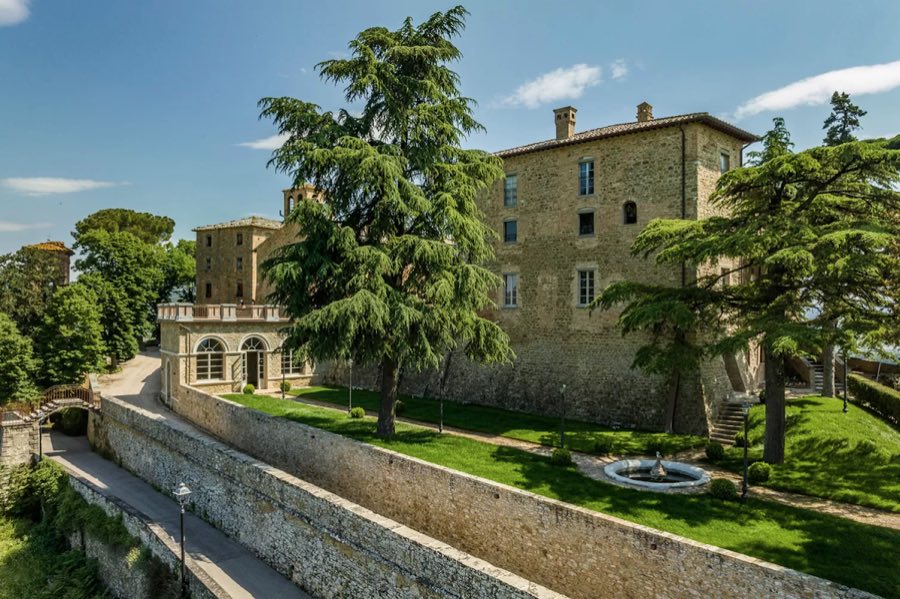
Montesperello is a castle in Italy with origins associated with the 7th century.
See all castles in ItalyThe Castle of Montesperello in Magione, Italy, was established during the Carolingian period, with the surviving site built by Carolingian authorities atop Mountain Penna.
Human use of the hill begins long before the castle. Traces of an Etruscan settlement dating to about 210–214 BCE have been found on the summit and slopes. In the nineteenth century, several Etruscan cinerary urns were discovered built into the walls of two houses on the hill and scattered along its flank, one urn bearing a carved Medusa head. After Rome extended control over the area, the landscape supported dispersed agricultural farms.
Pressure from migrating peoples and the Lombard conquest increased the need for defended positions. Monte Sperello formed part of a Byzantine defensive line organized from Perugia against Lombard attacks. In 608 a local named Bernardo Montesperli established a villa on the site; this residence originally lacked enclosing walls and later became the nucleus for the fortified settlement. Members of the family associated with the site appear in documentary records from the twelfth century.
Under Carolingian rule the land passed into imperial hands. In 997 Emperor Ottone III granted the estate to the Benedictine monastery of San Gennaro di Campoleone at the request of Hugh the Great, who was abbot and margrave of Tuscany. Over the medieval centuries the place saw frequent military action; the castle experienced multiple sieges, conquests, and battles that affected its fortunes and fabric. Population counts record the villa as having thirty inhabitants in 1282 and twenty-four in 1410.
In 1380 the fortress was razed and reverted to a simple villa. Perugia financed reconstruction in 1439, treating Montesperello as a defensive point facing Lake Trasimeno and the territories around Arezzo. During the fifteenth century the parish church of St. Christopher was erected outside the castle wall. Fighting during the 1479 war between Florence and the Papal State left the castle nearly destroyed again. A further rebuilding took place in 1495, explicitly carried out with attention to the then-new effects of firearms.
The complex underwent alterations in the nineteenth century and today functions as a private residential villa owned by the Pesciarelli family. The church of St. Christopher is listed in the Liber beneficiorum in 1350, was rebuilt around 1400–1450, and its bell tower assumed its present appearance in 1797. In the early 1930s a chapel dedicated to St. Francis replaced the former sacristy and three paintings by Tedeschi Tito depicting St. Francis and buildings in Assisi and Montesperello were installed. On 3 July 1949 the painter Gerardo Dottori completed three frescoes in the church apse that form a triptych devoted to St. Christopher, depicting his conversion, the episode of carrying the Christ Child, and his martyrdom.
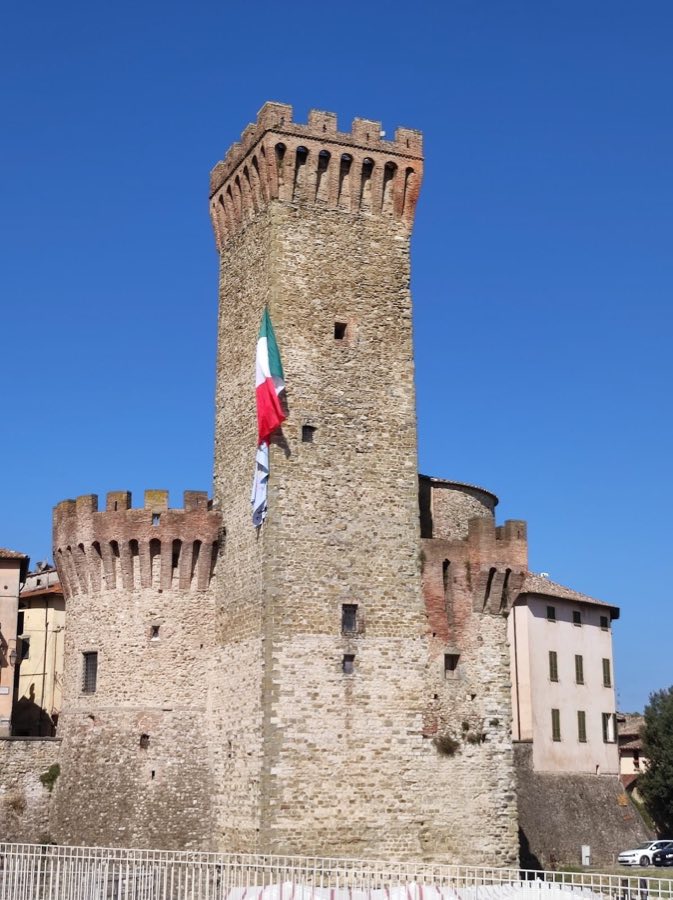
The complex occupies the summit and upper slopes of Mountain Penna and dominates the surrounding fertile valley. The surviving ensemble combines former defensive and domestic buildings gathered around the site of the medieval villa and later castle. Today the built complex includes three connected structures adapted as a hotel, providing about 130 rooms and some 30 to 40 apartment units within the historic fabric, a modern reuse that sits within the older plan.
Built fabric on the hill retains evidence of much earlier activity. During nineteenth-century work several Etruscan funerary urns were found embedded in the masonry of two houses and across the slope; one of these urns is decorated with a Medusa head. Vaulted basements under the castle houses contain a continuous underground passage that crosses beneath them and emerges beyond the outer wall. This subterranean corridor was used as an escape route during sieges, and fifteenth-century land registers identify the occupants of the basement houses as members of the Montesperelli family. The passage survives in situ within the basements.
A short distance north of the church of San Cristoforo, within a modern residential structure, an entrance gives access to a cavity known locally as the “Cave of the Mysteries.” The cavity includes a stair and an open area several meters across, and one internal wall bears an inscription with the year 1628. The original use of this cavity remains unclear in the record; it is documented as possibly having been an Etruscan tomb or a cellar, and also as a space that may have served as a tomb later reused for storage.
The parish church of St. Christopher stands adjoining the castle, outside the former defensive wall, and features an external bell tower whose belfry is recorded in its present form from 1797. Architectural changes to the church include the early 1930s addition of a chapel dedicated to St. Francis in place of the sacristy. Interior artworks include three paintings by Tedeschi Tito depicting St. Francis and regional buildings, and an apse triptych of frescoes executed by Gerardo Dottori on 3 July 1949, portraying episodes from the life and martyrdom of St. Christopher. These elements remain part of the church interior today.
The site’s recorded episodes of destruction and repair are visible in the sequence of the surviving masonry: destruction in 1380, rebuilding financed by Perugia in 1439, severe damage after the 1479 conflict, reconstruction in 1495 carried out with adaptations for firearms, and later nineteenth-century renovation that produced the present residential character. In the surrounding modern landscape, Lake Trasimeno lies a few kilometers to the west, the Autodromo dell’Umbria sits about one kilometer to the northeast at the foot of the hill, the Montemelino national airport is approximately three kilometers to the east, and the Cantina Berioli winery occupies the base of the hill’s southern slope amid cultivated vineyards.
No. 21445
No. 60838
No. 36137
No. 33347
Comments
Comments for Montesperello will require a verified account before posting.
We'll send a verification link before your first comment is published.