
No. 36137
Castello di Reschio
Italy
CastleIntact16th century
No. 33347
Castle · Italy
No. 33347 · 43.307 N, 12.328 E
Quick summary
Rocca of Umbertide is a castle in Italy with origins associated with the 14th century.
See all castles in ItalyThe Rocca of Umbertide is a medieval fortress located in the town of Umbertide, Italy. It was built by local authorities during the late 14th century as a defensive stronghold and symbol of civic power. Construction began between 1374 and 1385 following the designs of the engineer Angeluccio di Ceccolo, known as “Trocascio,” with architect Alberto Guidalotti overseeing the building process. The castle’s construction was completed by 1389, establishing its presence in the growing town.
In 1394, the Rocca played a key role in regional conflict when Braccio Fortebraccio da Montone, a prominent condottiero (military leader), was imprisoned there. Upon his release after the payment of a ransom, Fortebraccio seized control of the fortress and made it his residence until his death in 1424. This period marked a shift in the castle’s function, blending military and noble uses.
The fortress later became part of the Papal States, reflecting the broader political landscape of central Italy. In 1478, it suffered significant damage when forces led by Federico da Montefeltro attacked and devastated the structure. Despite this, the fortress retained its importance in local governance and defense.
By 1521, Pope Leo X assigned the castle’s custody to leading citizens of Fratta, the historical name of Umbertide, granting them responsibility for seven years. This arrangement was extended for an additional ten years by Pope Clement VII. Rather than employing soldiers for defense, funds were redirected to repair the fortress walls. During this period, the Papal administration provided an annual subsidy of sixty scudi to support maintenance, in return for a yearly offering of two pounds of wax to the magistrate’s chapel. This financial arrangement ceased in 1798 following the arrival of the French republican government.
Following the restoration of papal control in 1814, the Rocca served as a prison, a role it fulfilled until 1923. Afterward, the fortress was converted to residential use, housing people until 1974. Starting in 1984, the municipal government initiated extensive restoration efforts that uncovered previously hidden chambers, internal corridors, and dungeons below the structure. Since 1986, the Rocca has hosted cultural and artistic exhibitions. In 1991, it became the home of the Centro per l’Arte Contemporanea, which includes a collection of nineteen works donated by painter Giovanni Ciangottini.
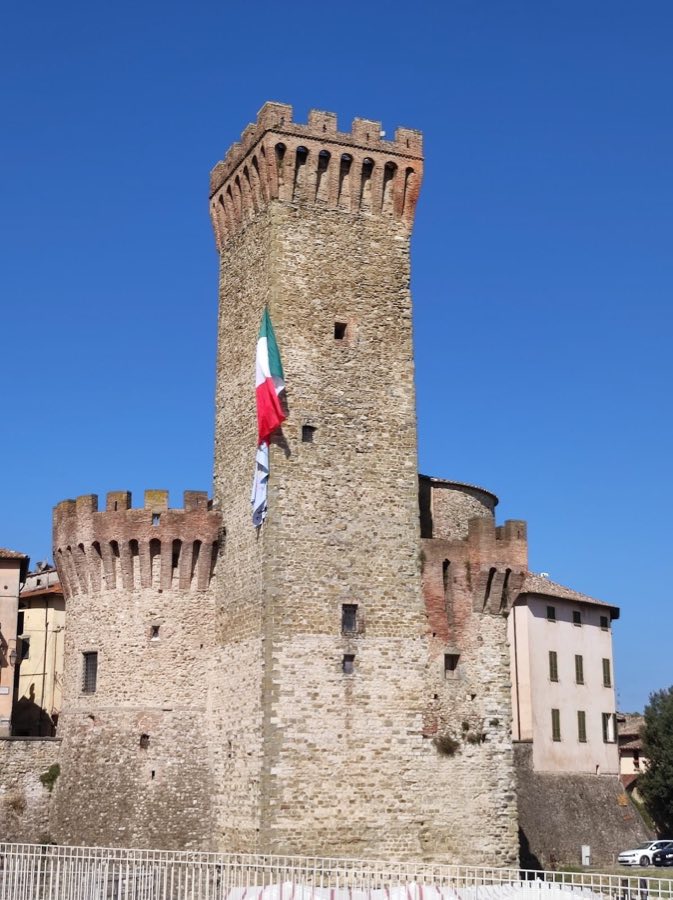
The Rocca of Umbertide presents a fortified layout characteristic of late medieval military architecture in Italy. Built primarily from local stone using traditional masonry techniques of the 14th century, the fortress is centered around a prominent square tower. This main tower measures 7.60 meters on each side and rises to 31.60 meters in height, featuring thick walls that reach 2.20 meters at the base, designed to withstand attacks and provide strong defensive capabilities.
Complementing the main tower are two lower circular corner towers and a third square bastion. All three structures are positioned to face Piazza Fortebracci at the heart of the town, providing strategic coverage of the central square. Originally, the Rocca had two accesses: the current main entrance opening onto the town square, and another called the “door of relief,” which faced the nearby Reggia stream, a minor tributary of the Tiber River. Both entrances were protected by drawbridges, offering additional defense by controlling access over the surrounding moat or ditch areas.
In the early 20th century, when the fortress was adapted for residential use, architectural changes were introduced, altering some original defensive features. Later, the restorations beginning in the 1980s not only aimed at conservation but also included the creation of a new entrance. This modification improved urban connectivity between two historic squares and facilitated access to the site while respecting its medieval character.
During these restoration projects, several inner spaces came to light that had remained concealed for centuries. Archaeologists and conservators uncovered ancient halls, interconnected passageways within the fortress walls, and subterranean dungeons that testify to the Rocca’s function as a place of detention. These discoveries have enriched understanding of the fortress’s complex layout and historical use, revealing layers of architectural adaptation across several centuries. The preservation and partial restoration of these elements allow visitors and scholars to appreciate the building’s evolving role in Umbertide’s history.
No. 36137
No. 21445
No. 11784
No. 85560
Comments
Comments for Rocca of Umbertide will require a verified account before posting.
We'll send a verification link before your first comment is published.