No. 23196
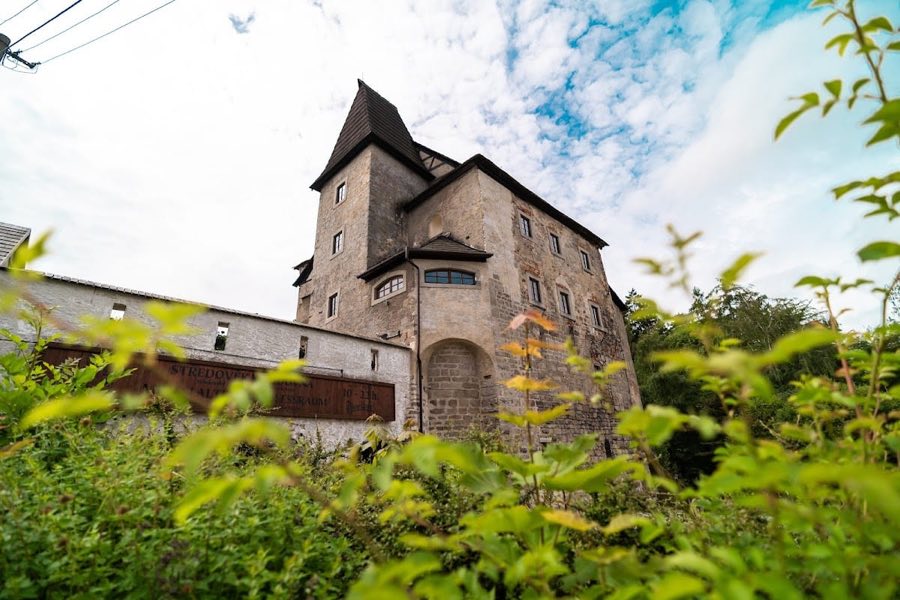
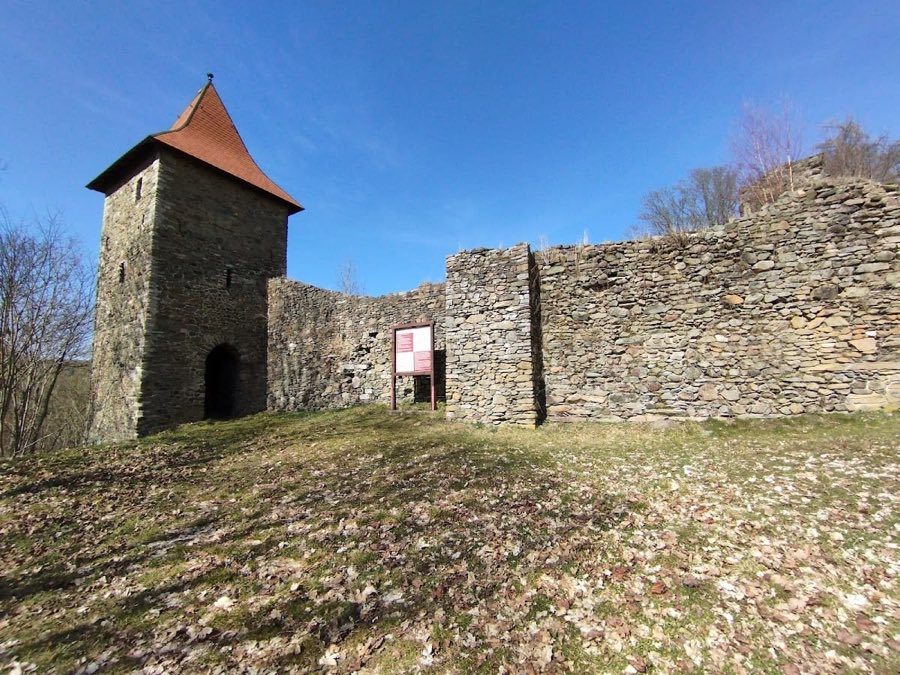
Vildštejn Castle
Czechia
CastleRuinFor events12th century
No. 66507
Castle · Czechia
No. 66507 · 50.255 N, 12.207 E
Quick summary
Neuberg Castle is a castle in Czechia with origins associated with the 13th century.
See all castles in CzechiaNeuberg Castle is located near the village of Podhradí in the Czech Republic and was established by the noble Neuberg (Neipperg) family. Its origins date back to the transition from the 12th to the 13th century, marking it as part of the medieval European feudal landscape. The first surviving written record mentioning the castle appears in 1288, involving Emperor Rudolf of Habsburg, who temporarily transferred the property to the Lords of Plavna before restoring it to the Neuberg family.
Throughout its early history, Neuberg Castle held a strategic position close to important trade routes leading towards Saxony. The Neuberg family used this advantage, sometimes engaging in raids that disturbed regional security. These attacks provoked retaliation from King Charles IV, who caused damage to the castle during his reign. Despite this, the castle was repaired and continued to be a center of regional conflict and power struggles.
In 1327, facing the political realities of the period, the Neuberg family formally conveyed their hereditary (allodial) lands to King John of Bohemia and received them back as a fief, which formalized their feudal obligations. Ownership of Neuberg passed into the hands of the von Zedtwitz family in 1392 through a combination of marriage and purchase. The von Zedtwitz line then governed the surrounding Aš region from Neuberg Castle for over two centuries.
By 1610, a significant fire severely damaged Neuberg Castle. Following this event, the von Zedtwitz family abandoned the ruined fortress and constructed new residences nearby, including a chateau in Podhradí, which was notably built using stone and materials salvaged from the former castle. Over the following decades, the castle ceased to function as a noble seat.
After the destructive Thirty Years’ War in the 17th century, Neuberg Castle fell further into disuse and neglect. During the 20th century Czechoslovak era, the lower castle was left to deteriorate, while a fire in 1902 destroyed the upper castle, which was never rebuilt. Preservation efforts did not begin in earnest until the late 20th century, with significant restoration work commencing after the year 2000. Between 2015 and 2018, the castle’s main cylindrical tower was renovated and made accessible.
Adjacent to the castle site, the Evangelical Church of the Good Shepherd was erected in the 15th century, reflecting the area’s religious transformation following the castle’s separation from the jurisdiction of Cheb in 1422 and the region’s move toward Lutheranism.
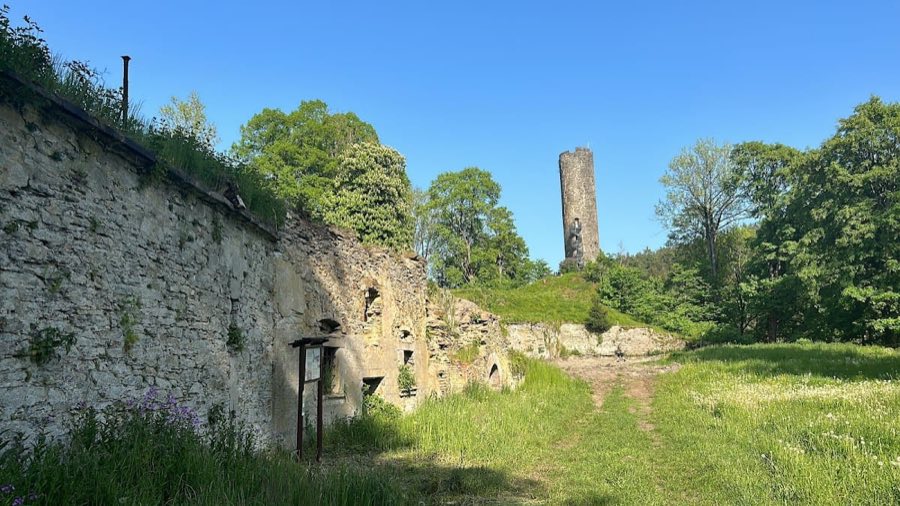
The remains of Neuberg Castle occupy a large, flattened rock terrace overlooking Podhradí. The complex originally consisted of an upper castle and a lower castle, interconnected but functionally distinct, spreading across this elevated site. Construction employed local quarry stone and traditional masonry techniques typical of medieval fortifications in Central Europe.
The most prominent surviving feature is the cylindrical bergfried, or keep, which served as the castle’s primary defensive tower and refuge. This tower rises approximately 22 meters from its base, while the rock spur it sits upon rises nearly 30 meters above the surrounding terrain. Measuring about 19 meters in circumference, the tower has been restored in recent years and today functions as an observation platform. It was the main stronghold, or mastio, of the castle.
The lower castle, once a three-winged building enclosing a roughly trapezoidal courtyard, now survives only in fragments. Remains include parts of the southern terrace wall built of quarry stone and the foundational outlines of the southern wing. This section of the fortress has largely been lost over time and has not been rebuilt.
The upper castle, or Horní zámek, retains more substantial ruins. Its external walls remain standing up to three stories high in places, punctuated by evenly spaced rectangular window openings. Many of these windows still preserve Baroque-style stone frames, decorative moldings, and cornices, alongside fragments of the original wall plaster and stucco embellishments, hinting at significant Renaissance or later modifications.
Below the main structures, cellars and foundational remains of a brewery are preserved in the southern moat area. During World War II, some of these vaulted cellars were adapted for use as air-raid shelters, demonstrating a layering of function over centuries.
Altogether, the ruins provide a view into the castle’s layered history, showing different phases of construction, alteration, destruction, and adaptation. While large portions of the lower castle have vanished, the upper castle remains extensive and evocative of its medieval past. The site’s elevated position offered both defensive advantage and control over local trade routes, reflected in its scale and surviving structures.
No. 23196
No. 28519
No. 53528
No. 85466
Comments
Comments for Neuberg Castle will require a verified account before posting.
We'll send a verification link before your first comment is published.