No. 23196
Vildštejn Castle
Czechia
CastleRuinFor events12th century
No. 28519
Castle · Czechia
No. 28519 · 50.132 N, 12.282 E
Quick summary
Seeberg Castle is a castle in Czechia with origins associated with the 18th century.
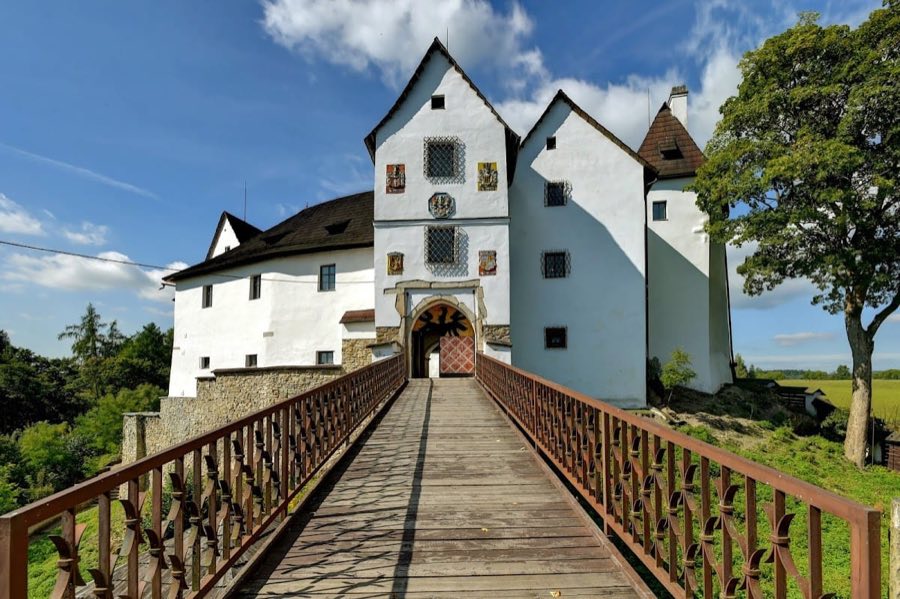
See all castles in CzechiaSeeberg Castle is located in Ostroh, within the municipality of Poustka in the modern Czech Republic. The site has a long history of human presence, with archaeological evidence pointing to a predecessor settlement or fortification dating back to the late Bronze Age. This early occupation is linked to the Urnfield culture, a prehistoric civilization known for its characteristic burial practices.
Around the year 1200, the castle as it is recognized today was constructed, serving as the residence of a ministerial family connected to the nearby town of Cheb. The first surviving written record mentioning the castle dates to 1322, when Louis IV of Bavaria pledged Seeberg as part of his property to King John of Luxembourg. This act placed the castle under the influence of significant regional powers during the High Middle Ages.
In 1398, administrative control of the castle passed to the town of Cheb, reflecting its importance within local governance. However, in 1435, Emperor Sigismund of Luxembourg granted Seeberg to his chancellor, Kašpar Šlik. Unable to maintain the castle financially, Šlik abandoned it, opening the way for a series of ownership changes. By 1461, Cheb councilor Kašpar Juncker acquired the property. After his death, ownership transferred to the brothers Konrád and Jošt of Neuberg. During their tenure, the castle became embroiled in the extended Neuberg-Zedtwitz conflict, suffering considerable damage.
The castle met severe destruction in 1648 when Swedish troops led by General Königsmark captured, looted, and set fire to Seeberg during military operations at the close of the Thirty Years’ War. Following this devastation, the owner Vít Dětřich of Steinheim undertook restoration efforts to repair the castle.
In the early 18th century, Seeberg returned to the town of Cheb, which maintained the property but only performed occasional repairs due to financial constraints. The castle’s condition deteriorated again until the early 20th century when substantial restoration was carried out by J. Pröckl between 1905 and 1915, helping to prevent further ruin.
After World War II, the castle once more fell into neglect until the 1970s, when the Municipal Museum of Františkovy Lázně began a program of reconstruction. In 1990, the site was officially opened to the public.
During the 16th and 17th centuries, the Church of St. Wolfgang, located near the castle, served as the burial place for its owners, with numerous epitaphs preserved in its interior. In a notable event during this period, Wolf Georg von Brandt was compelled to sell Seeberg in 1628 as a consequence of the Counter-Reformation, a movement within the Catholic Church aiming to restore Catholic dominance.
Under the communist regime in Czechoslovakia, both the castle and its associated church fell into disrepair once again. Subsequent comprehensive renovations restored the complex, enabling it to function as a museum that presents the history of the castle and the surrounding region.
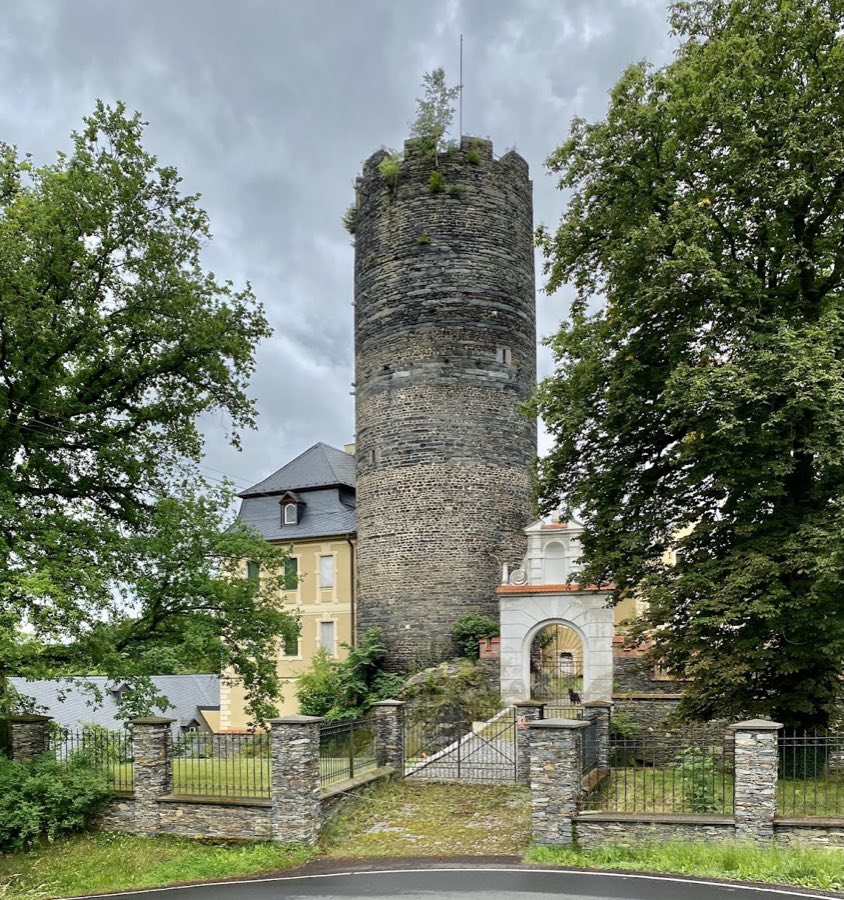
Seeberg Castle occupies a rocky outcrop overlooking the Slatinný stream. Its layout features two main sections with a core area smaller than the current overall complex. The original fortifications include remnants of a Romanesque curtain wall, a type of defensive stone wall, as well as a gate that survives partially within the core zone.
Attached to the northeastern corner near this gate is a tower-like structure built in the Romanesque style, indicating a later addition to the original fortifications. Before 1349, modifications were made that reduced the size of the castle’s original core by erecting a dividing wall with a gate that separated the back section, after which the buildings in that area were demolished.
Gothic architectural influences introduced a barbican—a fortified outwork that encloses the original core—and an extended gate that partially projects outward. These defensive improvements reflect the castle’s adaptation to changing military needs during the medieval period.
The outer bailey, an enclosed courtyard outside the main stronghold, contains several younger half-timbered buildings. Among these are an 18th-century barn and servants’ quarters. Additionally, two structures were relocated to the castle grounds: a tower granary dating from 1717, originally from the nearby village of Mlýnek, and a shed built in 1809. Both buildings exemplify the folk architectural traditions of the Cheb region.
The castle’s principal buildings have multiple floors and now serve as exhibition halls. Crossing a steep valley via a pedestrian bridge leads visitors to the nearby Church of St. Wolfgang, highlighting the close relationship between these two sites.
Decorative elements include four coats of arms carved visibly on the gate tower guarding the inner moat, representing the Junker, Brandt, Gerard, and Steinheim families—all factions tied to the castle’s history. The Junker family’s emblem is also displayed on an administrative building in front of the castle. On the rear façade, additional coats of arms commemorate the Nostiz, Neuberg, and Seeberg families.
The shape of the outer bailey reflects modifications made after the medieval period and does not correspond to its Gothic-era design. Inside, decorative displays reconstruct 19th-century interior styles ranging from Empire to Chippendale. Collections include glassware and porcelain made by notable Czech manufacturers. An exhibition modeled on a skanzen, or open-air museum, portrays 18th-century rural life in the Cheb region, featuring traditional clothing, agricultural tools, and a scale model of a typical half-timbered farmstead.
Since 2011, the castle’s cellars have been open to the public, featuring exhibitions about the famous poet Goethe and his romantic interests, the Cheb executioner Karel Huss, an armory displaying weapons, and a library collection. Four years later, an exhibit dedicated to the death of the military leader Albrecht von Wallenstein was installed in the space formerly used as the castle restaurant, adding further depth to the site’s historical narrative.
No. 23196
No. 86254
No. 53528
No. 29617
Comments
Comments for Seeberg Castle will require a verified account before posting.
We'll send a verification link before your first comment is published.