No. 52983
Vorburg, Oberurnen
Oberurnen, Switzerland
CastleRuin7th century
No. 94308
Castle · Switzerland
No. 94308 · 47.144 N, 9.053 E
For events
Niederwindegg is marked as a château or castle venue lead. Capacity, indoor/outdoor spaces, catering rules, and accommodation options are published only after public verification.
Event types: Private events, Cultural gatherings, Filming and photography
Quick summary
Niederwindegg is a castle in Switzerland with origins associated with the 13th century.
See all castles in SwitzerlandThe Medieval castle ruins of Niederwindegg stand in Schänis, Switzerland, and were erected by medieval feudal authorities.
Documents of the early 1200s refer to men named Hartmann von Windegg and Diethelm von Windegg in 1220 and 1229, though it is not clear whether those references point to Niederwindegg, to nearby Oberwindegg, or to the Windegg near Wald. In 1230 Count Hartmann the Elder of Kyburg handed over his holdings in the Gaster area to his wife Margaretha of Savoy, a transfer that specifically named the castle and its associated toll rights. The road toll connected with the site lay below the castle between Berg and the Linth river.
From the later 13th century the castle appears in Habsburg administration. A Habsburg bailiff is recorded at the castle in 1285, and from about 1288 that official also oversaw the Glarus valley. When Glarus joined the Swiss Confederacy in 1352 the larger administrative map was altered and the castle’s governance returned to the Gaster district.
Military tension with Austria affected the site in the mid and late 1300s. The stronghold was strengthened in 1359 and again in 1384 under the direction of the imperial administrator Eglof von Ems because of rising friction between the Confederacy and Austria. Open fighting followed the night of violence known as the Mordnacht von Weesen in 1388. The local administrator Arnold Burchi, a citizen of Rapperswil, took part in that episode, and punitive operations that followed included the burning of the town of Weesen. During the siege after those events the castle resisted attack and proved impregnable.
In 1406 the Niederamt Niederwindegg, the local administrative unit of Gaster, was pledged to Count Friedrich VII of Toggenburg. In 1486 the Gaster territory passed into shared control of Glarus and Schwyz and from that moment the area was commonly called the Herrschaft Windegg. After this transfer the castle no longer housed the regional administrator and is reported to have been abandoned and allowed to decay. It is conjectured that in 1486 stones from the ruin were quarried for the construction of the tower of the collegiate church at Schänis, and that the site continued to supply building stone afterwards. In 1955 Jakob Grüninger carried out trial boreholes at the location, leading to the hypothesis that a Roman watch post may once have occupied the spot; resolving that question would require a large-scale archaeological investigation.
The ruin occupies a northeast–southwest aligned plan on a ridge of conglomerate rock above the road between Schänis and Ziegelbrücke, reached today by a steep, narrow path taking about fifteen minutes on foot. The site layout places its defensive sector toward the mountain side on the northeastern edge, a position dictated by the slope and by the fact that the rocky spur could only be climbed from that direction.
A rectangular main residential building, the palas, stood separate from the uphill defensive area, and the two parts were divided by an artificial neck ditch cut into the rock to block access from the mountain. These elements belong to the medieval occupation and reflect the site’s role as an administrative and defensive center.
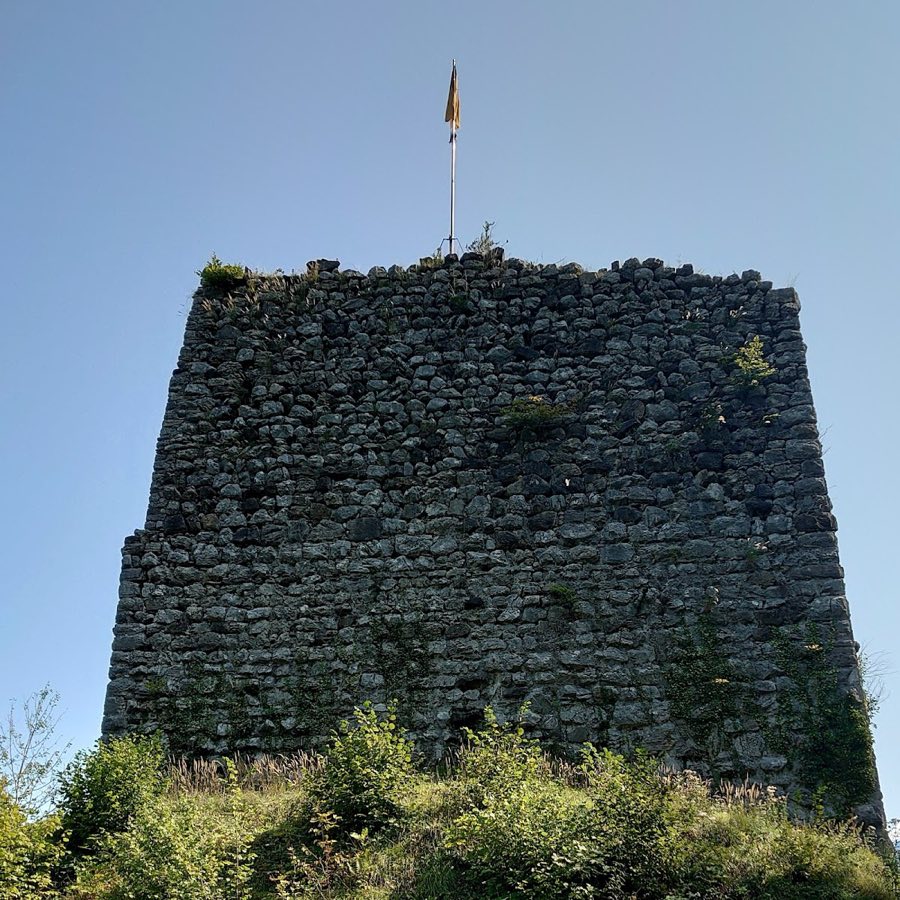
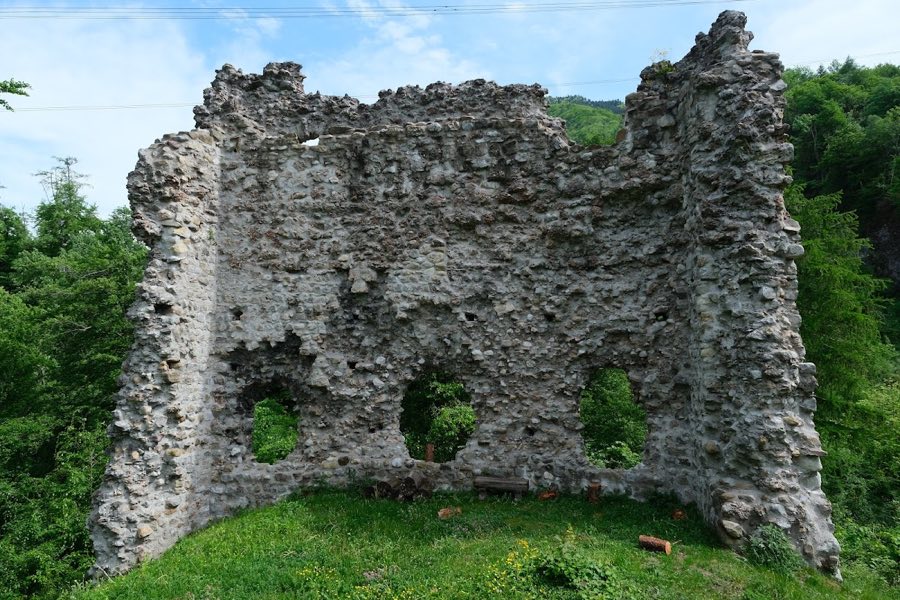
Present-day remains include a substantial surviving wall on the east side facing the mountain, rising to about eight metres in height and functioning as a buffer between the hillside and the interior. Elsewhere only fragments of walls survive. It is recorded that stone from the ruin was later removed for building projects, a reuse that is said to have begun around 1486 with material taken for the collegiate church tower at Schänis and to have continued subsequently. Trial boreholes carried out in 1955 produced evidence that led to the suggestion of an earlier, possibly Roman, watch post on the ridge, but confirming that hypothesis would require careful, extensive excavation.
No. 52983
No. 40521

No. 29704
No. 82227
Comments
Comments for Niederwindegg will require a verified account before posting.
We'll send a verification link before your first comment is published.