No. 94308
Niederwindegg
Switzerland
CastleRuinFor events13th century
No. 52983
Castle · Switzerland
No. 52983 · 47.118 N, 9.057 E
Quick summary
Vorburg, Oberurnen is a castle in Oberurnen, Switzerland with origins associated with the 7th century.
See all castles in SwitzerlandVorburg, medieval castle ruins in Oberurnen, Switzerland, was probably built or expanded by the Habsburgs.
During the High Middle Ages the land around Oberurnen belonged to Schänis Abbey, while taxes from the area were paid to Säckingen Abbey. In 1264 the Habsburgs inherited the bailiwick of Glarus from the Counts of Kyburg, and in 1288 Säckingen Abbey granted a fief over its lands to the Habsburgs. To strengthen their hold on Glarus the Habsburgs constructed Näfels Castle and appear to have built or enlarged Vorburg; by about 1300 the site served as an administrative centre for Habsburg authority in the region.
In the mid-fourteenth century Vorburg was the residence of the Austrian vogt Hermann von Landenberg. Conflict followed when Glarus rebelled against Habsburg rule in 1351 and destroyed Näfels Castle. Contemporary records do not confirm whether Vorburg was attacked at that time, though the wider fighting affected nearby strongholds. After the loss of Näfels the castle at Vorburg was probably enlarged, either under Habsburg direction or by forces from Glarus.
The castle appears in documentary records in 1369 when Rudolf Stucki used it as collateral, and it is named in 1386 as a refuge castle, suggesting it was not continuously occupied as a residence. During the fifteenth century the site was abandoned and fell into ruin; many stones show that a major fire occurred, but surviving documents do not state whether the blaze resulted from accident or an assault.
Repair and investigation of the ruin continued in later centuries. In the nineteenth century work preserved and repaired the north‑west wall of the tower. In 1940 the south ring wall was excavated and made stable. Archaeological investigation in 1970 uncovered traces of an outbuilding and a layer of animal bones. Since 2002 the foundation Pro Vorburg Oberurnen has maintained the ruins and cleared vegetation, with Ernst Küng constructing a well and a small tool shed to support maintenance. From 2017 the foundation, together with experts, began structural work to secure the site, clearing internal rubble and reinforcing walls in an initial phase. Following a 2020 motion by Landrat Steve Nann, the cantonal government allocated CHF 605,645 in 2021 to support the foundation’s conservation work.
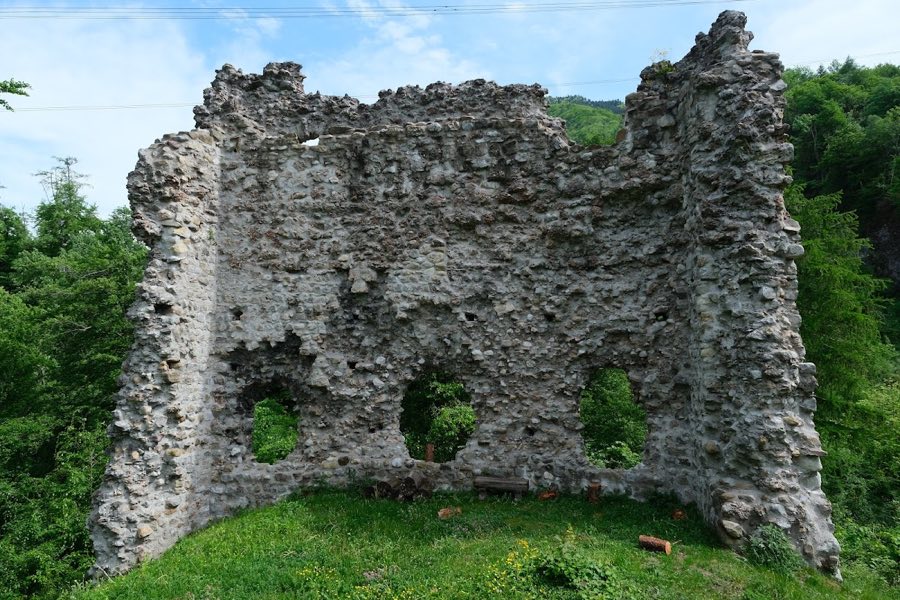
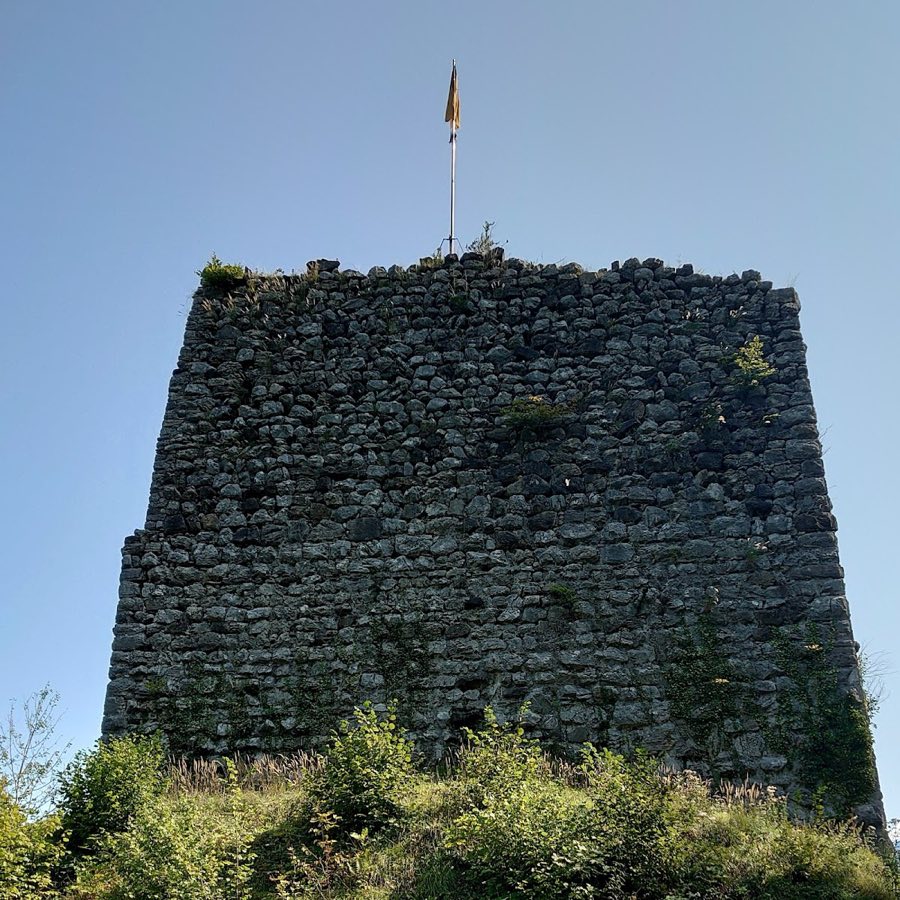
Vorburg occupies a hill north of the village and presents as a compact ruined stronghold focused on a large residential hall. The main building, or palas, is a roughly rectangular block measuring about eighteen by twenty-one metres. Its walls are substantial, roughly two metres thick, and were constructed from squared limestone blocks that are not finely dressed, while the corner stones were worked more carefully to form defined edges. The north‑west face of the palas still stands prominently, rising to about sixteen metres above the ground, a section that received nineteenth‑century repairs and remains a conspicuous element of the ruin.
A newer masonry link binds the palas to a residential wing on the eastern side, indicating later alteration or extension of domestic space. South and west of the main hall a narrow courtyard defended by an outer wall and two successive ditches formed a compact system of defenses. Foundations for a bridge crossing the north side of the inner ditch survive as trace elements in the ground, and the position of the gatehouse is most plausibly on the north side of the surrounding ring wall.
Archaeological and construction chronologies place the palas at the end of the thirteenth century, with the ring wall, the narrow outer courtyard and ancillary buildings dating to the early fourteenth century. The south ring wall was excavated and stabilised in 1940, and twentieth‑ and twenty‑first century conservation work has focused on clearing interior collapse and reinforcing standing masonry. Traces found during the 1970 excavation record an outbuilding near the core and a deposit of animal bones, adding detail to the site’s former use. The ruin is recognised locally as the most prominent medieval castle in the canton of Glarus and today survives as a fragmentary but well-documented ensemble of walls, ditches and foundations.
No. 94308
No. 40521

No. 29704
No. 82227
Comments
Comments for Vorburg, Oberurnen will require a verified account before posting.
We'll send a verification link before your first comment is published.