No. 90067
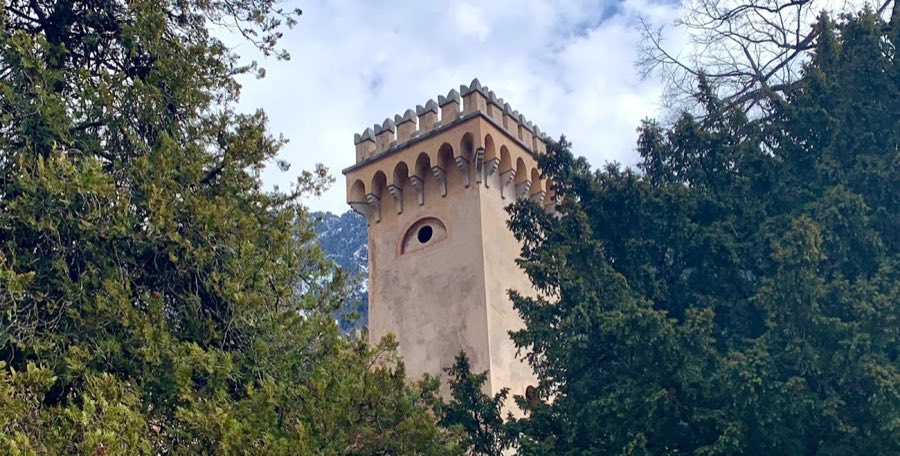
Castelmur Castle
Switzerland
CastleRuin19th century
No. 93600
Palace · Italy
No. 93600 · 46.171 N, 10.061 E
Quick summary
Palazzo Besta is a palace in Italy with origins associated with the 15th century.
See all castles in ItalyPalazzo Besta in Teglio, Italy, is a Renaissance patrician residence erected by the Lombard Besta family around 1433. Built in the early Renaissance over what was likely a medieval building, the palace is counted among the most important patrician dwellings of Lombardy and served as a seat of family power and display during the later Middle Ages and Renaissance. Its construction and decoration place it firmly within the cultural life of northern Italy from the fifteenth century onward.
The building campaign began circa 1433 on commission from Azzo I and Azzo II Besta, who transformed the site into a representative urban residence. Over the following centuries the palace continued to be a family home and a setting for elite life in Teglio, while interior decoration was added and updated to reflect changing tastes and literary subjects popular in the Renaissance.
Decoration and reworking of interior spaces proceeded through the sixteenth and into the early seventeenth century. The courtyard walls received painted cycles depicting episodes from the Aeneid between about 1540 and 1630, and the main saloons on the first floor were frescoed with mythological stories drawn largely from Ovid’s Metamorphoses and Ludovico Ariosto’s Orlando Furioso, together with biblical scenes. The vaulted Hall of the Creation carries lunettes showing Genesis narratives and a painted planisphere, a rounded world view that echoes sixteenth-century geographic representations and which may draw on the rare 1545 printed world map by Caspar Vopel.
Ownership passed through several noble families in later centuries, moving from the Besta to the Guicciardi, then to the Quadrio, and finally to the Parravicini. In the contemporary period the building came under state-level cultural management in December 2014, administered through the Museal Hub of Lombardy; that administrative body became the Regional Directorate of Museums in December 2019. The palace is owned by the government of the province of Lombardy. In 2016 the site received 4,180 visitors.
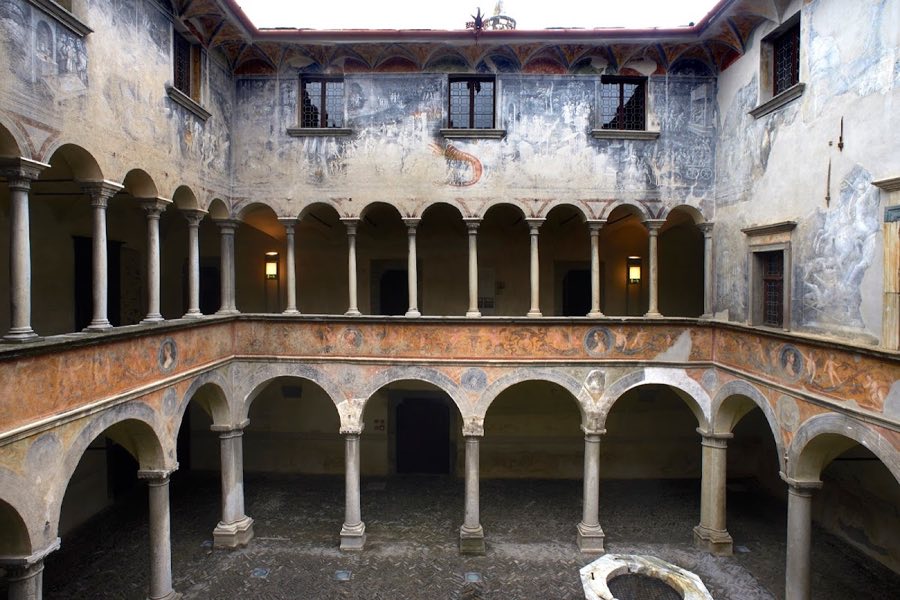
The palace presents a rectangular plan centered on an internal courtyard. The court is bordered by a double loggia, that is, two levels of open gallery space, and an eight-sided well stands within the court as a central feature. The courtyard serves both as an organizing element of circulation and as the setting for major painted decoration.
The courtyard walls are covered with narrative frescoes illustrating scenes from the Aeneid, a programme dated roughly between 1540 and 1630. These painted cycles occupy the vertical faces around the court and remain a defining visual feature of the interior void, integrating classical epic subjects into the domestic architecture.
On the principal floor, a series of large saloons are coated with mythological and biblical imagery. The subjects draw mainly on Ovid’s Metamorphoses and Ariosto’s Orlando Furioso, creating a sequence of learned and heroic episodes across the rooms. One notable panel by Giuseppe Prina shows the Queen of Sheba being received by King Solomon, combining a biblical subject with the palace’s broader decorative programme.
The room known as the Hall of the Creation contains semicircular lunettes bearing stories from Genesis and a painted vaulted ceiling that includes a rounded world map, described as a pallioforme planisphere. That painted globe is a distinctive Renaissance geographic image within the decorative scheme and links the theological narratives of the lunettes to contemporary mapmaking ideas of the sixteenth century.
On the ground floor, the former guardrooms have been converted into the Antiquarium Tellinum museum. This display houses prehistoric stelae recovered in the area, among them a carved stone interpreted as a representation of a Mother Goddess. These finds connect the site to much earlier local ritual and funerary practices while being presented within the palace’s historic rooms.
Overall, the palace survives as a preserved example of Lombard patrician Renaissance architecture, with major decorative schemes and interior spaces remaining in place and accessible within the historic building.
No. 90067
No. 24951
No. 80916

No. 18216
Comments
Comments for Palazzo Besta will require a verified account before posting.
We'll send a verification link before your first comment is published.