No. 83971
Bratislava Castle
Slovakia
CastleRestoredFor events9th century
No. 26685
Palace · Slovakia
No. 26685 · 48.145 N, 17.101 E
For events
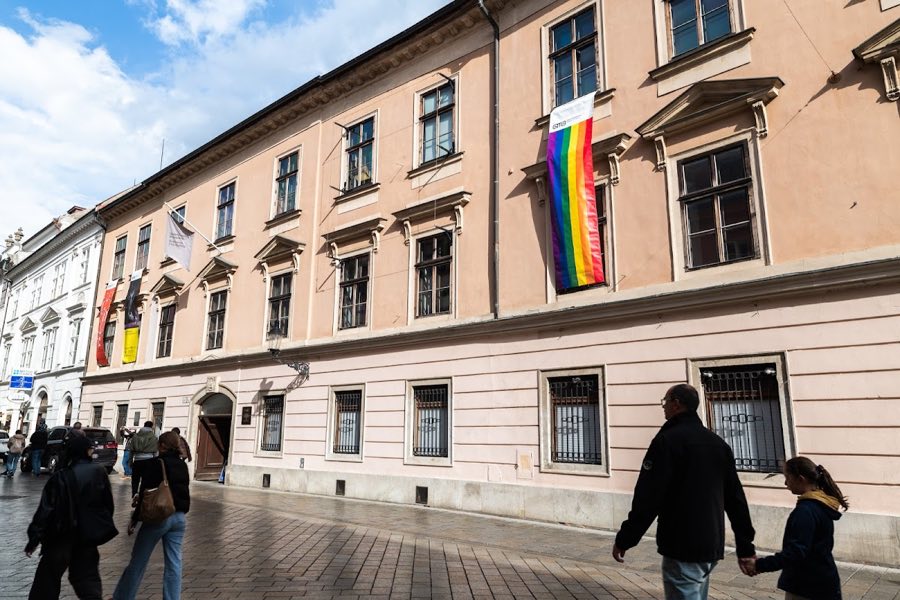
Pálffy Palace, Bratislava is marked as a château or castle venue lead. Capacity, indoor/outdoor spaces, catering rules, and accommodation options are published only after public verification.
Event types: Private events, Cultural gatherings, Filming and photography
Quick summary
Pálffy Palace, Bratislava is a palace in Bratislava, Slovakia with origins associated with the 17th century.
See all castles in SlovakiaPálffy Palace in Bratislava, Slovakia was a 17th-century noble residence built by the Pálffy family of the Kingdom of Hungary during the same phase of rebuilding that reshaped Bratislava Castle. Erected after 1635, the palace stood alongside a formal Renaissance garden and became an important urban estate beneath the castle, hosting high-ranking family members and public events that tied it to political and cultural life in the city.
Construction and early use took place in the mid-1600s under Pál Pálffy, who had been given responsibility by the Diet of Hungary in 1630 for wide-ranging works at Bratislava Castle. The complex included a private chapel, and Pál Pálffy died within the residence in 1653. The house remained the seat of the Pálffy family and their local officials, including Count Mikuláš (Miklós) Pálffy, who served as captain of the castle and as regional governor.
In the 1700s the palace underwent a major rebuilding in 1732 and continued to draw prominent visitors. In 1736 Francis Stephen of Lorraine, later Holy Roman Emperor, spent time in the rooms there. Political as well as religious matters found a venue in the palace when, in 1781, representatives of four Christian confessions met there following the Patent of Toleration, the imperial measure that extended limited freedoms to non-Catholic believers. The composer Wolfgang Amadeus Mozart gave a concert at the site during a visit to the city, adding a cultural highlight to its history.
From the 19th century the palace’s role shifted sharply. In 1870 Henrich Justi bought the property on behalf of the municipal authorities and gave it to the city. Civic use followed: the city installed artillery barracks and created an orphanage plus housing for poorer residents. Over decades the complex was altered for military and storage needs; the chapel was converted into stables and many interior spaces were adapted to meet the requirements of barracks and warehouses.
The turn of the 20th century brought gradual clearance of the older compound to make way for new buildings. The Pálffy Hall in the garden, once used as a riding and event space, was taken down in 1893. After 1900 much of the palace and its grounds were demolished to permit development, including the Svoradov student dormitory and an elementary school on Palisády Street; the garden, which had been opened to the public in 1801, was lost in this period. After World War II the surviving summer pavilion passed to the Bratislava Residential Company and served as a construction-materials warehouse.
Toward the end of the 20th century plans and protections altered the site’s course. A 1975 proposal imagined the remaining building as a wine house with an exhibit on winemaking. In 1985 the surviving structure was declared a Slovak Cultural Monument. An architectural competition in 1989 considered various cultural reuses, and in March 1990 the building (but not the surrounding land) was sold to ZO Zväzarm, the Veteran Car Club Rusovce. The pavilion has since been restored and today functions as a cultural venue for classical concerts, exhibitions, design events, and international meetings. The Zámocká Street palace is one of four separate historic houses in Bratislava that bear the Pálffy name.
The palace originally formed a large complex combining a principal house and a formal garden that extended across the block bounded today by Zámocká, Škarniclova, Palisády, Zochova and Pilárikova Streets. The main building presented a massive silhouette with castle-like walls and a restrained exterior, while contemporary accounts describe richly fitted interiors. A service road constructed by the Pálffy family to supply building works later evolved into what is now Zámocká Street.
Within the compound stood a private chapel and the Pálffy Hall in the garden. The hall functioned as a riding hall and a place for public gatherings and cultural entertainments, and for a time hosted theatrical performances. The hall was demolished in 1893. During the 19th and early 20th centuries the principal buildings were altered for artillery barracks, stables, and storage; the chapel was reused as stables and other rooms were adapted for military and municipal needs.
After large-scale removals around 1900 only the summer pavilion of the original complex survived. That pavilion passed through municipal hands and later became a warehouse before receiving protective status as a Slovak Cultural Monument in 1985. The pavilion has been restored and now serves cultural functions. Elements associated with the old compound were relocated: a historic portal was moved to a stairway from Svoradova Street in the 1920s or 1930s; that portal and the adjacent stairs were rebuilt in 2013 at a cost of 40,000 EUR.
Land that once belonged to the palace was redeveloped for educational and residential uses, including the Svoradov student dormitory and an elementary school on Palisády Street. Today the extant pavilion and the reconstructed portal and stairs remain as visible reminders of the former palace compound, while other major components of the estate survive only in the altered street pattern and in the footprint of later buildings.
No. 83971
No. 42591
No. 81073
No. 85634
Comments
Comments for Pálffy Palace, Bratislava will require a verified account before posting.
We'll send a verification link before your first comment is published.