No. 41002
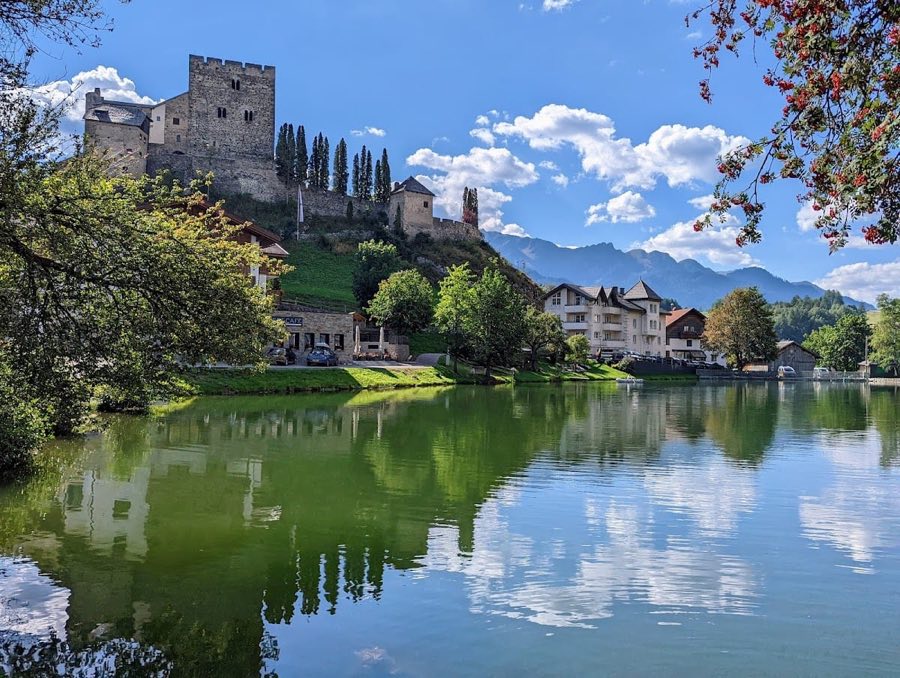
Laudegg Castle
Austria
CastleRuin17th century
No. 16116
No. 16116 · 47.053 N, 10.652 E
Quick summary
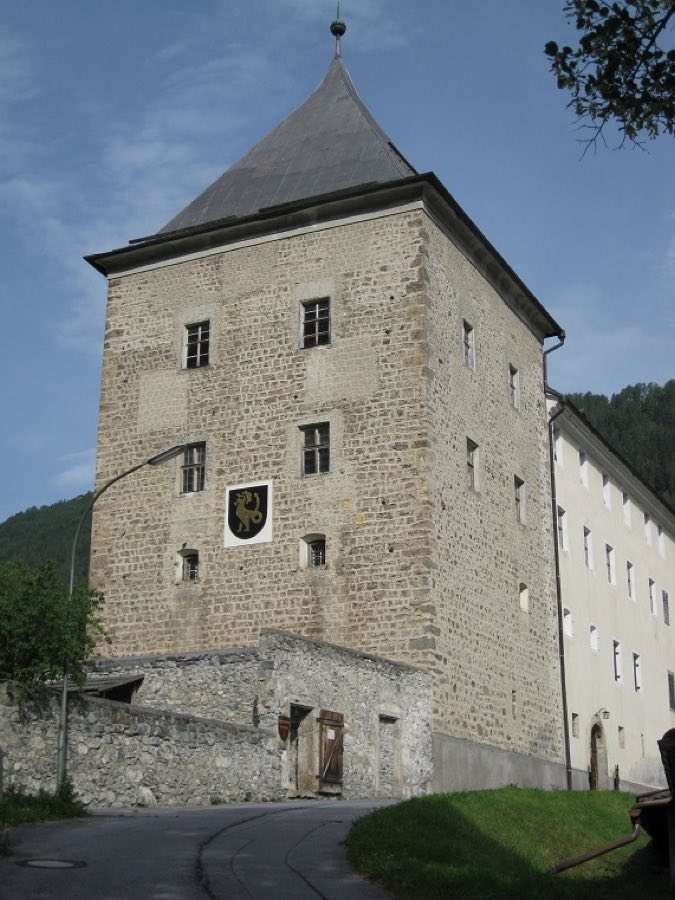
Schloss Sigmundsried is a castle in Austria with origins associated with the 14th century.
See all castles in AustriaSchloss Sigmundsried, Ried im Oberinntal, Austria is a medieval manor complex built and used by local feudal families, with documentary roots in the Middle Ages and a notable late 15th‑century transformation into a hunting residence. The settlement of Ried first appears in 1120 in the archives of the Bavarian monastery at Reichenbach, which exercised manorial rights there, and the placename Ried reflects the once swampy character of the Inn valley. Because the site faces the route over the Reschen Pass, it controlled a long‑established north–south road that in Roman times had been the military route Via Claudia Augusta.
By the early 14th century the castle served as the seat of the local Ried dynasty; in 1325 Hermann I von Ried held the place and his descendants maintained it through the middle of that century. Ownership passed in 1381 into the hands of the Starkenberger family when Duke Leopold III granted the tower at Ried to Hans von Starkenberg. During the 15th century the manor changed status often: in 1427 it belonged to the Tyrolean sovereign, and several private transfers took place in the mid‑1400s among regional nobles.
In 1471 Archduke Sigismund, nicknamed “the Rich in Coin,” took possession of the tower at Ried and in 1471–72 had it rebuilt and enlarged as a stately hunting lodge, thereafter called Sigmundsried. Financial pressure forced Sigismund to hand many properties over to his successor Maximilian I. The administration of Laudegg at Ladis assumed custody of Sigmundsried and its officials sometimes preferred living at the manor rather than at Laudegg itself.
After being pledged repeatedly in the late 15th century, members of the Schrofenstein family held the site; Oswald von Schrofenstein and later his son Siegmund figure among those owners. In 1532 Siegmund ceded the estate without redemption of the pledge to King Ferdinand I, who granted it to his chamberlain Martin Pedrot. Pedrot sold the property in 1546 to Veit von Wehingen, the Laudegg administrator, who added a chapel to the manor. During the 16th and 17th centuries the von Wehingen family and then the von Knillenberg family held rights or pledges at Sigmundsried; in 1630 Franz and Andreas von Knillenberg acted as pledge‑holders and the judicial administrators at times lived at the manor while Laudegg lay desolate.
In 1684 Martin Andreas Sterzinger, an administrator of Laudegg who later received ennoblement, purchased the estate and styled himself Sterzinger von Sigmundsried; his family retained it until 1775.
The late 18th century saw several private owners, including members of the Wille family and, from 1786, Johann and Joseph Heiseler, who bought the property in halves. In 1841 the imperial domain acquired the building and installed the district court of Ried there, together with detention rooms, the judge’s lodgings, and court staff. A new attic was added on the west side of the tower during the 19th century.
Sigmundsried continued to house the Ried district court until 31 December 1977. After that date the building served the Austrian Federal Army as a storehouse, with ownership passing to the Republic of Austria. Since 1999 the municipality of Ried has been the owner of Schloss Sigmundsried.
The manor occupies a raised terrace at the southwestern edge of the village of Ried im Oberinntal, positioned to oversee the historic road that crosses the Reschen Pass. The complex groups a substantial three‑storey tower, a residential wing, and a courtyard once defended by a surrounding wall. This arrangement reflects a fortified manorial site that developed from a medieval tower into a more comfortable residence over time.
The main tower stands on an almost square plan measuring roughly 11.40 by 11.63 metres, with walls about 1.50 metres thick. Its ground floor contains a dark vaulted chamber known locally as an Angstloch, a term for a secure, window‑poor room that served as a prison at times. The chamber is surrounded by much thicker masonry than the rest of the tower, has a single narrow light slit, and originally received prisoners through an opening above the vault; later it was used for storage.
The former open courtyard was closed in the early 16th century by building two stacked halls into the space, work attributed to Siegmund von Schrofenstein. The lower hall displays cross‑vaulted bays painted around 1535–1540 with floral and grapevine motifs in a Renaissance idiom. Above the central column, the vault spandrels carry heraldic paintings from the same period, showing the royal eagle, the Austrian shield, the Tyrolean eagle, and the arms of the von Wehingen family. In an arcade spandrel an armorial stone dated 1527 bears the coats of Viktor von Montani and his wife Margareth von Schrofenstein. The upper hall is set beneath a vaulted ceiling supported by a composite capital of red marble carved with acanthus leaves and dolphins.
A chapel built by Veit von Wehingen once adjoined the manor; that chapel was secularized and built over around the mid‑17th century. Later structural changes include the 19th‑century insertion of an attic space on the west side of the tower. The painted vaults, heraldic decorations, armorial stone, and the stacked halls constitute the castle’s most artistically important elements and survive as prominent features within the complex.
No. 41002
No. 25033
No. 98391
No. 91515
Comments
Comments for Schloss Sigmundsried will require a verified account before posting.
We'll send a verification link before your first comment is published.