No. 43830
Pasargadae
Iran
PalaceIntact6th century
No. 25994
Castle · Iran
No. 25994 · 32.597 N, 51.644 E
For events
Shahdiz Castle is marked as a château or castle venue lead. Capacity, indoor/outdoor spaces, catering rules, and accommodation options are published only after public verification.
Event types: Private events, Cultural gatherings, Filming and photography
Quick summary
Shahdiz Castle is a castle in Iran with origins associated with the 11th century.
See all castles in IranShahdiz Castle, in Isfahan municipality, Iran, may have been first constructed during the pre-Islamic Sasanian period and was later rebuilt by Seljuq authorities.
An early phase of the site is attributed to a pre-Islamic origin, with later reconstruction linked to the Seljuq sultan Malikshah. Medieval attribution credits Malikshah with building at the location near his capital, though the castle likely had earlier foundations.
In the late eleventh century the fortress came under the control of the Nizari Ismailis. The chief missionary, Abd al-Malik ibn Attash, based his headquarters at Isfahan, and his son Ahmad ibn Abd al-Malik ibn Attash effected a takeover of the fortress around 1100. Ahmad concealed his intent by posing as a schoolmaster, converted members of the garrison, which were largely of Daylami background, and set about re-fortifying the place in a manner similar to other Ismaili strongholds of the period. After securing the position he began to collect taxes from surrounding districts, and contemporary reports state he had converted some 30,000 people in Isfahan.
In 1107 the Seljuq sultan Muhammad I Tapar led a large campaign against the castle. Negotiations included a year-long religious debate, but Ahmad refused the terms offered and made a final stand. The garrison was overcome, many defenders were killed or fled, and Ahmad was captured. He and his son were executed and their heads were sent to the Abbasid caliph al-Mustazhir in Baghdad. Following the fall of the fortress, the sultan ordered Shahdiz demolished, and the nearby Khanlanjan fortress was apparently destroyed as well, a measure taken to prevent the site from being used again by the Nizari Ismailis. The loss of Shahdiz marked the end of Nizari Ismaili influence in the Isfahan area.
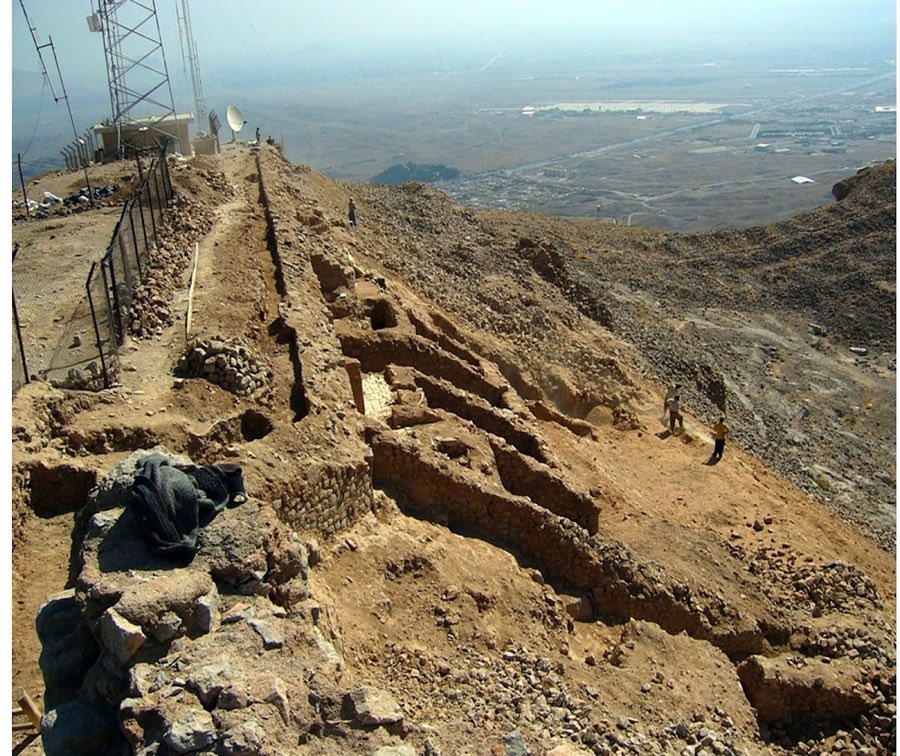
Shahdiz stands as conspicuous ruins on a rocky subpeak of Mount Soffeh, about eight kilometres to the south of Isfahan. The surviving earthworks and stone remains present a picturesque silhouette on the hillside, making clear that the site functioned as a defensive position guarding the route to the city.
The principal feature at the site is the ruined castle itself, recorded historically as a fortress. Its documented history records construction in an early period, reconstruction under Seljuq patronage, and re-fortification by the Nizari Ismailis around the beginning of the twelfth century. The fortress was demolished by Seljuq command after its capture in 1107, and today the structure survives only in fragmentary ruins on the mountaintop.
Historical comment tied to the place records that the demolition was intended to prevent reuse, and that a neighbouring stronghold, Khanlanjan, was apparently destroyed at the same time. The site is known in medieval texts by the names Shahdiz and Dizkuh, reflecting the continuity of its identity through the events of the eleventh and twelfth centuries.
No. 43830
No. 24496
No. 39006
No. 62976
Comments
Comments for Shahdiz Castle will require a verified account before posting.
We'll send a verification link before your first comment is published.