
No. 78325
Košťálov Castle
Czechia
CastleRuin14th century
No. 21661
Château · Czechia
No. 21661 · 50.498 N, 13.961 E
Quick summary
Skalka Castle is a château in Czechia with origins associated with the 14th century.
See all castles in CzechiaSkalka Castle is situated near the village of Vlastislav in the Czech Republic and was established by the medieval Bohemian nobility in the early 14th century. The first written record dates back to 1357 when Petr of Skalka was recognized as the castle’s owner, marking the site as a strategic noble residence within the Bohemian Central Highlands.
Throughout the 14th and early 15th centuries, the castle remained in the hands of its founding family before passing to several other noble owners. Among them was Hanuš Kaplíř ze Sulevic, who acquired the castle around 1414, followed by Jan II. Žlutický z Vřesovic, who held it until 1544. Later, from 1578, Adam Hrzán z Harasova became the proprietor. These successive owners maintained the castle as a feudal stronghold and administrative center during a period marked by regional conflicts and political shifts.
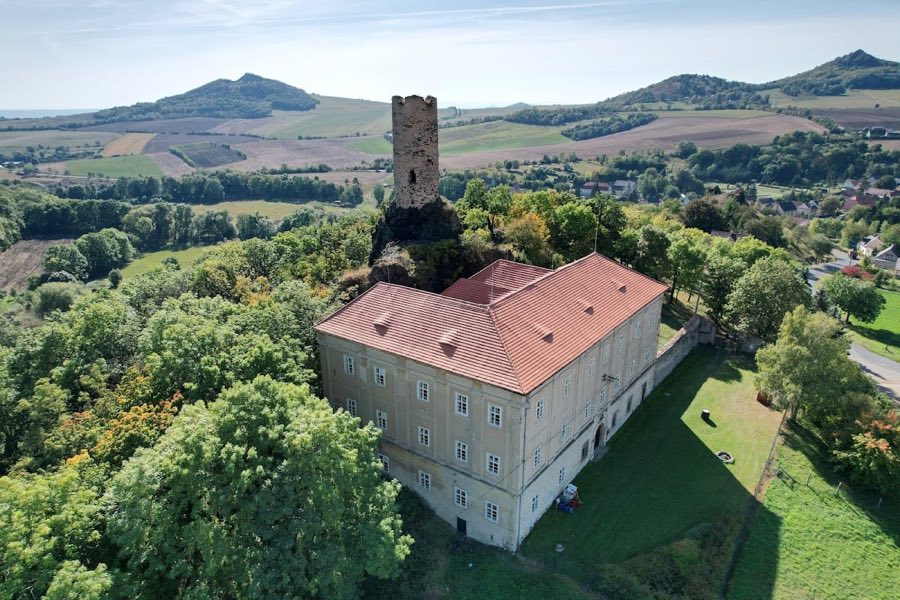
The castle’s military significance came under strain during the Thirty Years’ War (1618–1648), a devastating conflict affecting much of Central Europe. In 1639, Swedish forces inflicted heavy damage and effectively destroyed the fortress, after which it ceased to function as a noble residence. In the decades following this destruction, the Hrzán family constructed a Baroque chateau at the base of the ruined castle, likely under Jan Adam Hrzán z Harasova in the late 17th century. This new building was fashioned using stones reclaimed from the former fortress.
Ownership of the estate changed repeatedly during the 18th and 19th centuries. Marie Putzová z Adlerthurn acquired it in 1719, followed by the Hatzfeld family from 1730 until 1796. Subsequently, the Schönborn family took possession and maintained stewardship through to 1945. After the Second World War, the chateau served a new administrative purpose when it was adapted to store documents for the State Regional Archive in Litoměřice. Notably, in 1945, the chateau was also the birthplace of Cardinal Christoph Schönborn.
Since the early 21st century, the municipality of Vlastislav has owned the property, preserving its historical legacy and holding exhibitions to share local art and the history linked to Skalka Castle and the surrounding area.
Skalka Castle was originally constructed as a bergfried-type fortress, a common medieval form of fortification centered around a strong tower (bergfried) serving defensive and residential functions. The site consisted of a compact castle core and an outer bailey—the enclosed courtyard for support buildings—separated on the southern side by a moat carved directly into the rock. This natural barrier enhanced the fortress’s protection.
The most prominent surviving feature is the oval-shaped bergfried rising about 15.5 meters above the ground. It was built from light-colored sandstone known locally as opuka and crowned a basalt outcrop, providing a commanding vantage point over the landscape below. Access to this tower was unusual, obtained solely via a drawbridge leading from an adjacent palace block situated roughly five meters higher on an artificially raised ledge. This elevated entrance enhanced security by limiting entry points.
Inside the bergfried, inscriptions dated from the early 17th century (1605 and 1615) attest to its use as a prison during that period, reflecting a shift in its function toward containment within the castle’s operational structure. Today, this tower remains the only above-ground element of the medieval fortress, standing as a solitary testament to its former height and strength. Other parts of the castle, such as the gatehouse located in the outer bailey, have not survived above ground.
The later Baroque chateau, built in the late 1600s at the foot of the medieval ruins, is a two-story, rectangular structure with a facade marked by long pilasters that visually connect the two floors. Windows feature ornamental moldings characteristic of Baroque design. Inside, a first-floor corridor was vaulted with a segmental arch during renovations in 1959. The original interior furnishings, however, have not been preserved. The chateau’s design is attributed to Antonio della Porta, a known architect of the era, and masterfully incorporates stone taken from the demolished castle.
Surrounding the chateau was an economic courtyard that supported the estate’s operation, including a brewery, distillery, sheepfold, gamekeeper’s lodge, and pheasantry. Fruit trees were planted in the vicinity, indicating a managed landscape accompanying the residential buildings.
Close to the bergfried, a modern viewing platform has been constructed, offering expansive views across the Bohemian Central Highlands. Inside the chateau, exhibitions display the history of Skalka Castle and related local heritage, alongside artworks inspired by the region’s landscapes, linking the site’s medieval past to contemporary cultural expressions.
No. 78325
No. 37448
No. 38783
No. 69872
Comments
Comments for Skalka Castle will require a verified account before posting.
We'll send a verification link before your first comment is published.